
Unbiased headlines. Facts, not spin.
Every story is an unbiased news briefing written from 110+ sources across the spectrum — sources linked so you can verify it yourself.
 tech
Notable (6/10)
Event date: September 8, 2026
tech
Notable (6/10)
Event date: September 8, 2026
National Archives Ran Alibaba AI Search Tool Days After FBI Branded the Company a Malicious Copier of US AI
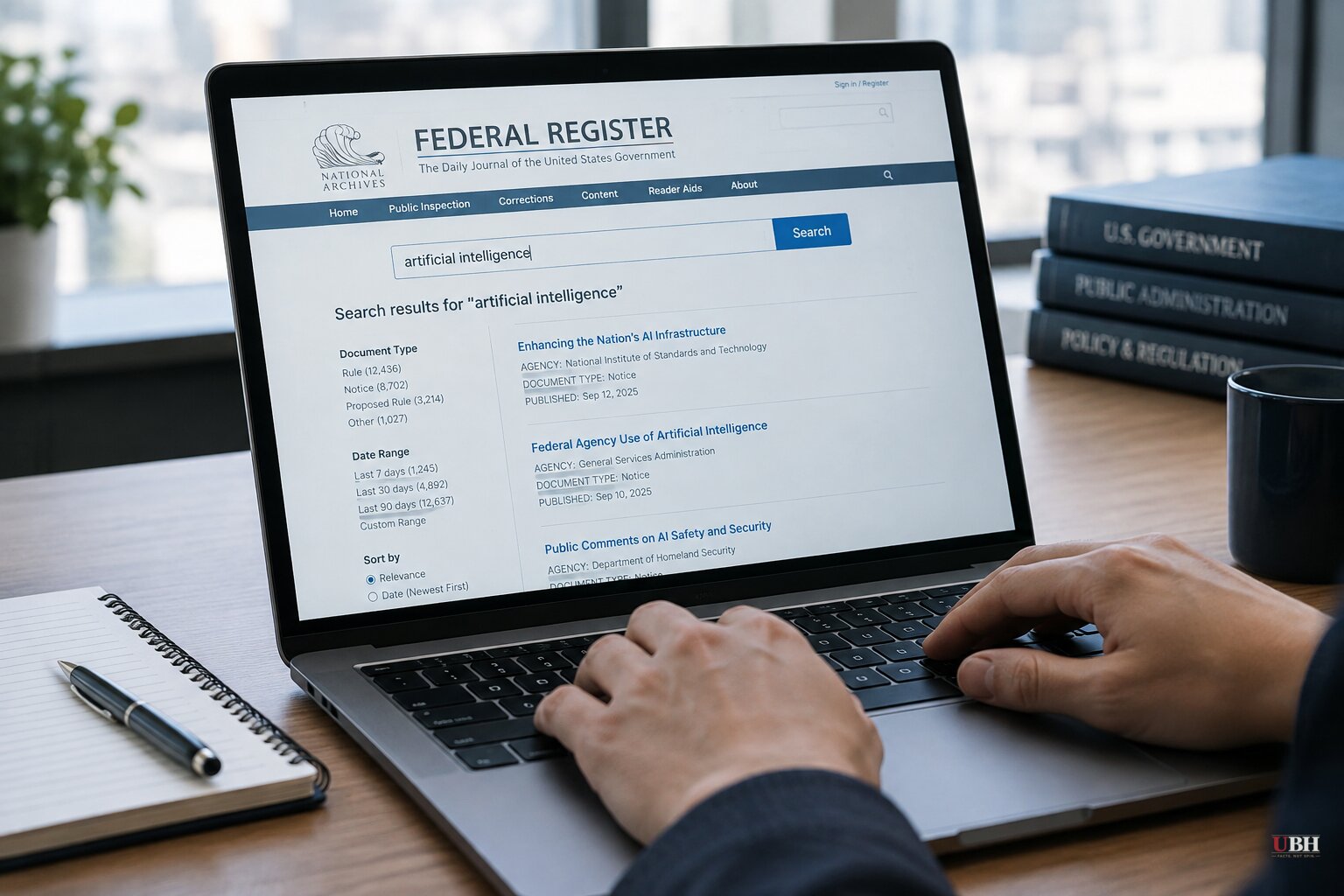
The FBI, NSA and CISA issued a joint advisory on September 8, 2026, naming Alibaba among six Chinese firms it accused of running "malicious copying" of US AI models "at industrial scale." Nine days later, on Wednesday, September 17, the National Archives and Records Administration pulled an Alibaba-built AI search tool from the Federal Register website, according to Reuters, after social media users noticed it was running.
What Was Actually Running
The Federal Register's advanced search page, used by the public to search proposed federal rules and public comments, offered four search modes: Semantic, Keyword Only, a Neural option built on a separate third-party model, and two options built on Alibaba's Qwen3:0.6B model. A screenshot posted to X by a user identified as "tleilax___" on September 15 first surfaced the Qwen option publicly, and an archived version of the site's source code confirmed it was removed Wednesday, according to Reuters.
Qwen3:0.6B is a small, 600-million-parameter, open-weight model from Alibaba's Qwen family, built for document retrieval rather than complex reasoning. Its weights are Apache 2.0 licensed and publicly downloadable, meaning any organization can run it on its own servers without a live connection back to Alibaba. Whether that is what NARA did is the unanswered question. Tech Times reported the tool was still visible as late as September 16 and framed the deployment window slightly differently than Reuters' September 17 timeline, but neither outlet has established exactly when the tool went live or where the underlying computation ran.
Neither the National Archives, the White House, nor the FBI has publicly explained who deployed the tool, when it was installed, or whether search queries were processed locally or routed anywhere near Alibaba's own infrastructure. NARA has not responded to requests for comment from Reuters, Ars Technica, or Benzinga.
The Security Question, Stated Both Ways
Representative John Moolenaar, the Michigan Republican who chairs the House Select Committee on the Chinese Communist Party, said flatly: "No federal government entity should use a Chinese AI model. Doing so only makes the federal government more dependent on Chinese AI models and that is not in the national interest." Daniel Castro, president of the Information Technology and Innovation Foundation, told Reuters it was "one of the most insane things I've ever seen" for a federal agency to run software built by a company the FBI had just labeled a national security threat.
If the government's own law enforcement agencies say a company's AI models are the product of stolen American technology, a federal website running that company's model looks like exactly the kind of quiet dependency Moolenaar is warning against, regardless of what data was involved.
But the specifics narrow the risk. Georgetown Law professor Anupam Chander told Reuters the Federal Register's content is already public by design, so the Qwen model was never handling sensitive government information. Because Qwen3:0.6B is open-weight, it can be downloaded and run entirely on an agency's own servers. This would give the government more control over the data than sending queries to an externally hosted commercial model, according to security experts who spoke with Reuters. Senator Mark Warner, the Virginia Democrat who vice-chairs the Senate Intelligence Committee, framed the actual open question precisely: whether US data ever left the government's security boundary and landed on Alibaba-controlled systems. Nobody has answered that yet.
The Underlying Allegation
Anthropic told lawmakers in June that operators tied to Alibaba's Qwen research unit ran a large-scale distillation campaign against Claude between April 22 and June 5, 2026, using roughly 25,000 fake accounts to harvest 28.8 million exchanges, according to Startup Fortune's account of that disclosure. The September 8 joint advisory went further, stating that for the six named firms, "the sheer scale of these campaigns and their sophistication indicate that distillation is not a supplement to these companies' AI model development, but the critical core of it," and that the activity occurred "likely with Chinese government awareness" — stopping short of alleging direct state involvement.
China has rejected all of it. The Chinese embassy in Washington called the copying allegations "unfounded." Foreign Ministry spokesperson Mao Ning called them "groundless" and said China's AI progress rests on "high-level scientific and technological self-reliance." Assistant Foreign Minister Liu Bin called the distillation accusations "misguided and counterproductive" at the World AI Conference in Shanghai, though he did not directly address Anthropic's specific figures.
What's Unresolved
The removal happened in the same window as a planned meeting between President Trump and Chinese President Xi Jinping, adding political weight to a story that, on the technical merits, both Reuters' expert sources and Ars Technica's reporting suggest was a low-risk deployment. NARA still has not said who approved the Qwen tool, whether it was ever formally reviewed, or whether any other federal system currently runs Chinese-origin AI models undetected. Until an agency answers that, Warner's question about where the data actually went remains open, and Moolenaar's broader complaint about undisclosed dependency on Chinese AI has no federal rule standing behind it to prevent a repeat.
Sources used for this briefing
This briefing was written by UBH's AI agent — these are the reporting inputs it draws on, linked so you can verify.


