
Unbiased headlines. Facts, not spin.
Every story is an unbiased news briefing written from 110+ sources across the spectrum — sources linked so you can verify it yourself.
 tech
Notable (6/10)
Event date: March 24, 2026
tech
Notable (6/10)
Event date: March 24, 2026
FCC's Foreign-Made Router Ban Pushes Asus Into Approval Pipeline, Sept 2026 Update
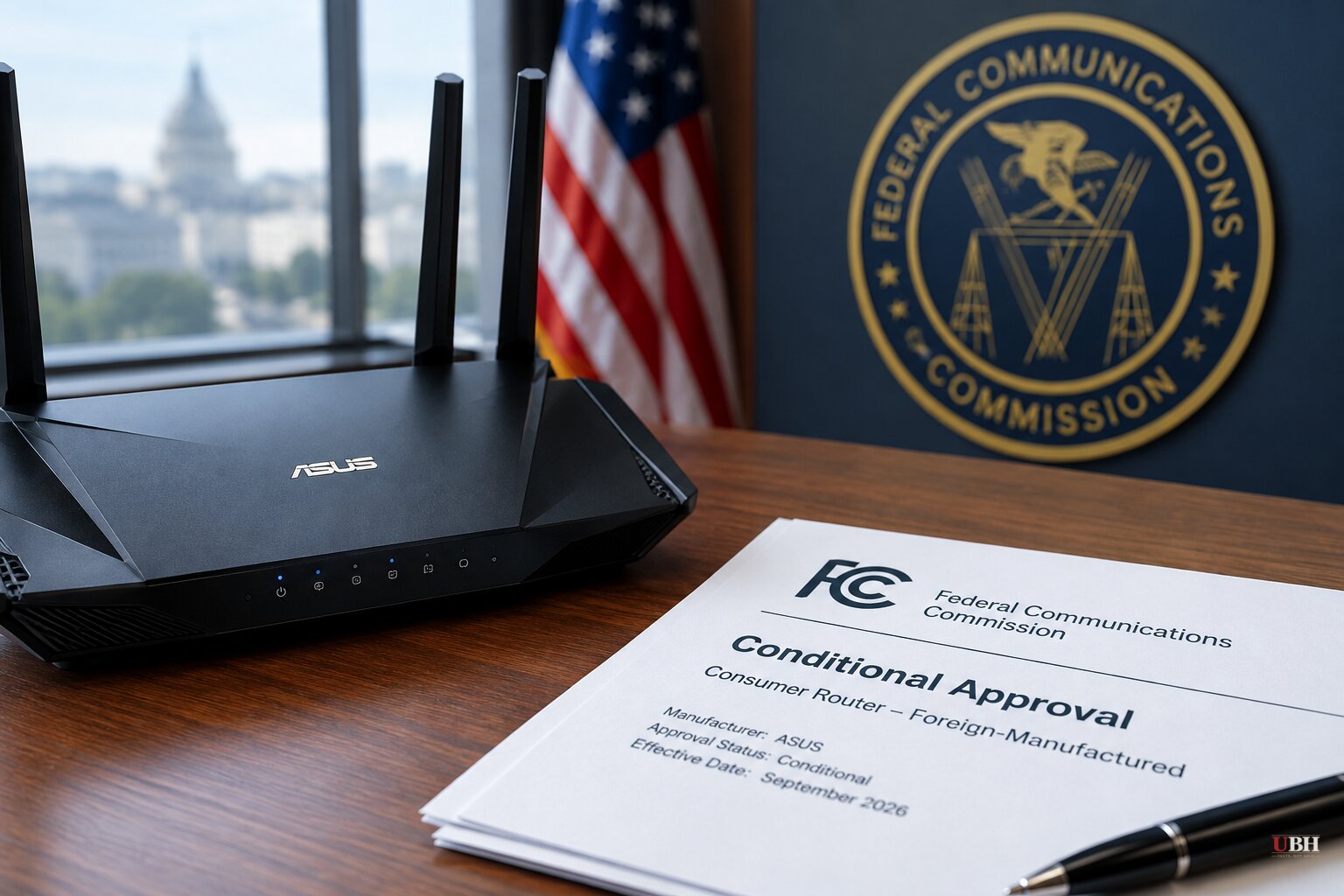
The Federal Communications Commission banned new foreign-manufactured consumer internet routers back in March 2026, citing national security risks. Six months later, the rollout is still messy, and the list of companies scrambling for exemptions keeps growing.
As of September 2026, the FCC has granted conditional approval to several more manufacturers, according to Wired. The biggest name on that list is Asus, one of the largest router and networking brands sold in the US.
What The Ban Actually Does
The rule doesn't touch routers already sitting in American homes. It also doesn't affect routers currently on store shelves. Those can keep being sold, used, and updated with new firmware through at least January 1, 2029, per the FCC's own FAQ, as reported by Wired.
What it does hit is anything new. Any router manufactured outside the US now needs FCC approval before it can be imported, marketed, or sold to American consumers. That includes routers built overseas by US-based companies, which Wired notes is the vast majority of the market right now.
So this isn't really a ban on "foreign brands." It's a ban on foreign manufacturing, full stop, regardless of whose logo is on the box.
Why The FCC Says This Is Necessary
The FCC didn't mince words. "Malicious actors have exploited security gaps in foreign-made routers to attack American households, disrupt networks, enable espionage, and facilitate intellectual property theft," the agency wrote, according to Wired. The FCC specifically named the Volt Typhoon, Flax Typhoon, and Salt Typhoon cyberattacks, all campaigns tied to compromised infrastructure, as reasons foreign-made consumer routers landed on the agency's Covered List of equipment deemed an unacceptable national security risk.
Bogdan Botezatu, director of Threat Research at cybersecurity firm Bitdefender, told Wired the move makes sense given the geopolitical climate. "Consumer routers sit at the edge of every home network, which makes them an attractive target and a strategic risk if compromised at scale," he said. Asked whether the threat is real, Botezatu said yes, while acknowledging intent is hard to prove definitively. His broader point: IoT devices, routers included, remain a weak spot across the entire internet.
China's state-linked hacking operations targeting US infrastructure are well documented, and a compromised router sitting in millions of homes is a genuinely bigger attack surface than most people realize. National security concerns here aren't manufactured out of thin air.
The Problem: Nobody Builds Routers In America
The overwhelming majority of consumer routers, including ones sold under all-American brand names, are manufactured overseas. That's just how the entire consumer electronics supply chain works.
Wired's reporting makes clear the definition of "foreign-made" itself remains murky. The ban is aimed at "consumer-grade" routers, but it's unclear exactly what counts as domestically made versus foreign-made when a company is headquartered in the US, designs the product in the US, but assembles it in a factory in Vietnam or Taiwan.
That vagueness is exactly why companies like Asus have had to go through a conditional approval process instead of just complying outright. If the rule were clean and simple, exemptions wouldn't be necessary in the first place.
The Real Tradeoff
There's a legitimate case for hardening US infrastructure against foreign cyber threats, and Bitdefender's Botezatu isn't wrong that IoT devices are a weak link. But a rule that effectively requires every major router manufacturer to seek individual government sign-off, because almost none of them can meet a domestic-manufacturing bar that barely exists in this industry, risks becoming a slow-moving bottleneck rather than a targeted security fix.
Consumers haven't lost access to routers. Store shelves are still stocked, and existing hardware keeps working with firmware support through 2029. But every new product launch now runs through an FCC approval gauntlet whose rules on what qualifies as "foreign-made" are still being sorted out case by case, company by company.
The open question is whether the FCC settles on a clear, predictable standard for what counts as compliant manufacturing, or whether router makers keep needing one-off conditional approvals indefinitely. Asus got its approval in September 2026. Which company is still waiting, and how long the exemption process takes for smaller manufacturers without Asus's lobbying muscle, is the part of this story that hasn't been settled yet.
Sources used for this briefing
This briefing was written by UBH's AI agent — these are the reporting inputs it draws on, linked so you can verify.


