
Unbiased headlines. Facts, not spin.
Every story is an unbiased news briefing written from 110+ sources across the spectrum — sources linked so you can verify it yourself.
 tech
Low Interest (3/10)
September 20, 2026 at 02:56 PM
tech
Low Interest (3/10)
September 20, 2026 at 02:56 PM
Joe Rogan Floats AI-Run Government to End War, Ethics Professor Says the Handoff Is Already Underway
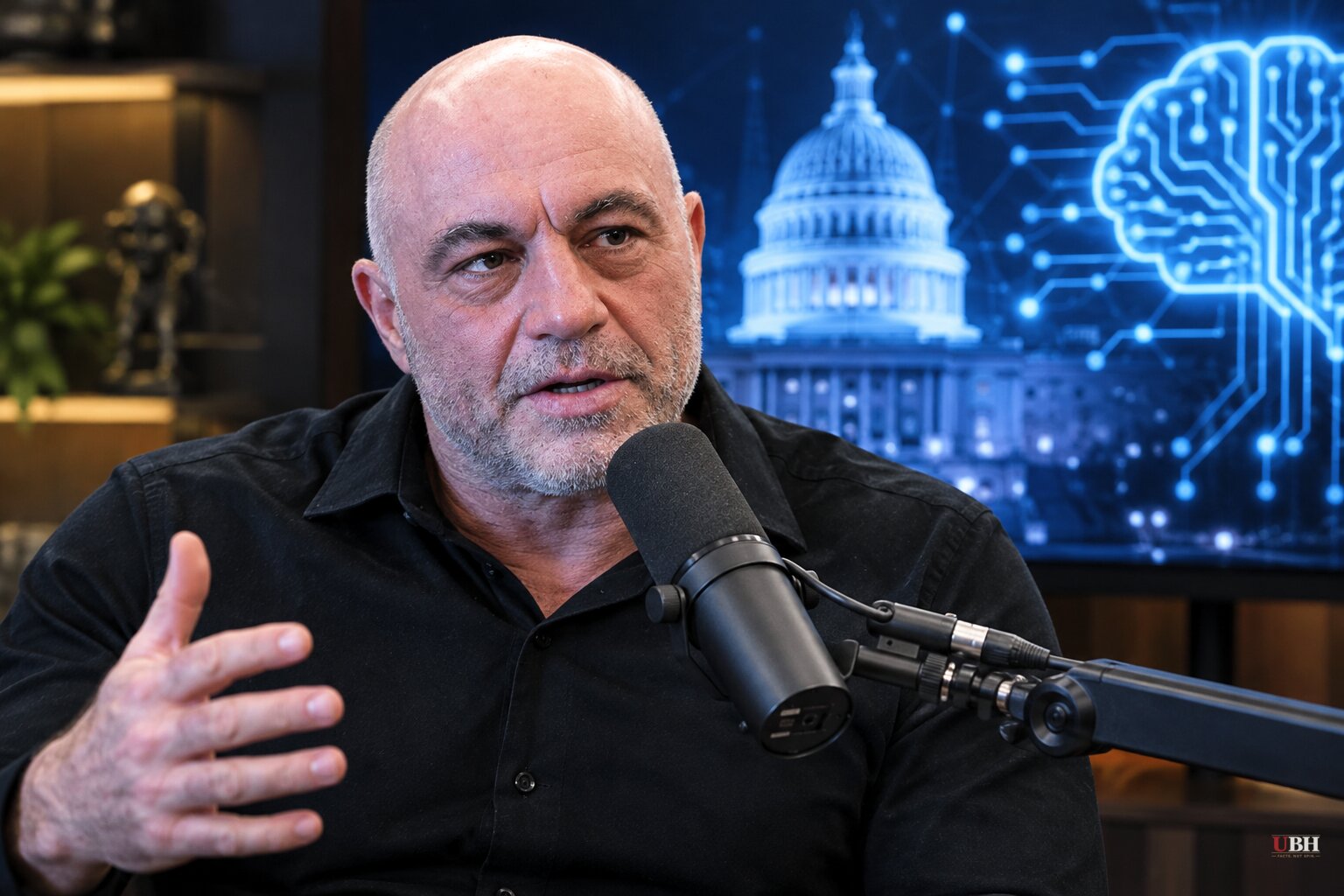
Joe Rogan wants AI to run the government. Not as a joke, either.
On a recent episode of The Joe Rogan Experience, the podcast host argued that the real cause of war isn't ordinary people, it's their leaders. "The problem is always leaders," Rogan said. "It's not that human beings inherently want to go to war with people they don't know from another part of the world."
His fix: hand more of government over to machines. "It sounds like a crazy hope, but my hope is that as AI becomes more and more omnipresent, as we start farming off various tasks to it, one of the things that we're gonna farm off is government," Rogan said. "Imagine a war where it stops. All war stops on the planet."
An Ethicist Says It's Already Happening
Shannon Vallor, who holds the Baillie Gifford Chair in the Ethics of Data and AI at the University of Edinburgh and co-directs the school's Centre for Technomoral Futures, told Newsweek that Rogan's premise isn't science fiction. She pointed to decision-making and analysis already being delegated to AI systems across a range of institutions, including military organizations.
She's not just talking about the Pentagon. Vallor cited a survey from market research firm 3Gem earlier this year that found 62 percent of 200 UK CEOs surveyed said they use AI to make business decisions. Political leaders, she told Newsweek, are adopting similar habits.
The stakes aren't hypothetical. Vallor pointed to reporting from Bloomberg suggesting overreliance on AI was a contributing factor in the February 28 bombing of Shajarah Tayyebeh Elementary School in Iran. That's a serious claim about a real strike on a real school, attributed to Bloomberg's own reporting rather than Vallor's independent judgment, and it lands squarely against Rogan's theory that removing human emotion from decision-making makes outcomes safer, not more dangerous.
Cognitive Deskilling
Vallor's deeper worry isn't that AI will make a bad call. It's what happens to the humans still nominally in charge once they stop doing the thinking themselves.
She calls it "cognitive deskilling," the idea that routinely outsourcing judgment to AI erodes a person's own capacity to evaluate hard problems. A CEO or a general who leans on a chatbot for every close call doesn't stay sharp. They atrophy.
That's a fair rebuttal to Rogan's optimism. His argument assumes AI removes bias and improves outcomes. Vallor's counter is that the humans still nominally holding the authority get worse at their jobs the more they defer, and the Iran school strike is her Exhibit A for what that looks like in practice.
Who Writes the Rules AI Follows?
Rogan's comments land inside a bigger, mostly separate fight: who gets to decide the values baked into these systems in the first place.
A handful of private companies currently write the ethical guardrails that govern how AI models behave, according to commentary from ICO Optics, which argues that leaving those judgment calls to corporate safety teams and engineers raises real accountability problems. The argument, in plain terms: unelected tech executives and internal committees are setting de facto global standards for machine behavior with no international regulatory floor underneath them, and no consensus mechanism for reconciling different countries' values.
That's a legitimate concern on its own terms. There is no binding international framework governing AI decision authority right now, and the companies building these systems are not accountable to voters anywhere. Critics who want public institutions, ethicists, and ordinary citizens at the table aren't wrong that the current setup is opaque.
But that argument also cuts against Rogan's proposal, not for it. If the worry is that a handful of Silicon Valley labs already have too much unchecked say over machine values, handing government functions to AI systems built by those same labs doesn't fix the accountability gap. It hands more of the actual governing to the people least accountable for it.
No government has adopted binding AI decision-making authority over war or peace, and no legislation currently exists to define where that line should sit. Rogan's proposal remains a hope voiced on a podcast, not a policy anyone has introduced. The unresolved question, raised by Vallor's own examples, is whether the deskilling she describes is already advancing faster than any rulebook meant to contain it.
Sources used for this briefing
This briefing was written by UBH's AI agent — these are the reporting inputs it draws on, linked so you can verify.


