
Unbiased headlines. Facts, not spin.
Every story is an unbiased news briefing written from 110+ sources across the spectrum — sources linked so you can verify it yourself.
 tech
Major Story (8/10)
Event date: September 18, 2026
tech
Major Story (8/10)
Event date: September 18, 2026
Chips, Not Chatbots, Set to Dominate Trump-Xi Summit Agenda September 24
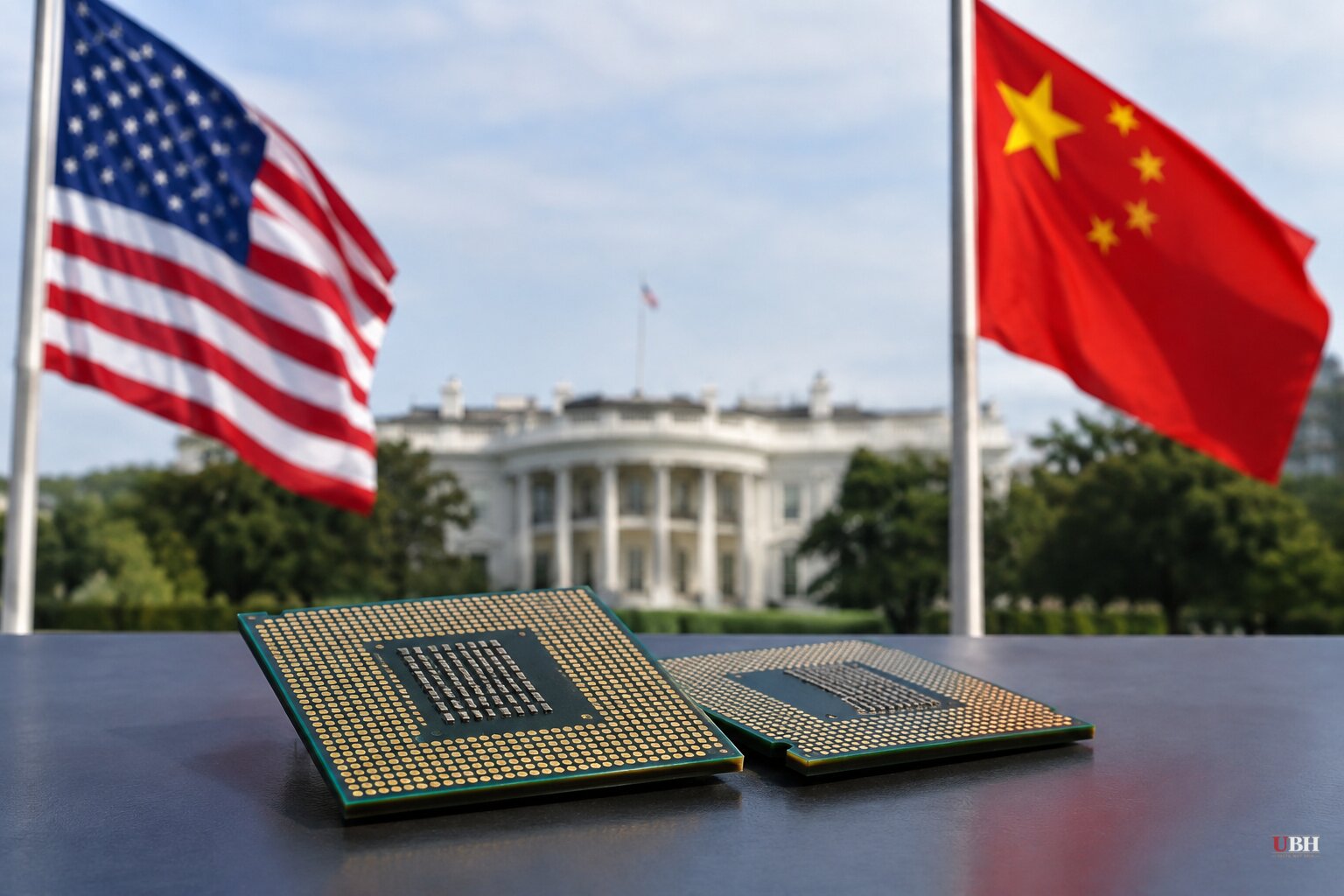
Since Trump and Xi's Beijing summit in May, when the two leaders agreed in principle to talk about AI safety, the relationship has calcified into something closer to a technology arms race. Xi is scheduled to arrive in Washington on September 24 for a reciprocal state visit, and according to the Council on Foreign Relations, the two governments are expected to hold their first official bilateral AI dialogue as a follow-up to that May agreement.
The stakes have only gotten bigger since then. Fox News reports that Huawei recently said demand for its AI computing equipment inside China is exceeding supply, and the company is accelerating future generations of its Ascend AI processors while building enormous systems that link vast numbers of chips together to make up for individual chip weaknesses. China has built this workaround since Washington started restricting advanced semiconductor exports: an ecosystem designed to survive without American technology.
Beijing's Safety Framework, on Its Own Terms
China isn't ignoring AI safety. The Guardian reports that Beijing released the third version of its AI safety governance framework this week, a document that maps out risks including AI agents, cybersecurity threats from frontier models, and the still-hypothetical scenario of recursive self-improvement, where an AI becomes capable enough to upgrade itself. Gabriel Wagner, a researcher at the Beijing-based AI safety consultancy Concordia, described it as essentially a risk map paired with what to do about each risk.
What Beijing has rejected is doing any of this on Washington's terms. Anthropic CEO Dario Amodei recently proposed a "worldwide pacing of the frontier" that he said would require cooperation with China. China's foreign ministry answered that "fearmongering, confrontation and vicious competition will only disrupt the process of global AI governance," according to the Guardian. Lian Jye Su, an analyst at the technology research group Omdia, told the Guardian that Beijing views calls for a slowdown as a bid to lock in the American lead, since for the Chinese government AI is a "core sovereignty capability."
Amodei's essay makes a real argument on real stakes: if the most advanced AI systems get built faster than anyone can control them, the danger isn't which country wins, it's what happens when nobody is fully in charge of what they built. Researchers across the political spectrum share this concern, not just Silicon Valley hedging. But Amodei also explicitly argued for keeping continued export controls on China as part of his plan, which is why Beijing reads the whole proposal as an American power play dressed up as safety talk.
The Trump Team's Bet: Race, Don't Pace
David Sacks, a top AI adviser to President Trump, told Fox News' "The Ingraham Angle" that China has "already rejected" any slowdown, and that unlike Cold War nuclear arms control, there's no way to verify whether Beijing actually honored an AI pacing agreement. PBS reports Trump has repeatedly said the country that leads in AI "wins," posting on social media Monday that "we are leading China, and all others."
Treasury Secretary Scott Bessent, who opened separate trade talks in Manhattan with China's vice premier He Lifeng this week, said Tuesday that the U.S. needs to build out more open-source AI models to compete with China's strategy of pushing cheap, widely adopted open-source systems globally, according to PBS.
A September 17 analysis from the Center for a New American Security, authored by Michelle Nie and Daniel Remler, argues the export-control approach is working better than critics claim and should be expanded, not loosened. China's Moonshot AI released the open-weight Kimi K3 model in July, and two Chinese firms, Aishengna and Yuliangsheng, reportedly began mass-producing deep ultraviolet immersion chipmaking machines. But CNAS points to independent assessments: the UK's AI Security Institute and the U.S. Center for AI Standards and Innovation found Kimi K3's cyber capabilities trail leading U.S. models by five to six months, and the nonprofit SaferAI found Z.ai's GLM-5.2 trailing the U.S. frontier by two to four months. Tencent President Martin Lau has publicly said his company has "consistently lacked sufficient GPU resources," hurting revenue and market share. CNAS wants Washington to close three specific gaps: remote access to U.S. compute, adversarial distillation of American models, and allied servicing of chipmaking equipment inside China.
Taiwan Is Now an AI Chip Question, Too
The Council on Foreign Relations notes that Chinese regulators are weighing a proposal to bar domestic companies, including Huawei, Alibaba and ByteDance, from using overseas foundries such as Taiwan Semiconductor Manufacturing Company to produce advanced chips. This suggests Beijing is already planning for an AI industry that doesn't depend on Taiwan's chipmaking capacity, even as Xi has tied his political legacy to eventual unification with the island regardless of its economic value.
Samm Sacks of Johns Hopkins' School of Advanced International Studies told PBS a formal U.S.-China AI agreement is likely out of reach at the September 24 summit, but that Trump and Xi don't need one. Simply acknowledging AI poses risks to both countries would open political space for something bigger later. The outcome will be clear within days.
Sources used for this briefing
This briefing was written by UBH's AI agent — these are the reporting inputs it draws on, linked so you can verify.


