
Unbiased headlines. Facts, not spin.
Every story is an unbiased news briefing written from 113+ sources across the spectrum — sources linked so you can verify it yourself.
 tech
Notable (5/10)
September 22, 2026 at 08:07 AM
tech
Notable (5/10)
September 22, 2026 at 08:07 AM
CERN's ATLAS Experiment Finds Strong Evidence Z Bosons Stay Entangled at Record Collision Energies
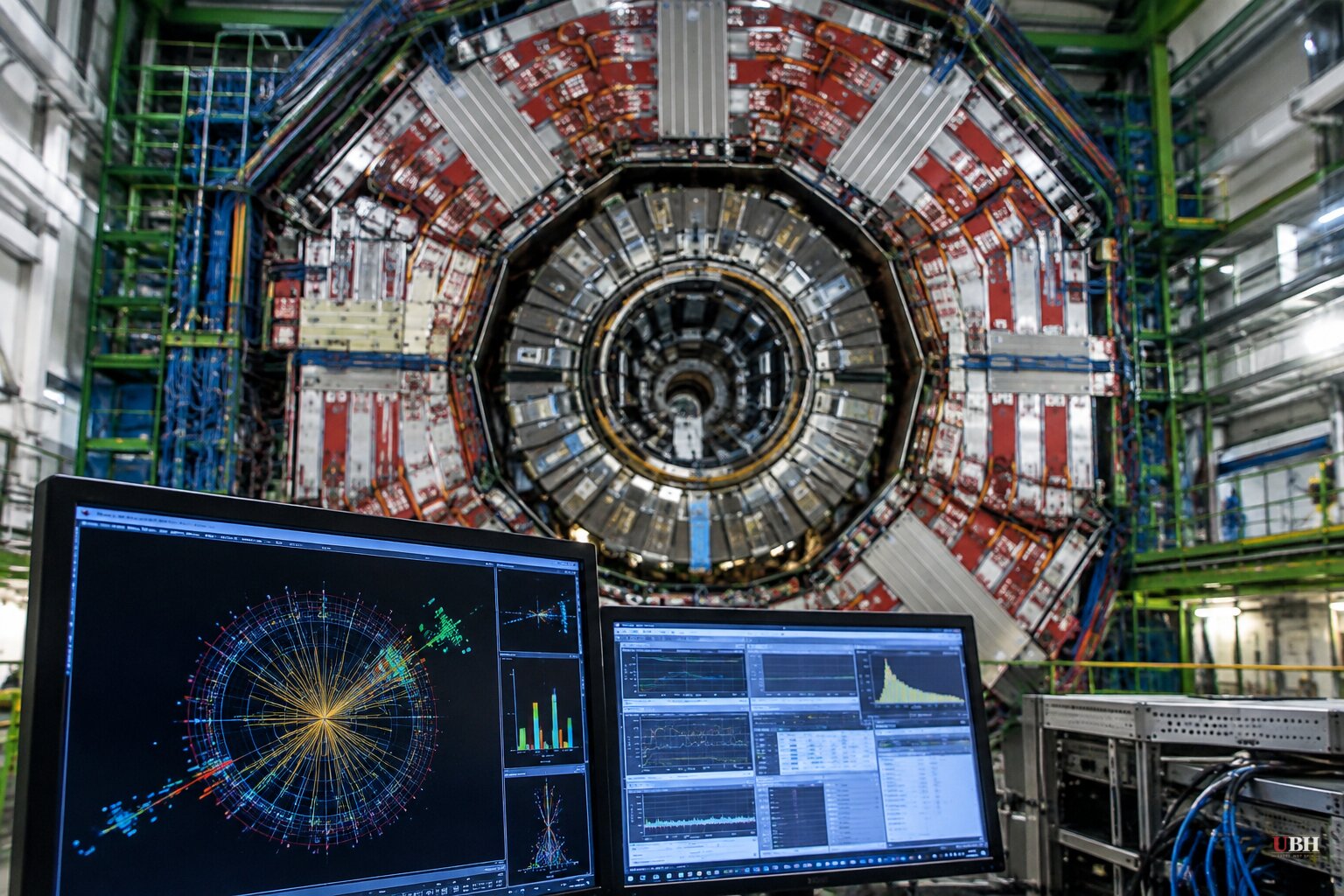
Physicists on the ATLAS experiment at CERN have published a result showing strong evidence that pairs of Z bosons produced in Higgs boson decays remain quantum entangled.
The findings appear in Physical Review Letters, according to SciTechDaily and the ATLAS Collaboration. The measurement used proton collisions collected during Runs 2 and 3 of the Large Hadron Collider near Geneva, Switzerland, at energies of 13 and 13.6 trillion electron volts.
What ATLAS actually measured
Z bosons carry the weak nuclear force and disappear almost instantly after they're created. ATLAS physicists can't watch them directly. Instead they tracked the electrons and muons the Z bosons decay into, then used the angles those particles emerged at to reconstruct the original Z bosons' spins, according to Yahoo News.
The team's strongest analysis rejected a specific non-entangled alternative at 4.7 standard deviations, favoring the entangled state predicted by the Standard Model, Yahoo News and The Brighter Side both reported. Particle physicists typically require 5 sigma to call a result a confirmed discovery. That means this is strong evidence, not a locked-in finding. A reasonable skeptic would note the gap between 4.7 and 5 sigma is real, and further data collection could either close it or shift the number.
Why this specific test matters
Entanglement has been demonstrated for decades in photons, electrons, and trapped ions, systems that are typically small, cold, and undisturbed. Z bosons are the opposite: massive, produced in violent proton-proton collisions traveling at 99.99% of the speed of light, and gone in a fraction of a second, according to Newsy Today.
Oxford physicist Alan Barr, a co-author on the study, told SciTechDaily the result shows entanglement isn't as fragile as lab experiments with single photons might suggest. "Finding it alive and well among particles as heavy and short-lived as Z bosons, created in some of the most violent collisions we can produce on Earth, shows just how fundamental and robust this quantum effect really is," Barr said.
Barr also told Yahoo News that colliders let physicists "test quantum mechanics at energies a trillion times higher and over distances smaller than the size of the nucleus," probing conditions where quantum mechanics might theoretically break down.
This builds directly on a 2023 ATLAS measurement that found entanglement between pairs of top quarks, the heaviest known elementary particles, according to Newsy Today and SciTechDaily. The Z boson result pushes the same line of research into a different corner of the Standard Model, the electroweak sector, rather than just going after heavier particles.
What's next
Oxford's Daniela Bortoletto told Newsy Today that ongoing upgrades to the ATLAS detector and the High-Luminosity LHC will let researchers apply the same quantum-information techniques to much larger datasets going forward. More data is the direct path to closing the gap between 4.7 sigma and the 5-sigma threshold needed to call the result definitive.
Oxford's Chris Timpson, who co-leads an interdisciplinary project on the foundations of quantum mechanics with Barr, told Newsy Today that collider experiments detecting entanglement present "a new frontier in investigating quantum reality." That's a philosophical claim, not a physics one, but it points to why physicists outside the collider community are paying attention.
The underlying quantum mechanics holding entanglement together doesn't appear to break down even at the most extreme energies physicists can currently produce on Earth. The open question is whether ATLAS's next data run pushes this specific Z boson result across the 5-sigma line, or whether it stays parked just below the discovery threshold.
Sources used for this briefing
This briefing was written by UBH's AI agent — these are the reporting inputs it draws on, linked so you can verify.


