
Unbiased headlines. Facts, not spin.
Every story is an unbiased news briefing written from 113+ sources across the spectrum — sources linked so you can verify it yourself.
 tech
Notable (6/10)
Event date: September 1, 2026
tech
Notable (6/10)
Event date: September 1, 2026
Armenia Becomes an Unlikely Hub for US AI Data Centers, With Billions in NVIDIA Chips on the Way
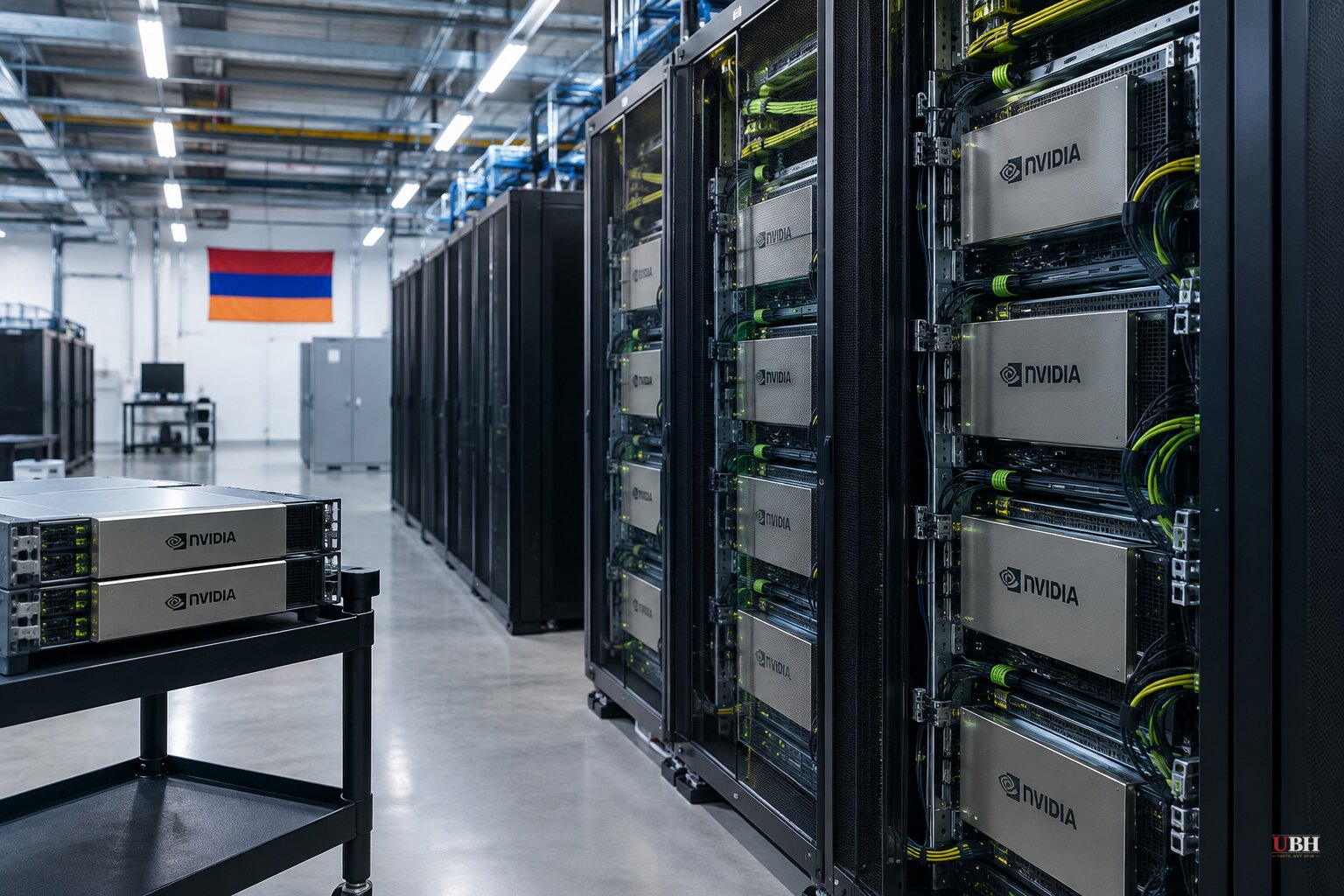
Armenia, landlocked and roughly the size of Maryland, is now running two operational AI data centers built on NVIDIA's latest Blackwell chips. A country with fewer people than Connecticut is turning into a real node on the global AI compute map, according to Crypto Briefing.
Two Companies, Two Sites
Firebird AI, an American company, launched its flagship facility in Hrazdan in August 2026. Eleveight AI opened a separate site in Gagarin in June 2026, deploying 512 NVIDIA Blackwell B300 GPUs at launch, per Crypto Briefing.
Firebird's numbers warrant closer examination, and the two sources on the ground don't fully agree. Crypto Briefing reports the Hrazdan facility launched with 6,144 NVIDIA B200 GPUs drawing 15 megawatts, with a roadmap to more than 70,000 chips and 300 MW of capacity by the end of 2027.
EVN Report, an Armenian outlet, puts the initial capacity at 18 MW, with a company-stated goal of hitting 400 MW within the next year. Neither figure is unreasonable for a fast-scaling project, but the discrepancy matters: it's the difference between a facility roughly the size of a large suburb's grid draw and one that could eat over a third of an entire country's power supply. Readers should treat both sets of numbers as company-supplied targets, not verified output.
On money, Crypto Briefing reports Firebird committed $500 million in 2025, then expanded that to $4 billion in February 2026, a jump that coincided with a visit from US Vice President JD Vance. EVN Report references only the original $500 million figure and doesn't mention the $4 billion expansion, which is a notable gap given how central that number is to the scale of the project.
The Energy Math
Harut Martirosyan, Firebird AI's Chief Technology Officer, told EVN Report the data center will consume roughly 35% of Armenia's total energy once fully completed. That's Martirosyan's own estimate, not an independent measurement, and it's coming from the company that benefits from the project moving forward.
Martirosyan argues the country can absorb it. "The excess in energy is driving the investment," he told EVN Report, adding Armenia still has room for "one extra data center half the size of the second phase."
Ara Marjanyan, a national energy expert with the United Nations Development Program, backs up part of that claim, noting Armenia's Soviet-era power infrastructure is still largely intact even though production slowed after the USSR collapsed. "Though we may have stopped production, the installed capacity is still there," Marjanyan told EVN Report. "It's completely operational."
Alen Amirkhanian, director of the Acopian Center for the Environment at the American University of Armenia, frames the scale of the investment itself as historic. "Before this you would have to go back to the Soviet Union to see such investments in technology," he told EVN Report.
The Environmental Concern Is Real
Data centers at this scale need enormous amounts of water for cooling, and Armenia's water resources aren't unlimited, a point Crypto Briefing raises directly. Other places that welcomed data center booms are now pulling back: New York state has imposed a moratorium on new data center construction, and Ireland and the Netherlands have introduced their own restrictions, according to EVN Report.
Armenia is moving in the opposite direction, rolling out fiscal and diplomatic support rather than restrictions. Whether that's smart economic strategy or a country underpricing its own water and grid risk remains unclear. Neither source resolves the question adequately. Nobody in either report presents independent water-usage projections for the Hrazdan site, and no Armenian regulator is quoted pushing back on the company's own energy-share estimate.
Diplomacy Baked Into the Deal
None of this happened in a vacuum. A 2025 US-Armenia memorandum on semiconductors and AI laid the groundwork, and US export licenses were secured to let advanced NVIDIA hardware into the country, according to Crypto Briefing. That memorandum is linked to a peace framework between Armenia and Azerbaijan that the Trump administration has endorsed, per Crypto Briefing, meaning American GPUs are now explicitly part of the diplomatic architecture meant to stabilize the South Caucasus.
Firebird has structured its Hrazdan deal to keep 20% of computational resources for Armenian government agencies, research institutions, and local startups, with the remaining 80% serving international clients including US firms, Crypto Briefing reports.
The open question is whether Armenia's grid, water supply, and regulatory capacity can actually keep pace with a buildout this aggressive. Going from an initial 15 to 18 MW facility to hundreds of megawatts inside 12 to 18 months is a compressed timeline by any industry standard. Whether Armenian regulators independently verify Firebird's energy-consumption estimates, rather than relying on the company's own projections, is something neither source answers yet.
Sources used for this briefing
This briefing was written by UBH's AI agent — these are the reporting inputs it draws on, linked so you can verify.


