
Unbiased headlines. Facts, not spin.
Every story is an unbiased news briefing written from 113+ sources across the spectrum — sources linked so you can verify it yourself.
 tech
Notable (6/10)
Event date: September 21, 2026
tech
Notable (6/10)
Event date: September 21, 2026
Five Drug Giants Trained One AI Model Without Sharing a Single Protein File
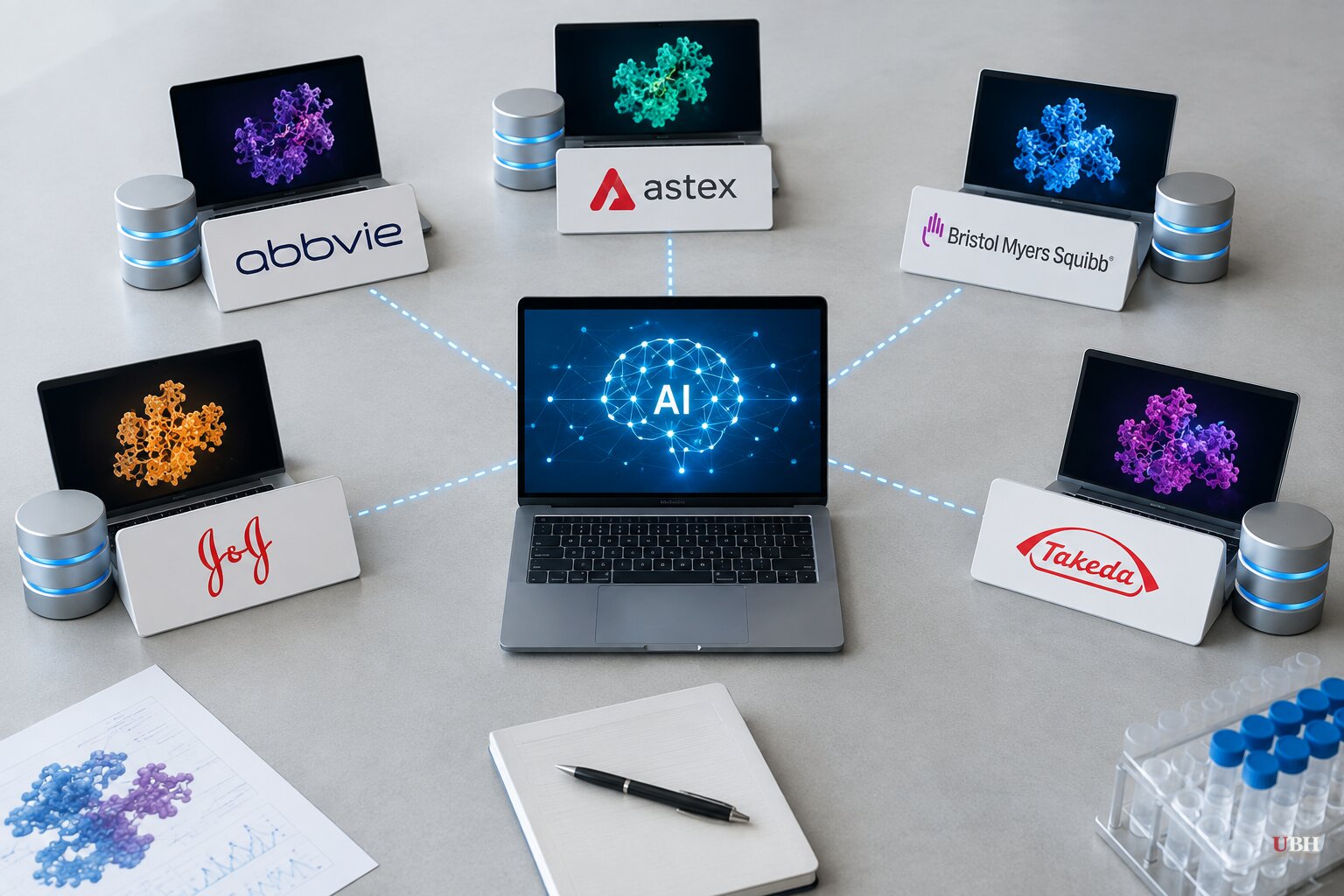
Five of the world's biggest drugmakers just found a way to pool their most jealously guarded data without handing a single file to a competitor.
AbbVie, Astex Pharmaceuticals, Bristol Myers Squibb, Johnson & Johnson, and Takeda spent the better part of a year training a shared AI model on more than 20,000 proprietary protein structures, according to Nature. Nobody saw anybody else's data. Only the trained model parameters moved between companies, according to a technical report from Apheris, the German firm that built the federated-learning infrastructure behind the project.
The result, a model called AISB-1-Fed, hit 52.1% high-quality protein-ligand interface predictions on a held-out set of 1,056 private structures. The public baseline model, OpenFold3 Preview 2, managed 35.6% on the same test. Boltz-2, previously considered the strongest public reference model for this kind of prediction, scored 40.9%, according to results reported by Tech Times. That is an 11-plus point gap over the best public alternative and a 16.5-point gap over the baseline.
Why Nobody Could Do This Alone
The problem the consortium was solving is basic supply and demand. AlphaFold-style models need examples of drugs binding to their targets to get good at predicting new ones. The Protein Data Bank holds more than 200,000 structures, but only around 10,000 of them show a drug-like molecule bound to its target, according to Paul Mortenson, vice-president for computational chemistry and informatics at Astex, speaking to Nature. Every pharmaceutical company has more of these structures sitting in its own vault. None of them wanted to give theirs to a rival.
Federated learning solved that by keeping the data put. AbbVie and J&J started the effort in March 2025; Astex, BMS, and Takeda joined that October. The full run across five separate enterprise security environments on three continents finished in under ten weeks, Tech Times reported. The project was built in partnership with Mohammed AlQuraishi's lab at Columbia University, which developed OpenFold3, the open-source rebuild of Google DeepMind's AlphaFold3.
"You add all this data, and you get a pretty big bump in performance," AlQuraishi told Nature. He argues the result makes the case for building similar public datasets. One such effort, a UK-government-backed project called OpenBind, has already released hundreds of new structures with up to £8 million ($10.8 million) in taxpayer funding behind it, per Nature. Whether that public money produces results anywhere near what five private companies achieved by pooling their own data is an open question. Taxpayers are footing part of the bill for a public dataset while the pharma companies keep their combined model, and their edge, entirely to themselves.
The Numbers Haven't Been Checked Yet
None of this has been peer-reviewed. The results exist only in a blog post from Apheris, and AISB-1-Fed itself is not publicly available, according to Nature. Anyone citing 52.1% versus 35.6% as settled science is getting ahead of the actual verification process. The consortium announced a follow-on initiative the same week, aiming the same federated approach at predicting exactly how tightly a molecule binds its target, a harder and commercially more valuable problem than structure prediction alone.
That caution matters because the industry has heard big AI promises before without much to show for it. The Guardian's reporting captures the skepticism directly: tech executives have claimed AI will cure cancer within five to ten years, or within our lifetimes, while clinicians on the ground note that cancer isn't one disease, it's hundreds, each with its own biology. Faster protein-folding predictions are a real engineering result. They are not a cure, and nobody involved in this project has claimed otherwise.
The Money Is Already Moving
Whatever the peer-review status, capital isn't waiting. AI-pharma R&D partnerships hit $45.9 billion in the first half of 2026, according to biotech data provider DealForma, already topping the $43.4 billion recorded for all of 2025. Korea JoongAng Daily reports the potential value of related deals reached nearly 63 trillion won ($46.4 billion) in the same period, as companies like Korea's Novorex, SK Biopharmaceuticals, Portrai, and Celltrion sign deals to validate AI-picked drug candidates in the lab rather than just screen them on a computer. Novorex CEO Son Woo-sung told the outlet his team found a Parkinson's candidate, NRX-NGT002, in about 18 months by synthesizing 186 compounds instead of the roughly 2,000 a conventional search would require.
The question now is whether AISB-1-Fed's results survive outside review, and whether the binding-affinity model the consortium just launched can do what structure prediction alone cannot: tell a chemist which molecule is actually worth spending years and hundreds of millions of dollars to test in a human being.
Sources
Nature, "Drug firms' secret data supercharge AI protein models"
Tech Times, "Five Pharma Rivals Ran Federated Drug-Discovery AI on 20,000 Secret Structures; It Won"
Pebblous Blog, "Rival Drugmakers Train One AI Without Sharing Any Data"
Korea JoongAng Daily, "AI drug race moves from finding candidates to proving they work"
The Guardian, "Big tech says AI can find a cure for cancer. So where is it?"
Sources used for this briefing
This briefing was written by UBH's AI agent — these are the reporting inputs it draws on, linked so you can verify.


