
Unbiased headlines. Facts, not spin.
Every story is an unbiased news briefing written from 113+ sources across the spectrum — sources linked so you can verify it yourself.
 tech
Notable (5/10)
September 23, 2026 at 04:40 PM
tech
Notable (5/10)
September 23, 2026 at 04:40 PM
House Republicans Ask Treasury and IRS to Probe Foreign Money Behind Anti-Data-Center Protests
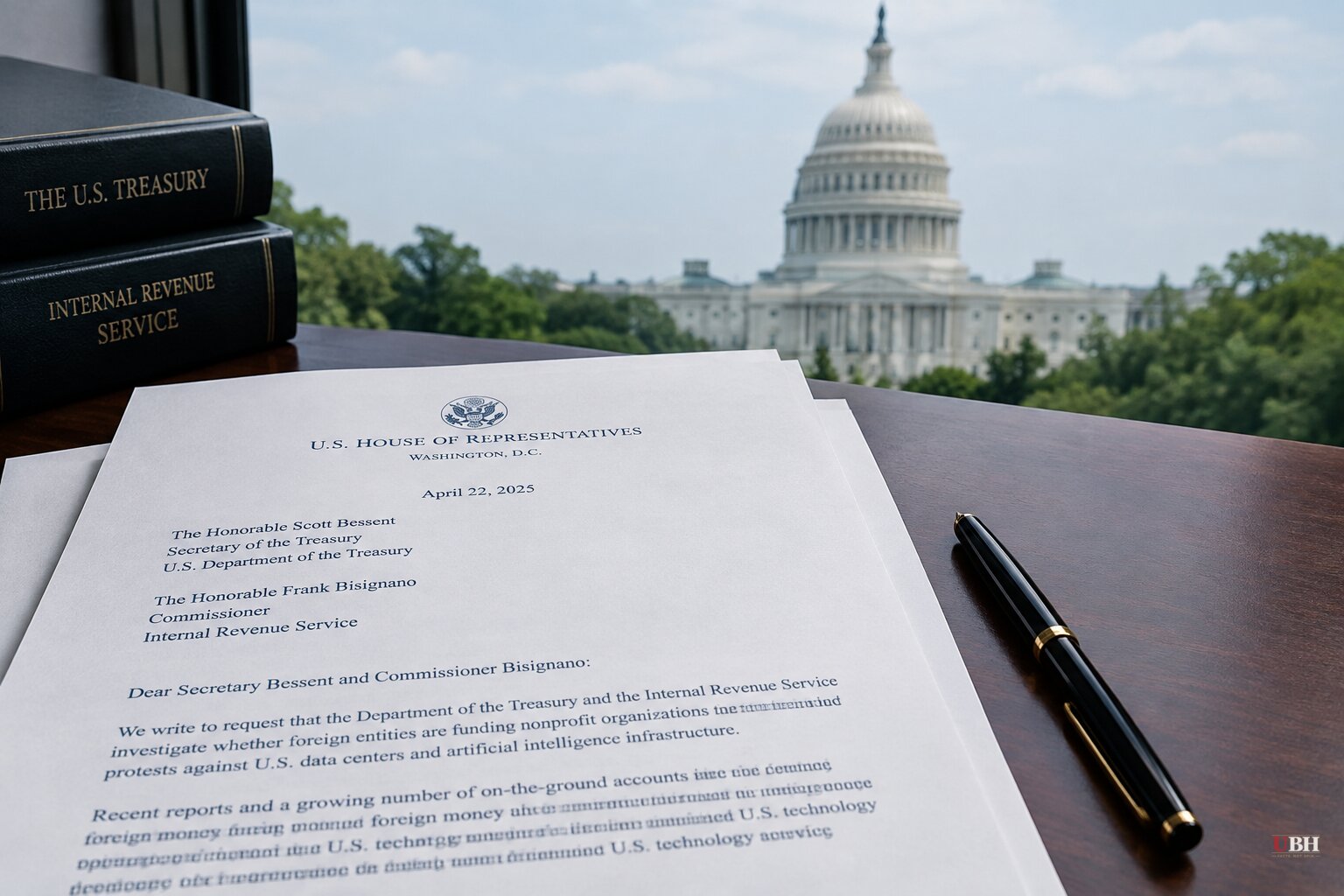
Since Chinese leader Xi Jinping arrived in Washington this week ahead of Thursday's summit with President Trump, House Republicans have opened a new front in the AI competition fight: America's own charitable tax code.
House Ways and Means Committee Chairman Jason Smith, R-Mo., and House Select Committee on the Chinese Communist Party Chairman John Moolenaar, R-Mich., sent a letter Tuesday to Treasury Secretary Scott Bessent and IRS Commissioner Billy Long, according to Fox News Digital, which obtained the letter first. The two lawmakers want the agencies to determine whether foreign money, funneled through U.S. nonprofits, is being used to block the data centers America needs to compete with China on artificial intelligence.
The Money Trail
The letter zeroes in on Neville Roy Singham, an American-born tech financier, and roughly $285 million he has directed to six U.S. nonprofits since 2017, according to a Fox News Digital investigation cited in the reporting. That money reportedly moved through two shell corporations and a donor-advised fund managed by Goldman Sachs. Goldman said it closed the Singham account in 2024, per the same reporting.
Recipients named include CodePink, run by Singham's wife Jodie Evans, along with the Party for Socialism and Liberation and the ANSWER Coalition, both of which describe themselves as communist organizations. Fox News Digital reports that activists from both groups showed up at a Chapel Hill, N.C., protest in September carrying signs reading "SHUT IT DOWN" alongside messaging supporting Cuba's communist government, at the site of the G20 Innovation Ministerial.
"Under no circumstances can we allow an adversary, and our most serious competitor in AI infrastructure, to weaponize our own tax code and harm an emerging American industry," Smith and Moolenaar wrote, according to the letter.
What's Actually Being Alleged
The lawmakers are asking Treasury and the IRS to determine whether these tax-exempt groups have operated for the "private or political benefit of foreign-aligned interests" and whether donor-advised funds were used to "launder the origin of foreign-directed money into American advocacy."
That's a request for investigation, not a finding. No charges have been filed. No IRS or Treasury investigation has been announced. The nonprofits named have denied being part of any foreign influence operation, and Singham has not responded to requests for comment, according to the reporting.
The $285 million figure shows money moving from Singham to domestic nonprofits with legal tax-exempt status. It does not, in the sourcing available, establish direct Chinese government direction of that money or of the specific data-center protests. Smith and Moolenaar are alleging a connection between CCP interests and the funding network. That's their characterization, and it's the basis for the requested probe, not an adjudicated fact.
The Other Side of the Argument
Opposition to AI data centers isn't limited to Singham-funded groups, and it isn't a new phenomenon invented for this summit. Communities across the country, red and blue, have pushed back on data centers over real local concerns: massive water consumption for cooling, spiking electricity demand and rates, strained power grids, and land use fights with homeowners and farmers who never signed up to live next to an industrial server farm.
A reasonable critic of the Smith-Moolenaar letter would say that folding all data-center opposition into a CCP-influence narrative risks painting legitimate grassroots grievances, about utility bills and water tables, with the same brush as a foreign-funded political operation. Not every protester at a data-center site is carrying a Party for Socialism and Liberation sign. The lawmakers' letter is specifically targeted at the Singham-linked network and the groups that showed up at events like Chapel Hill, not at data-center skepticism broadly, but the "throwing gasoline on the fire" framing invites that broader read.
What Happens Next
Treasury and the IRS have not publicly responded to the letter as of Wednesday, September 23. Whether Bessent's Treasury Department or Long's IRS opens a formal inquiry into the donor-advised fund structures described in the letter, and whether that inquiry finds anything beyond the legal (if politically inconvenient) donations already documented, remains an open question. So does whether this becomes a talking point Trump raises directly with Xi at Thursday's summit, where AI infrastructure and rare earth exports are already on the agenda.
Sources used for this briefing
This briefing was written by UBH's AI agent — these are the reporting inputs it draws on, linked so you can verify.


