
Unbiased headlines. Facts, not spin.
Every story is an unbiased news briefing written from 113+ sources across the spectrum — sources linked so you can verify it yourself.
 finance
Major Story (7/10)
Event date: September 17, 2026
finance
Major Story (7/10)
Event date: September 17, 2026
KKR Leads $10 Billion Private Capital Wave Into South Korea's AI Data Centers
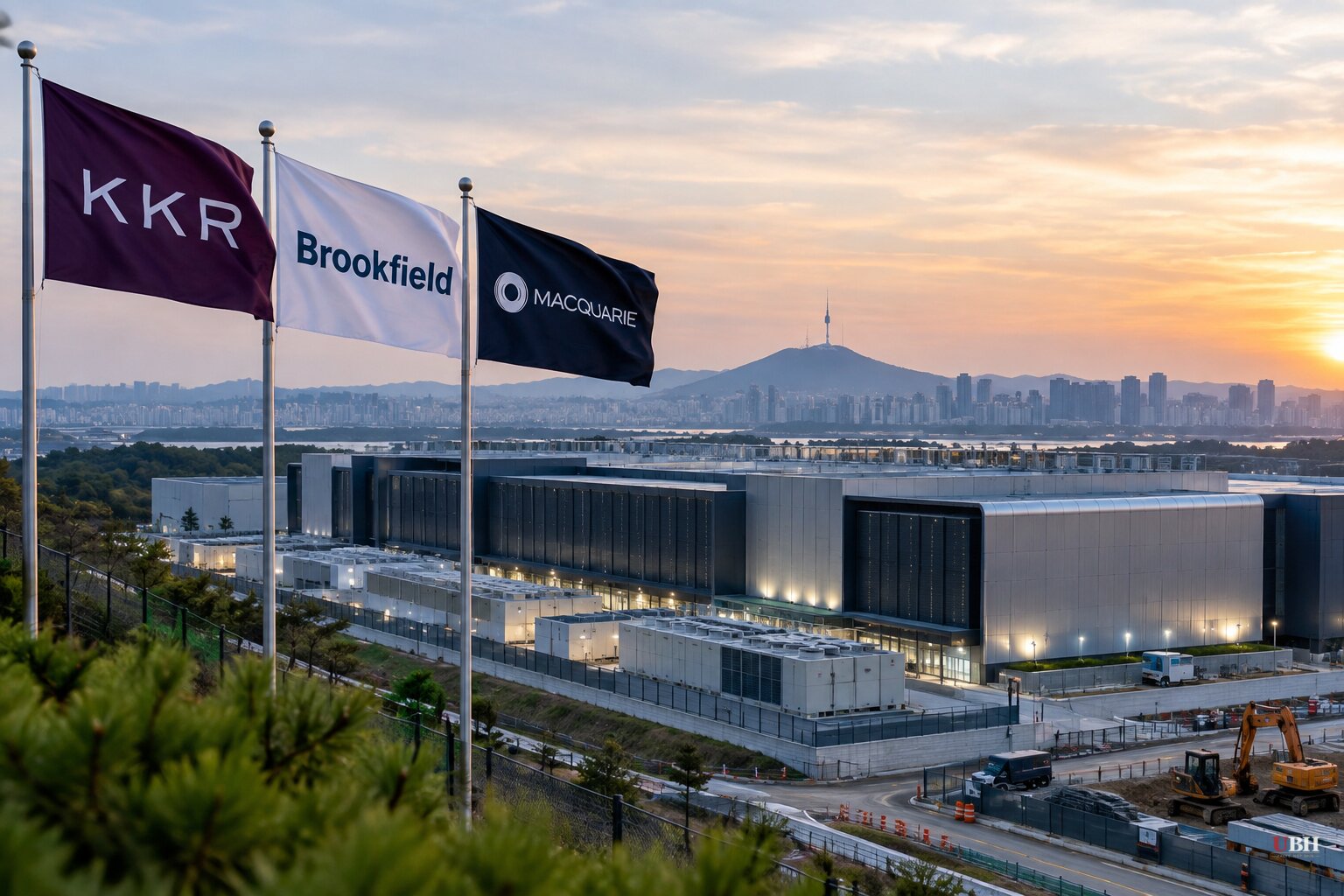
KKR & Co. put roughly $3 billion into South Korea in 2026, its biggest annual total in the country ever, according to Bloomberg calculations based on disclosed deal values and ownership stakes. That's on top of more than $5 billion the New York firm has already deployed across Korean energy, utilities and digital infrastructure over the past six years, according to a source familiar with the matter cited by Korea JoongAng Daily.
KKR isn't alone. Brookfield Asset Management and Macquarie Asset Management have joined the rush, and together with their partners the three firms have pledged at least $10 billion into Korea's digital infrastructure over the coming years, Korea JoongAng Daily reported.
The Money Is Moving Fast
The shift in who's funding Korea's data centers is stark. Financial investors held just 17% of the country's data center investment between 2020 and 2023, with telecom companies dominating at 83%. Samil PwC now projects that ratio to flip almost entirely by 2027, with financial investors controlling 90% and telecoms falling to 10%, according to Korea JoongAng Daily.
Korea's private commercial data center market was worth 3.6 trillion won ($2.65 billion) last year and is projected to grow 54% to 5.56 trillion won by 2028, per data cited by the same outlet. CBRE Research called data centers an asset class in its "initial stages" of becoming an independent, yield-generating investment category, driven by the arrival of global funds and specialized developers.
KKR's largest recent move came in August, when it agreed to take a 29% stake in SK Horizon, a new AI data center infrastructure company being spun off from SK Broadband. The deal is part of a larger 3.08 trillion won transaction in which KKR, IMM Investment and Stonebridge Capital together bought 49% of the entity. SK Horizon is set to launch in February 2027 with eight operating data centers, including sites in western Seoul and Ulsan, and is designed to scale to 318 megawatts of capacity, according to Adalytica. That followed a July deal in which KKR took a 51% stake in a new SK Group renewable energy venture valued at 2 trillion won.
Brookfield took a different route. In July it partnered with Naver and Nvidia on up to $9 billion in AI infrastructure financing, plus a separate $1 billion Nvidia investment in the Korean tech company, according to Adalytica. The plan calls for expanding Naver's Sejong data center from 55 megawatts to 200 megawatts by 2028, with a special-purpose vehicle buying Nvidia GPUs and selling compute capacity back to Naver.
Power Is The Bottleneck, Not Money
David Luboff, KKR's co-chairman and an infrastructure investment specialist who joined the firm in 2019, told a session at the World Knowledge Forum in Seoul that Korea's world-class companies, skilled workforce and "trusted regulatory environment" make it one of KKR's key markets, according to mk.co.kr. But he was blunt about the constraint: "The biggest problem is power, and land and water are also problems." He argued investors need to treat data centers, real estate and power as a single infrastructure ecosystem rather than separate bets.
Every one of these deals, from SK Horizon's 318 megawatts to Naver's expansion, lives or dies on whether Korea's grid can actually deliver the electricity.
The Broader Machine Behind The Bet
KKR's Korea push is part of a much bigger global pivot toward financing AI infrastructure with private credit. The firm structured more than $80 billion in private investment-grade transactions in the first half of 2026, more than double all of 2025's activity, according to a company presentation reviewed by Bloomberg. Chris Sheldon, KKR's co-head of credit and markets, said demand for AI infrastructure financing over the next five years could outpace the $7.6 trillion of capital currently available. KKR was also part of a group of six asset managers that announced a partnership with Nvidia last month to mobilize more than $500 billion in third-party capital for AI infrastructure buildout globally.
KKR's non-U.S. private credit fund, KKR Income Trust I, took withdrawal requests equal to about 2.5% of its net asset value in the third quarter, even as broader North American private credit markets face redemption pressure amid concerns over asset quality in software lending.
The Domestic Argument Cuts Both Ways
A Fox News opinion piece argues the stakes go well beyond Korea. It warns that if the U.S. blocks data center construction at home, through local moratoriums driven by community concerns over power and water use, it risks losing control of the data, compute and intellectual property that flow through AI systems, potentially ceding ground to China, which the piece says has announced nearly $300 billion in data center investment through 2030. The op-ed also notes India is offering a 20-year tax holiday for foreign cloud operators and that Korea is offering regulatory relief to attract the same kind of capital now flowing into SK Horizon and Naver's expansion.
The communities pushing back on U.S. data centers have a legitimate concern. These facilities draw enormous amounts of electricity and water, and Luboff himself identified power as the single biggest obstacle even in Korea, a country he says has favorable conditions. That tension, local grid and water strain versus the national push to not fall behind on AI infrastructure, is unresolved in both countries. Korea is betting integrated planning around power can solve it. Whether the U.S. reaches the same conclusion, or keeps handing the buildout to countries offering fewer regulatory obstacles, remains an open question heading into the 2026 midterms.
Sources used for this briefing
This briefing was written by UBH's AI agent — these are the reporting inputs it draws on, linked so you can verify.


