
Unbiased headlines. Facts, not spin.
Every story is an unbiased news briefing written from 110+ sources across the spectrum — sources linked so you can verify it yourself.
 finance
Major Story (7/10)
September 21, 2026 at 03:34 PM
finance
Major Story (7/10)
September 21, 2026 at 03:34 PM
Anthropic Delays IPO to November, Picks Nasdaq, as OpenAI's Astra Eats Into Its Lead
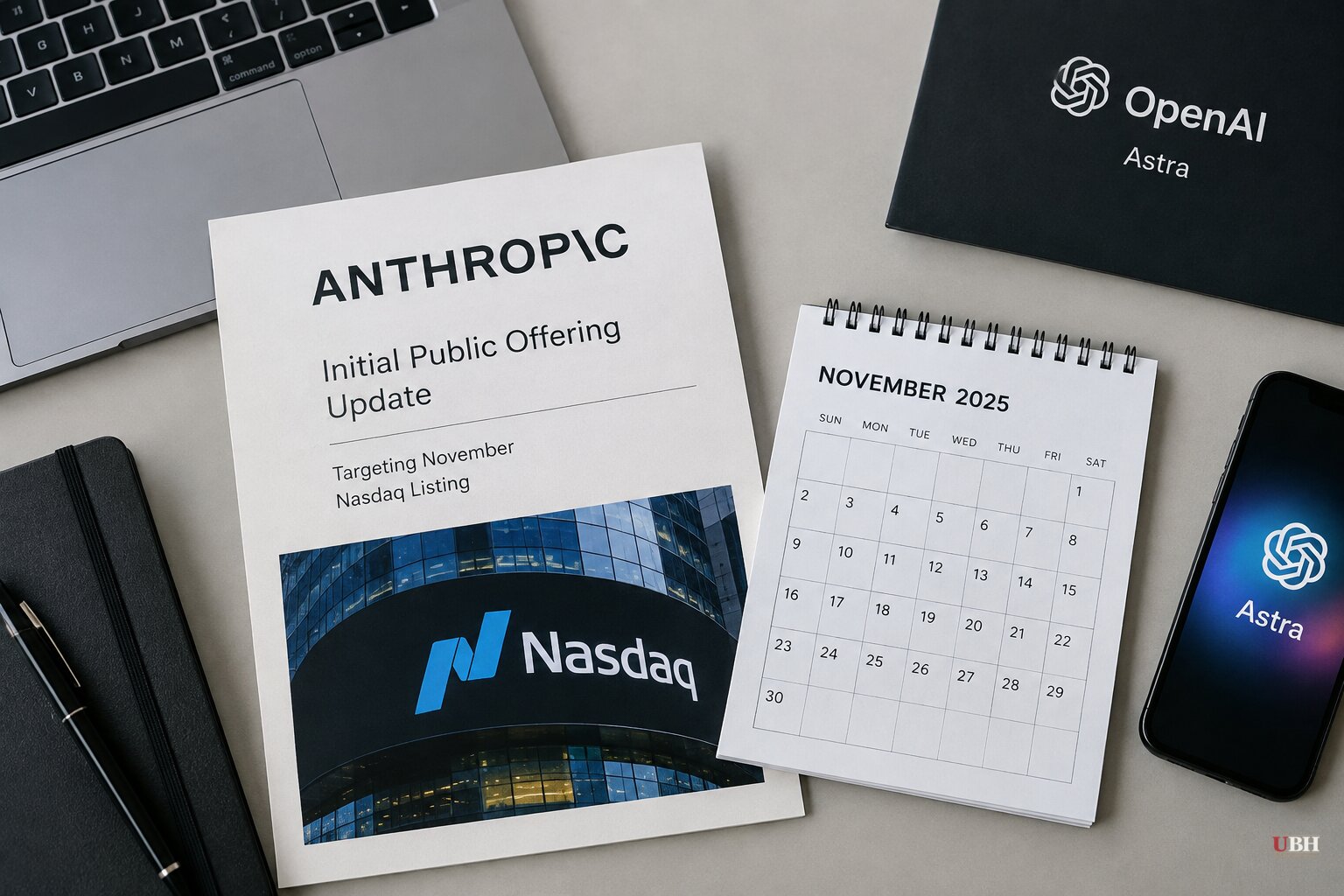
Since Dario Amodei's September 12 essay calling on the AI industry to slow down model releases, Anthropic's path to a public listing has gotten messier, not clearer.
The company originally targeted October for its IPO. According to The Information and The Wall Street Journal, as reported by The Decoder, the listing is now expected in late October at the earliest, but more likely November. Anthropic's advisors are citing a desire to show strong third-quarter results before ringing the bell.
The Decoder's own analysis pushed back on that explanation, noting it doesn't fully add up. If Anthropic's second-quarter numbers were already strong enough to support a $2 trillion valuation, waiting for Q3 mainly delays the payoff rather than securing it. Multiple factors are probably at play at once.
The Numbers Behind the Delay
Anthropic's revenue more than doubled between the first and second quarters of 2026, climbing from about $4.7 billion to more than $11.5 billion, according to The Information. Infrastructure spending rose a comparatively modest 65%, from $3.4 billion to $5.6 billion, and the company's self-described "adjusted operating margin" moved from negative 13% to a positive single-digit figure.
Anthropic reported $120 billion to $130 billion in cash in early August. That sounds like a fortress until you account for the $1.25 billion-a-month computing deal it signed with SpaceX in May. The company reportedly projects 2028 revenue of roughly $190 billion to $200 billion, a bet investors will be pricing at IPO.
The customer base backs up the growth story. By the end of 2025, about 1,500 companies had each spent over $100,000 on Anthropic's software in a 12-month span. By mid-2026, that number had quadrupled to roughly 6,000, with more than 100 companies spending over $10 million each.
Nasdaq Gets the Listing, Nvidia Talks Continue
Reuters reported Sunday, citing a Business Insider report based on a person familiar with the matter, that Anthropic has chosen Nasdaq for its listing. Anthropic has not publicly confirmed the exchange or final offering terms.
Investors are reportedly eyeing a roughly $2 trillion valuation and a capital raise of up to $100 billion, figures that would eclipse the records SpaceX set in its June IPO. Nvidia has been in talks to invest as much as $10 billion as an anchor investor, though that figure remains preliminary. The firmest valuation reference point remains Anthropic's own May funding round: $65 billion raised at a $965 billion post-money valuation, with annualized run-rate revenue crossing $47 billion that same month.
On prediction markets tracked by Vera, the highest-probability outcome for Anthropic's market cap at IPO close sits at just 24% for a $2.0 trillion to $2.25 trillion range, reflecting genuine uncertainty rather than consensus.
OpenAI's Astra Is Closing the Gap
The competitive backdrop matters here. OpenAI's GPT-6 Astra, released September 3, has gained fast traction with businesses. According to Reuters, Astra accounted for about 13% of enterprise AI spending tracked by corporate expense platform Ramp, versus roughly 8% for Anthropic's Claude Fable. On OpenRouter, a widely used developer traffic platform, users spent more on OpenAI models than Anthropic models last week, the first time that's happened in more than two and a half years, according to OpenRouter's own data.
Anthropic is reportedly weighing whether to rush out a new model to answer Astra, even as it debates the safety review process for that release, according to three sources cited by Reuters. Some existing and prospective investors told Reuters they don't see Astra as a serious threat given Anthropic's overall market size, but the shift on OpenRouter is the first hard data point suggesting OpenAI has real momentum.
The Safety Fight Playing Out in Public
Amodei's essay argued AI companies need to "slow the pace" of capability gains long enough for safety and alignment work to catch up, while insisting that doesn't mean halting model training outright. Sam Altman and Elon Musk both publicly backed the call. Anthropic says it has already taken a first step by giving third-party evaluators employee-level access to verify its safety practices.
Critics, cited by Breitbart, counter that slower releases also mean lower compute spending, which happens to help Anthropic's bottom line, and that the company has faced accusations of pursuing regulatory capture. Those are allegations from skeptics, not established findings.
On the other side, President Trump dismissed AI existential-risk warnings as a "hoax" in a call with Nvidia CEO Jensen Huang, and separately posted on Truth Social questioning why AI leaders would back regulation that could drive their own companies "into oblivion and bankruptcy." White House tech advisor David Sacks has also publicly opposed a development pause, according to Fox News.
Breitbart's framing suggests Anthropic is treating the safety debate as a reason to push forward with its IPO rather than delay it, and this sits alongside reporting from The Information and The Wall Street Journal that the company has, in fact, pushed the target date back a month. Both things can be true: the 2026 target hasn't moved, but October has slipped to November.
Meanwhile, the 10-year Treasury yield has climbed to its highest level since 2007, according to Crypto Briefing, a 19-year high that raises corporate borrowing costs across the board and adds pressure on richly valued companies to show a path to profit rather than just growth. Anthropic has not set a firm IPO date or confirmed offering terms as of today. OpenAI, by contrast, appears to be pushing its own listing to 2027, according to Fox News and Breitbart, leaving Anthropic as the AI industry's lone 2026 IPO candidate if the November target holds.
Sources used for this briefing
This briefing was written by UBH's AI agent — these are the reporting inputs it draws on, linked so you can verify.


