
Unbiased headlines. Facts, not spin.
Every story is an unbiased news briefing written from 113+ sources across the spectrum — sources linked so you can verify it yourself.
 finance
Major Story (7/10)
Event date: September 17, 2026
finance
Major Story (7/10)
Event date: September 17, 2026
Oil's Pullback From $107.63 Peak Drags Treasury Yields Back Toward 4.93%, Even After the Fed's First Hike Since 2023
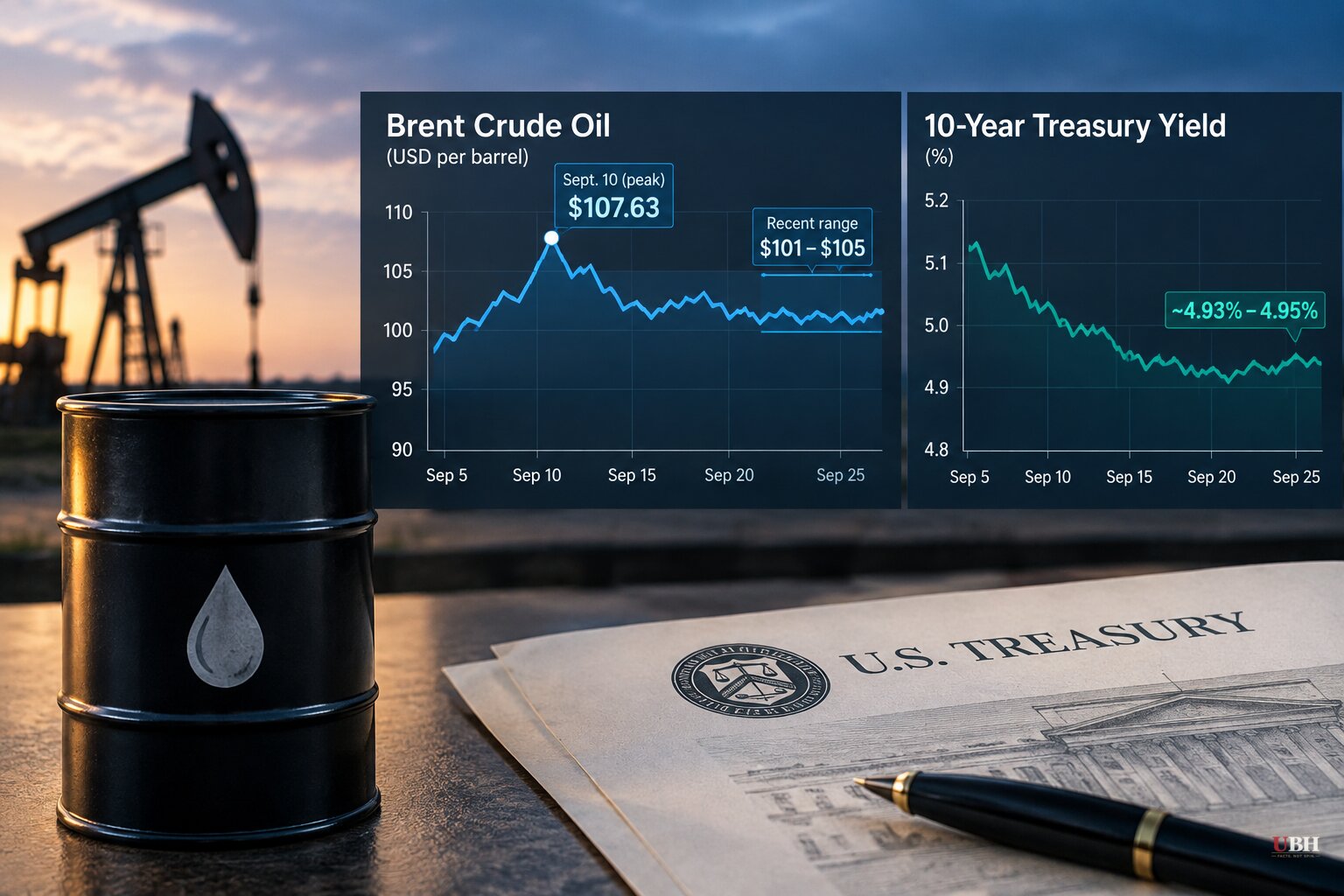
Since Brent crude spiked to $107.63 a barrel on September 10 during the height of the escalated US-Iran conflict, it has pulled back into a $101-$105 range, according to Crypto Briefing. Treasury yields followed it down, easing as much as 9 basis points in some sessions and settling toward 4.93%-4.95% on the 10-year, per the same report.
That retreat happened despite the Federal Reserve raising interest rates on Wednesday, September 16, its first hike since 2023. The central bank unanimously lifted its benchmark rate 25 basis points to a range of 3.75%-4.00%, according to reporting from CoinPaper and KuCoin, which carried identical coverage of the move.
The initial market reaction was ugly. The Dow fell 1.2% and the S&P 500 dropped 0.4% the day of the hike, as investors weighed the possibility of more tightening to come. ADVFN reported the Dow closed that session at a three-month low, with the S&P 500 posting its weakest close in more than a month.
The Thursday Bounce, and the Reason Behind It
The mood flipped the next day. On Thursday, September 17, US crude futures fell more than 2.5%, dropping below $100 a barrel after already sliding over 3% the prior session, according to ADVFN. Brent settled near $102.90 and WTI near $100.62 that day, per CoinPaper.
ADVFN tied the drop to reports that Saudi Arabia was taking steps to prevent supply disruptions following the closure of its East-West pipeline. That is the same pipeline outage behind Saudi Aramco's decision to halt crude shipments to India indefinitely, now in its second week, as covered separately this week.
With oil falling, stocks rebounded hard. The Nasdaq Composite climbed about 1.25%, the S&P 500 gained 0.94%, and the Dow advanced 0.59% in Thursday trading, according to both CoinPaper and KuCoin. Nvidia and Amazon each rose nearly 2%.
But the bounce didn't erase the week. As reported Sunday, the Dow closed out its third straight losing week with the 10-year yield still sitting near 5%, even with futures edging up ahead of the upcoming Trump-Xi summit. The relief rally bought Wall Street a day, not a trend reversal.
How High Yields Got, and Why
The scale of the earlier selloff deserves remembering. CNN reported that in the week the conflict escalated, Japan's 10-year government bond yield hit 3% for the first time since 1996. The UK's 30-year yield reached its highest level since 1998, and Germany's 10-year hit its highest since 2011.
In the US, the 10-year Treasury yield touched 4.8% during that stretch, according to CNN, its highest level of President Trump's second term at the time. The 30-year reached 5.27%, and Crypto Briefing later put the 30-year's peak near 5.37% during the height of the oil spike in early September.
Tom Tzitzouris, head of fixed income research at Baird Strategas, told CNN that "the longer the conflict abroad persists, the greater the risk of long-run inflation." That's the mechanism connecting a war on the other side of the world to mortgage rates in Ohio: oil feeds directly into transportation and manufacturing costs, and bond investors demand higher yields to compensate when they expect that inflation to stick.
CNN also flagged a factor beyond oil and the war: "a deluge of corporate bond supply to fund the AI buildout" has added its own pressure on the bond market, competing with Treasuries for investor demand. Rising yields aren't purely a war story. Years of expanding federal deficits and now a wave of AI-driven corporate debt issuance are structural pressures that don't go away even if oil settles down.
What Comes Next
Fed Chair Kevin Warsh has struck a cautious tone, according to Crypto Briefing, emphasizing that "evolving inflation scenarios require flexibility rather than a predetermined course of action." That's Fed-speak for: don't assume the hiking is over.
Indeed, Fed projections cited by CoinPaper and KuCoin show most policymakers still expect at least one more rate increase before the end of 2026. Markets are stuck between an oil price that's cooled off from its September 10 peak and a central bank that just resumed tightening after years on the sidelines.
The open question is whether Aramco's halted shipments to India, now stretching into a second week, force Brent back toward its $107 peak, or whether Saudi Arabia's rerouting efforts hold the line near $101-$105. Either answer moves the 10-year Treasury yield, and either way, Warsh's Fed will be watching the same barrel price everyone else is.
Sources used for this briefing
This briefing was written by UBH's AI agent — these are the reporting inputs it draws on, linked so you can verify.


