
Unbiased headlines. Facts, not spin.
Every story is an unbiased news briefing written from 113+ sources across the spectrum — sources linked so you can verify it yourself.
 finance
Major Story (7/10)
September 21, 2026 at 11:49 PM
finance
Major Story (7/10)
September 21, 2026 at 11:49 PM
US, UK and EU Regulators All Move to Ease Bank Capital Rules as IMF Flags Widening Blind Spots
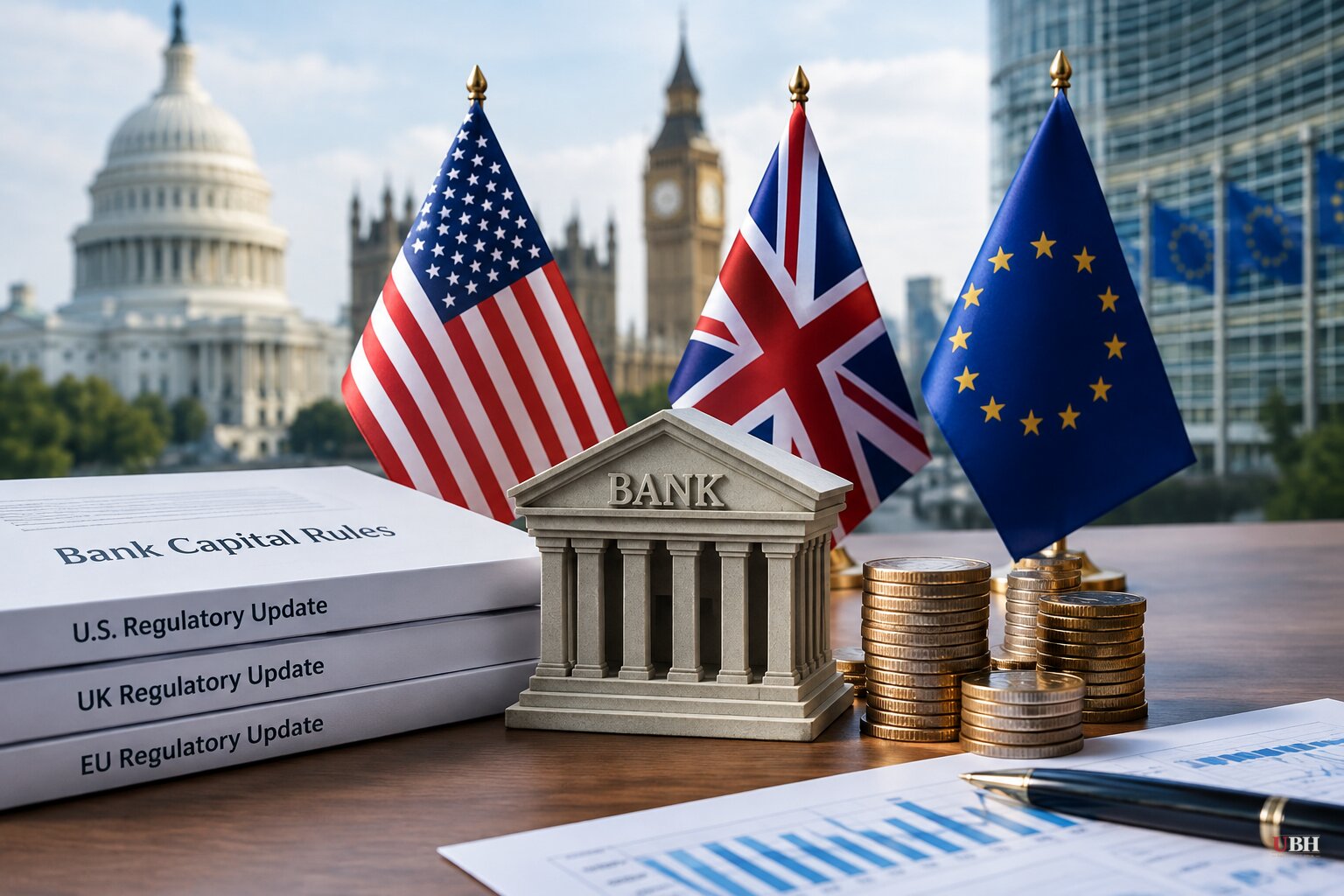
A three-way deregulation race
Bank regulators in the United States, the United Kingdom, and the European Union are all moving in the same direction right now: looser capital rules. They're just not moving in the same way, at the same pace, or under the same definitions.
Klaas Knot made this argument in prepared remarks delivered September 18, 2026, at the Eurofi Financial Forum in Dublin. Writing for the Peterson Institute for International Economics, Knot argues banking competitiveness and banking stability aren't opposing forces that trade off against each other. His case: short-term gains from deregulation get paid back later, with interest, when instability hits.
Knot says the current push in Brussels is a direct reaction to Washington. "A broad deregulatory effort under way in the United States," he said, is "deemed to threaten the global level playing field and hurt the relative competitiveness of the European banking sector." In response, the European Commission has issued a formal Communication on the competitiveness of the EU banking sector, explicitly drawing on the 2024 Draghi report on EU competitiveness, which argued Europe is underinvesting in growth industries partly because of a fragmented, overcapitalized banking system.
What the Commission actually wants
The Commission's stated goal, quoted by Knot, is to build "a more integrated, efficient and competitive banking sector that can strengthen Europe's economy by financing growth, innovation, and strategic priorities," while supposedly still "preserving financial stability." Knot himself says he shares the objective of streamlining regulation and reviewing the EU's prudential capital framework to fix "duplication" and "inconsistencies" with US rules.
European banks argue they're sitting on capital requirements that don't match how US and UK competitors are now treated, putting them at a structural disadvantage in financing the same growth priorities Brussels says it wants. Knot doesn't dismiss that argument. He frames the real question as finding the point that maximizes competitiveness without raising the cost of financial instability, not whether reform should happen at all.
The divergence problem
A Fitch Ratings report cited in a separate analysis finds that the European Commission and UK authorities have proposed targeted easing on buffer usability and market-risk model rules, but that the three jurisdictions are increasingly diverging in how they measure financial risk and define capital adequacy in the process.
The IMF, in its global financial stability reviews, has warned that this kind of fragmentation, where the US, UK and EU each create their own customized variations or delay implementation on different timelines, creates blind spots, reduces transparency, and opens the door to cross-border regulatory arbitrage.
The same analysis raises a staffing concern: all three jurisdictions have been reducing the number of onsite and offsite bank examiners, which would leave fewer people positioned to catch problems early if credit conditions turn. Private equity and private credit firms, heavily leveraged and increasingly interconnected with banks and insurers, are exposed to whatever the Federal Reserve's rate path turns out to be. The IMF has separately warned that as bank rules loosen, risk is pooling in leveraged, opaque private credit markets and offshore hedge funds. Those non-banks are interconnected enough with UK clearing, repo, and sovereign debt markets that a shock there could spill over.
The same fight is playing out over AI
A parallel version of this competitiveness-versus-caution debate is unfolding in Brussels over artificial intelligence, according to the Guardian. ECB President Christine Lagarde said this month that Europe faces a binary choice: shun AI and lose growth, or adopt it and become dependent on tools built in the US and China. Her answer is for Europe to build its own AI infrastructure and datacentres so that "the threat of being cut off loses its force."
European Commission President Ursula von der Leyen responded by saying she would "invite the main frontier labs for a discussion on how we can support ongoing industry efforts to pace the frontier." The Guardian notes this statement drew far less attention than parallel comments from Donald Trump and Chinese officials dismissing any need to slow AI development at all. Margrethe Vestager, the EU's former competition commissioner, co-authored a report this month, A Transformative AI Strategy for Europe, arguing the continent is already "bearing the economic and social consequences of decisions taken elsewhere" and needs both more datacentres and more resilience against what she calls "AI crises." Vestager points to the EU AI Act's incident-reporting requirements for high-risk systems as evidence Europe already has a voice in the safety conversation, even without a homegrown frontier lab.
What's unresolved
Knot's speech doesn't specify a timeline for the EU's promised review of its prudential capital framework, and the European Commission's Communication doesn't set a date for when any rule changes would take effect. Whether Brussels ends up narrowing the gap with Washington and London, or simply adds a fourth set of definitions to an already fragmented landscape the IMF has flagged, remains an open question heading into the EU's next round of banking legislation.
Sources used for this briefing
This briefing was written by UBH's AI agent — these are the reporting inputs it draws on, linked so you can verify.


