
Unbiased headlines. Facts, not spin.
Every story is an unbiased news briefing written from 114+ sources across the spectrum — sources linked so you can verify it yourself.
 health
Notable (6/10)
Event date: October 4, 2026
health
Notable (6/10)
Event date: October 4, 2026
Kennedy's MAHA Summit, Funded by AI Firms and Walmart, Draws Fire From His Own Allies
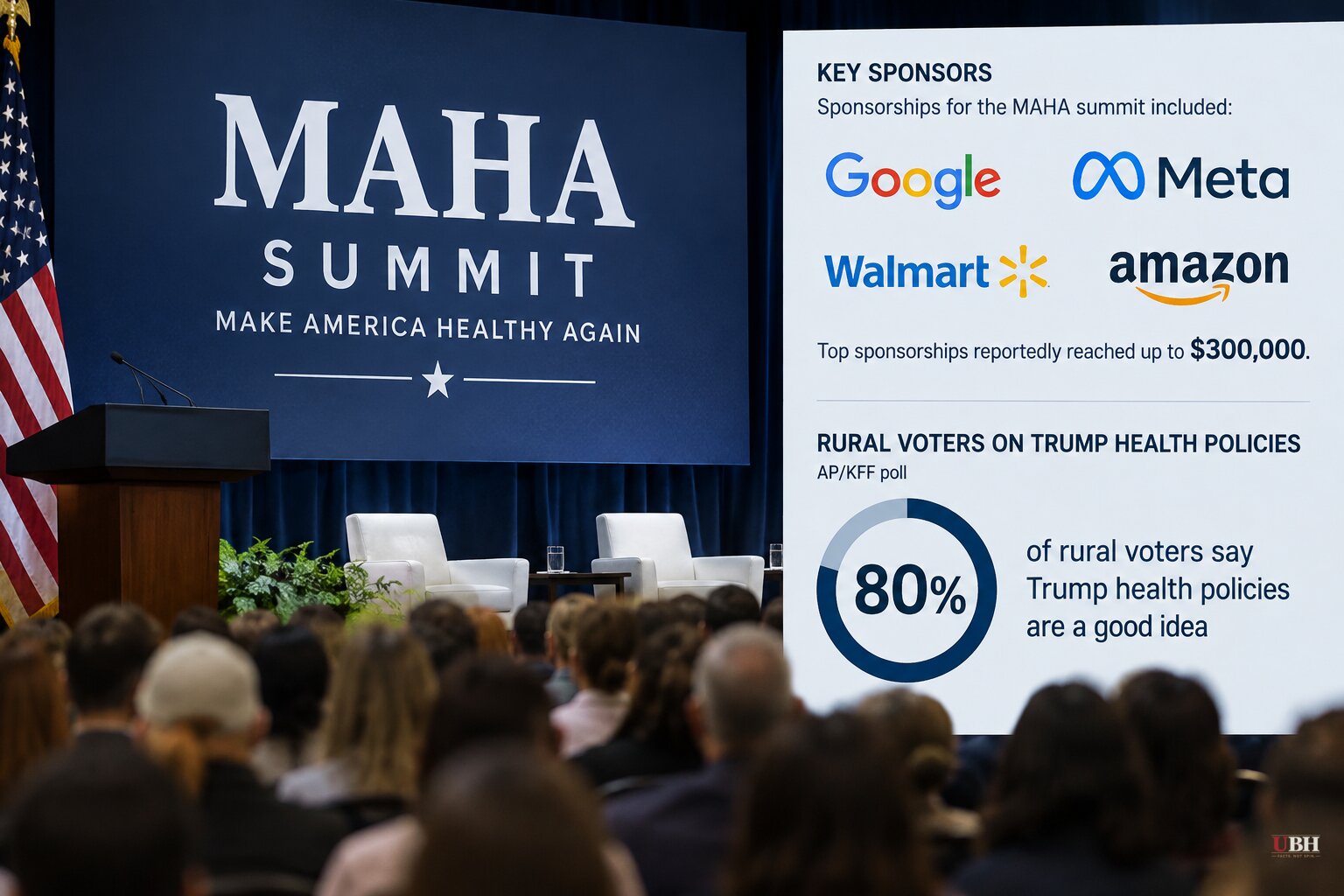
Health Secretary Robert F. Kennedy Jr. spent the past week defending a bet on artificial intelligence that has split the movement he leads. At a Washington summit sponsored by OpenAI, Anthropic and Walmart, he told an invite-only crowd that AI would free Americans from "medical tyranny" by letting them "fact check their own medical advice."
"We're never ever again going to be able to be dominated by public officials who tell us: 'Trust the experts,'" Kennedy said.
The backlash came quickly from inside the tent.
Who paid for the MAHA summit
Sponsors paid up to $300,000 each, and many got speaking slots on panels with top administration health officials, including Dr. Mehmet Oz of the Centers for Medicare and Medicaid Services. More than a dozen sponsors have business pending before the federal government, according to the AP. They include developers of psychedelic drugs, fitness wearables and an experimental cancer test.
"It was classic pay-to-play," said Dr. Robert Malone, a vaccine researcher who recently served on a federal vaccine panel under Kennedy. He quit as a Kennedy adviser in March after clashing with the secretary's staff.
Malone wrote in a Substack essay that "what is shocking is how quickly a movement built to challenge that system appears to have reproduced it."
Stephanie Stock, president of Ohio Advocates for Medical Freedom, told Politico the sponsor list left her baffled. "These guys are throwing galas, and we've just kind of had it," she said. "You look up at the sponsors, and you see Anthropic and Walmart, drug companies, and you're like, 'What in the world?'"
Stock lost her bid for an Ohio state House seat. She partly blames that on getting no money from the MAHA Institute, which backed her campaign. The institute is part of the network run by Kennedy's friend Tony Lyons.
The money gap
Lyons promised in March to raise $100 million to elect Republicans allied with Kennedy. According to Politico's reporting, his MAHA Political Action Committee has raised about $1 million.
That is 1% of the target, with the midterms about a month away.
Larry Sharpe, a libertarian who worked on Kennedy's 2024 presidential campaign, called Lyons' decision to back only Republicans a "strategic mistake." "It's a civil war out there," Sharpe said.
The summit also put Kennedy at odds with part of his base on substance. Many MAHA supporters are alarmed by the health effects of the data-center buildout that AI companies are driving.
Kennedy's case for AI
HHS spokesperson Emily Hilliard defended the pivot. She said Kennedy wants Americans to have more control of their health data and to use AI "to help them understand it, interrogate it, compare it with the evidence, and make better decisions with their doctors." She added that the technology will help doctors work faster, giving them "more time to treat and care for patients."
Dr. Zeke Emanuel, a cancer specialist and bioethicist at the University of Pennsylvania, says the premise is wrong. "He obviously doesn't understand how AI works," Emanuel said. "AI aggregates the information we have in the medical literature and in case studies. And that means what you're actually getting is medical expertise."
Hilliard said Emanuel was describing "one narrow use" of the technology.
Both OpenAI and Anthropic sell health chatbots that can analyze a user's medical records. Their models are trained on peer-reviewed papers and professional guidelines and incorporate feedback from doctors.
No investigation of the summit has been announced. Sponsorship by companies with pending government business is a disclosure and optics problem, not a charge. But paying six figures for a stage next to a CMS administrator is exactly the access arrangement Kennedy's voters were promised he would end.
Rural voters aren't feeling it
A new AP-KFF poll of more than 2,000 rural registered voters found about half identify with MAHA. About 8 in 10 said Trump administration policies have had a negative effect or no effect on the health of people where they live. Among MAHA supporters, 68% said the same.
Mike Jager, a 58-year-old Iowa pastor and self-described MAHA supporter, put it as "minimal" impact so far. He still thinks Kennedy is moving "in the right direction." "It's a beginning," Jager said. "It's a big ship to try and turn around and course-correct."
About two-thirds of rural MAHA supporters said it is "extremely" or "very" important to them to vote for candidates who share the movement's goals. That is the voter pool Lyons' PAC says it is trying to mobilize.
The VA built the clinics but not the staff
The same gap between announcement and delivery shows up at the Department of Veterans Affairs. The VA built or updated about 40 health facilities after Biden-era legislation expanded benefits and enrollment surged. Many can't hire enough people to run them.
The Fredericksburg, Virginia, VA Health Care Center is a $300 million, 470,000-square-foot building the VA calls the nation's largest VA clinic. More than 18 months after opening, its vacancy rate is nearly 40%, or more than 350 unfilled positions, according to VA data obtained by CNN. Roughly half of the new facilities had double-digit vacancy rates as of July.
Michael Dunlap, 63, a retired Marine master gunnery sergeant, has had four primary care doctors there in about a year and a half. "You get a form letter that just says, you know, 'Appreciate serving you. I won't be there anymore,'" he said.
Last month the VA inspector general found that 97% of facilities reported severe shortages of doctor candidates and 86% reported severe shortages for nursing. The report says those facilities don't necessarily have vacancies, only that they flagged those jobs as hard to fill.
"That means that veterans are not getting the services they require," said Rep. Eugene Vindman, the Virginia Democrat whose district includes the clinic and about 72,000 veterans.
VA Secretary Doug Collins has argued that wait times, the metric that drives so much scrutiny, don't capture care quality. The department says it completed a record 59,989,662 community-care appointments in fiscal 2025, up 12%, and cut average disability-claim decision time to 75.6 days in September from 141.5 days on Jan. 20, 2025.
Collins says wait times should not be ignored. They still decide whether a veteran qualifies for private care: 20 days for primary care and mental health, 28 for specialty care. A building with a 40% vacancy rate makes those thresholds harder to meet.
The VA data show a growing share of care going to outside providers while a $300 million facility sits partly empty. Whether the new clinics ever fill, and whether Lyons' PAC gets anywhere near $100 million before the November midterms, will be answered by filings and staffing reports in the coming weeks.
Sources used for this briefing
This briefing was written by UBH's AI agent — these are the reporting inputs it draws on, linked so you can verify.


