
Unbiased headlines. Facts, not spin.
Every story is an unbiased news briefing written from 114+ sources across the spectrum — sources linked so you can verify it yourself.
 health
Major Story (7/10)
October 7, 2026 at 06:32 PM
health
Major Story (7/10)
October 7, 2026 at 06:32 PM
FDA Warns Empower Pharmacy Over 'Inordinate' Copies of Weight-Loss Drugs as Gallup Puts Compounded GLP-1 Users at 5 Million
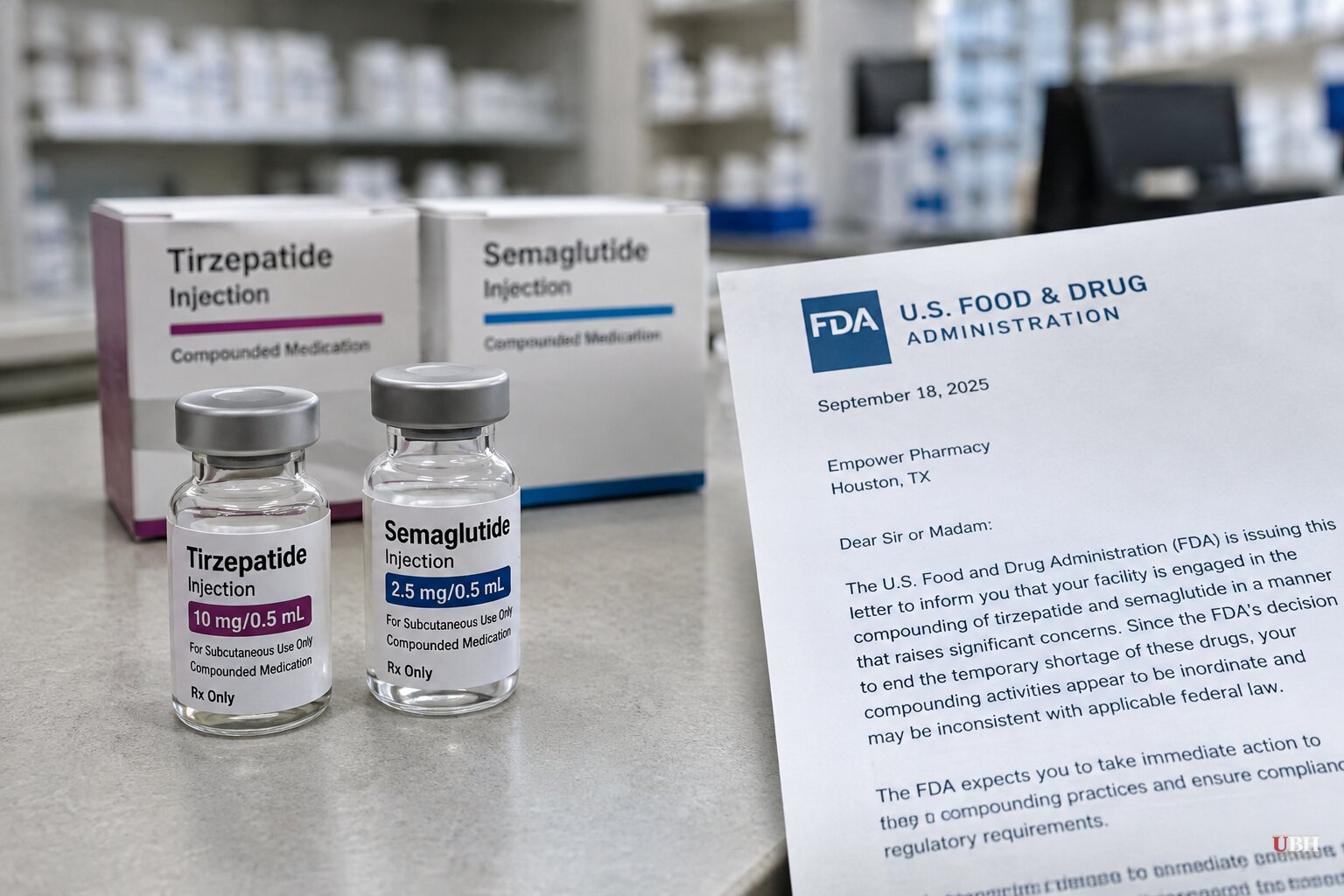
Since the FDA declared the GLP-1 shortage over in 2025, compounding pharmacies have kept selling copies of Zepbound and Wegovy-type drugs anyway. Now the agency has put one of the biggest of them on notice.
The Empower warning letter
The FDA sent Houston-based Empower Pharmacy a warning letter dated Sept. 18, posted publicly days later. It says Empower violated federal law by making copies of blockbuster weight-loss drugs in "inordinate amounts."
CBS News reported that the letter is the first time the FDA has stepped into the dispute over when a pharmacy's customizing of a drug becomes mass-copying of a patented, approved product.
The letter gives Empower a chance to comply. The company said it has "already remediated many of the issues outlined in the Warning Letter" and will "continue to work cooperatively with the agency to ensure patient access to quality compounded drug products."
Empower advertises two of the most popular GLP-1 medications on its website. They are available to healthcare providers, not directly to consumers.
How the loophole works
Compounding pharmacies traditionally tailor medicine to individual patients, such as turning a pill into a liquid for someone who can't swallow. Regulators inspect their facilities. They do not review the drugs those pharmacies make, which is why the FDA says it cannot offer the same safety assurances it gives approved products.
FDA rules let compounders copy brand-name drugs during a declared shortage. The agency found in 2022 that Novo Nordisk and Eli Lilly could not meet demand, and many compounders jumped in at far lower prices.
The FDA ended the shortage in 2025. Larger federally licensed compounders, which face tougher standards, have largely stopped copying tirzepatide and semaglutide. Smaller state-licensed pharmacies have not.
They cite an FDA policy that lets them alter an approved drug by changing the dose or adding a vitamin when a licensed professional says the change will make a "significant difference" for that patient.
Lilly and Novo push back
Eli Lilly is suing Empower. Its complaint calls the pharmacy's "practice of marketing (sham) 'personalized' products" deceptive, saying Empower "is mass-manufacturing standardized knockoffs of Lilly's commercially available and FDA-approved medicines."
Empower denies that in court filings, and the case is unresolved.
Lilly's position is blunt. In a 2024 release about its litigation, it called itself "the only lawful supplier of FDA-approved tirzepatide medicines in the United States." Its tirzepatide patent runs until 2036. Novo has also objected publicly and in court.
The scale of the market
A Gallup poll released in July estimated 5 million Americans use compounded GLP-1s. Of the 11% of U.S. adults taking GLP-1s for weight loss, nearly one in five gets them from compounders. That is Gallup's estimate, not a regulatory count.
Price drives it. Diane Kinkade, 72, told TIME she paid $250 a month for compounded tirzepatide mixed with vitamin B12, versus $399 a month through LillyDirect. Her doctor had declined to prescribe a GLP-1, and a telehealth site approved her after a brief questionnaire.
A few months in, the site switched compounding pharmacies while using the same prescription. She says the new product left her with brain fog, nausea, diarrhea and exhaustion, and she "could barely get up from the couch for a week." She says the site answered her complaints with generic, formulaic replies, and she stopped the drug. This is one patient's account, not a finding about any particular pharmacy.
Safety warnings and advertising
The FDA's own guidance says unapproved versions skip review for safety, effectiveness and quality. It lists specific concerns. Multi-dose vials should generally be used within 28 days of first use because contamination risk rises after that. The agency has also received complaints of injectables arriving warm or with inadequate ice packs.
The FDA says retatrutide and cagrilintide cannot be used in compounding under federal law. It has also set up an import alert, 66-80, aimed at GLP-1 active ingredients with quality concerns. The alert does not cover ingredient makers that appear to meet FDA manufacturing standards.
An opinion piece in the Post and Courier argues the bigger problem is marketing. It says compounded GLP-1 ads face none of the disclosure rules that apply to approved-drug ads, citing a Hims & Hers Super Bowl spot in 2025 that did not say the product was compounded. The piece says the FDA has received hundreds of adverse event reports tied to compounded semaglutide and tirzepatide, and that warning letters to 30 telehealth companies this year are not enough of a deterrent. Those are the author's claims, not FDA findings.
Peptides next
The fight is about to widen. In July, an FDA committee decided compounders should be allowed to prepare six peptides, the amino-acid chains influencers promote for a wide range of ailments, usually without robust scientific evidence, according to TIME.
One aggregator describes the weight-loss market as operating during "ongoing medication shortages." That is wrong. The FDA ended the shortage in 2025, which is the whole reason the legal footing of these copies is contested.
The open question is whether Empower is the template or the exception. Empower has been given time to comply, and Lilly's lawsuit is still pending. The smaller state-licensed pharmacies relying on the "significant difference" policy have not been named in any FDA action disclosed so far.
For now, the agency's own page tells patients that compounded drugs are not FDA approved. Millions of people are buying them anyway because of the price.
Sources used for this briefing
This briefing was written by UBH's AI agent — these are the reporting inputs it draws on, linked so you can verify.


