
Unbiased headlines. Facts, not spin.
Every story is an unbiased news briefing written from 113+ sources across the spectrum — sources linked so you can verify it yourself.
 energy
Notable (6/10)
Event date: October 1, 2026
energy
Notable (6/10)
Event date: October 1, 2026
Kelvin Wave to Push West Coast Sea Levels Up a Foot as Super El Niño Strengthens
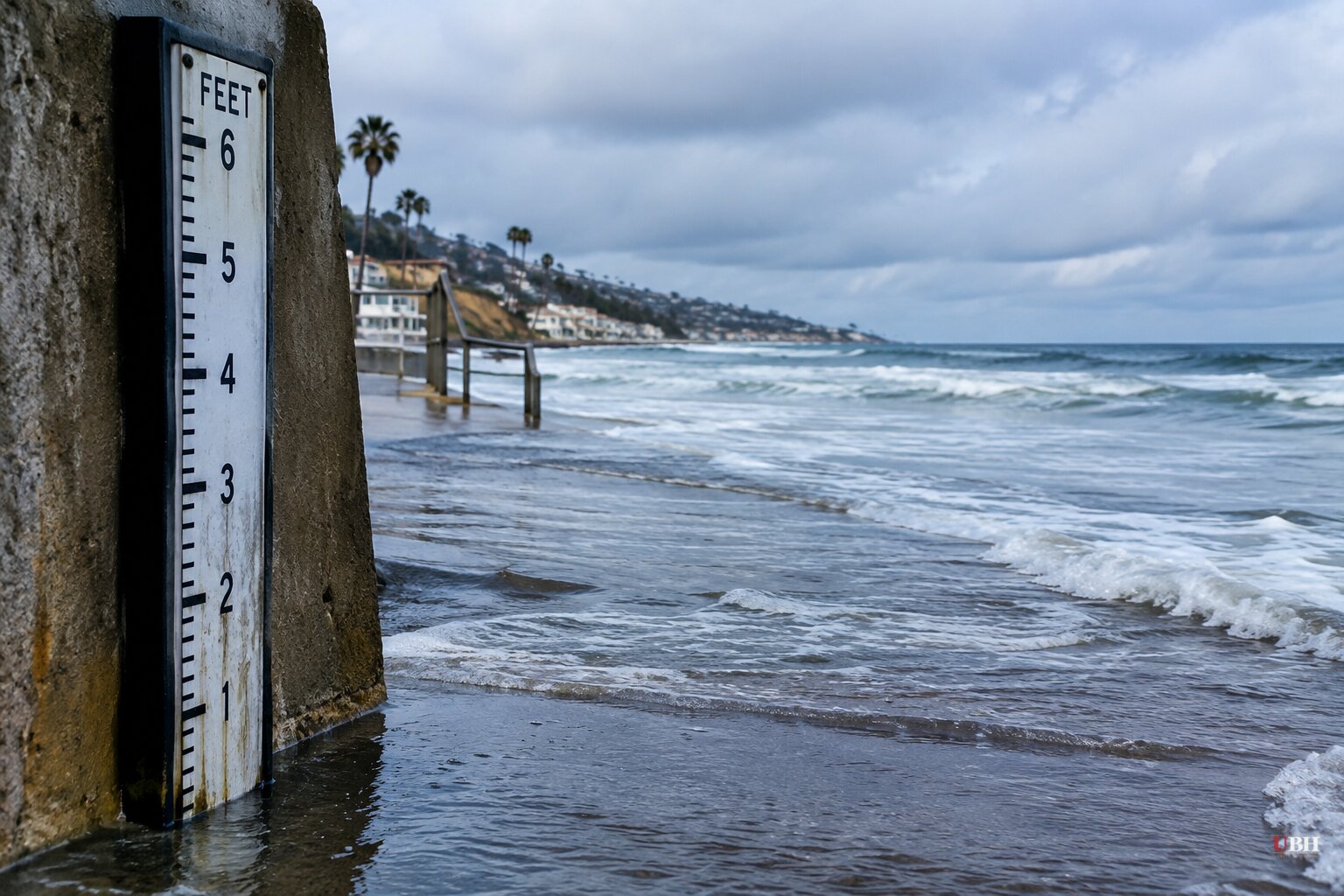
A slow-moving pulse of warm water is crawling up the Pacific coast and will push sea levels along California, Oregon and Washington up to a foot higher than normal through October, according to the Associated Press and multiple ocean scientists tracking the phenomenon.
It's called a Kelvin wave, and despite the dramatic headlines, it isn't a wall of water. Michael Jacox, a research oceanographer with NOAA Fisheries' Ecosystem Science Division, told the AP it's more like water sloshing in a bathtub during an earthquake than a tsunami. Severine Fournier, an ocean scientist at NASA's Jet Propulsion Laboratory, compared it to the wave that circles a stadium: the disturbance moves, but the water itself mostly doesn't.
What's actually happening
The wave is traveling roughly 6 miles per hour, or about 150 miles a day, and is moving north along the coast, according to the AP. It originates near Indonesia when trade winds along the equator weaken or reverse, letting a bulge of warm water slosh east across the Pacific until it hits South America, then splits and runs up the North and South American coastlines, per the AP and NOAA oceanographer Dillon Amaya.
This isn't the first one this year. Amaya told KQED a first Kelvin wave moved up the coast in May and June, driving San Francisco's highest June and July tides on record. A second wave, the one now underway, has been moving north from the Gulf of California and could reach the Bay Area as soon as mid-October, KQED reported October 1. Amaya said signs point to a third wave already forming near the equator. During a strong El Niño year, as many as six of these waves can occur, with elevated seas lasting three to six months.
NOAA's Climate Prediction Center put the odds at 75% that this year's El Niño becomes a "historic" one this fall into winter, according to its September outlook cited by KQED.
Why it matters more than the number suggests
Jacox's point to the AP: the wave itself probably won't flood anything on its own. What it does is raise the floor. If sea levels are already 6 inches above normal when a big storm or king tide hits, the storm surge now starts from a higher baseline, and the damage is worse than it otherwise would be.
Amaya put a number on that to Agence France-Presse: every 2 to 4 inches of background sea level rise roughly doubles flood risk, because the extra height compounds with storm surge, swells and high tides across a huge volume of water.
Jonathan Warrick, a research geologist with the U.S. Geological Survey, told The Guardian the real danger window is winter. "The thing to look out for is what will happen in January, February and March, that's when we get the biggest storms, we get our largest waves and we have some very large tides," he said, adding that if those systems align with elevated Kelvin-wave sea levels, "we really are kind of rolling the dice."
Damage has already shown up. Agence France-Presse reported that in Dana Point and Laguna Beach, south of Los Angeles, several homes have been rendered uninhabitable and at least one has collapsed. In Malibu, pounding waves from a hurricane opened a sinkhole in the driveway of a home owned by actor Nicolas Cage. The Independent reported the Bay Area got its second-ever coastal flood advisory this month, and that Governor Gavin Newsom declared a state of emergency mobilizing state agencies in response.
Natural cycle versus added warming
Kelvin waves are, in the words of Amaya and the AP, a "fact of life" during El Niño, a naturally occurring Pacific climate pattern that recurs independent of long-term human-caused warming. David Webb, a physical oceanographer at the U.K.'s National Oceanography Centre, told Live Science this year's version is an "internal Kelvin wave" driven by shifting equatorial winds, and cautioned the generation process "may not be a particularly clean single wave, possibly a bit messy."
Separately, the oceans have been warming for decades. The Independent cited United Nations figures showing Pacific sea levels have risen 4 to 6 inches since 1993, on top of 8 to 9 inches of global sea level rise since 1880 per federal data. The Guardian's framing leaned harder into tying the current wave directly to "human-caused climate crisis" and warned it could roughly double the prior century's sea level rise. That's a legitimate point about compounding baselines, but the scientists quoted across outlets, including Jacox, Amaya, Webb and Warrick, describe the wave mechanism itself as a recurring El Niño feature rather than a direct product of warming, even as warming raises the water it's riding on top of.
California's king tides around Thanksgiving and Christmas are expected to run higher than typical this year because of the moon's position relative to Earth's equator, according to Anthony Edwards, a meteorologist at the San Francisco Chronicle. Whether that king-tide peak lines up with a storm system and an active Kelvin wave—the exact scenario Warrick flagged—won't be known until the winter storm pattern actually develops.
Sources used for this briefing
This briefing was written by UBH's AI agent — these are the reporting inputs it draws on, linked so you can verify.


