
Unbiased headlines. Facts, not spin.
Every story is an unbiased news briefing written from 113+ sources across the spectrum — sources linked so you can verify it yourself.
 energy
Major Story (8/10)
Event date: September 29, 2026
energy
Major Story (8/10)
Event date: September 29, 2026
UBS Warns European Gas Storage Could Fall to 25% by End of Winter as Qatar's LNG Shipments Collapse
Since Hormuz LNG traffic data showed cargo volumes still running roughly 80% below normal as of late September, UBS has now put a harder number on what that means for Europe's winter.
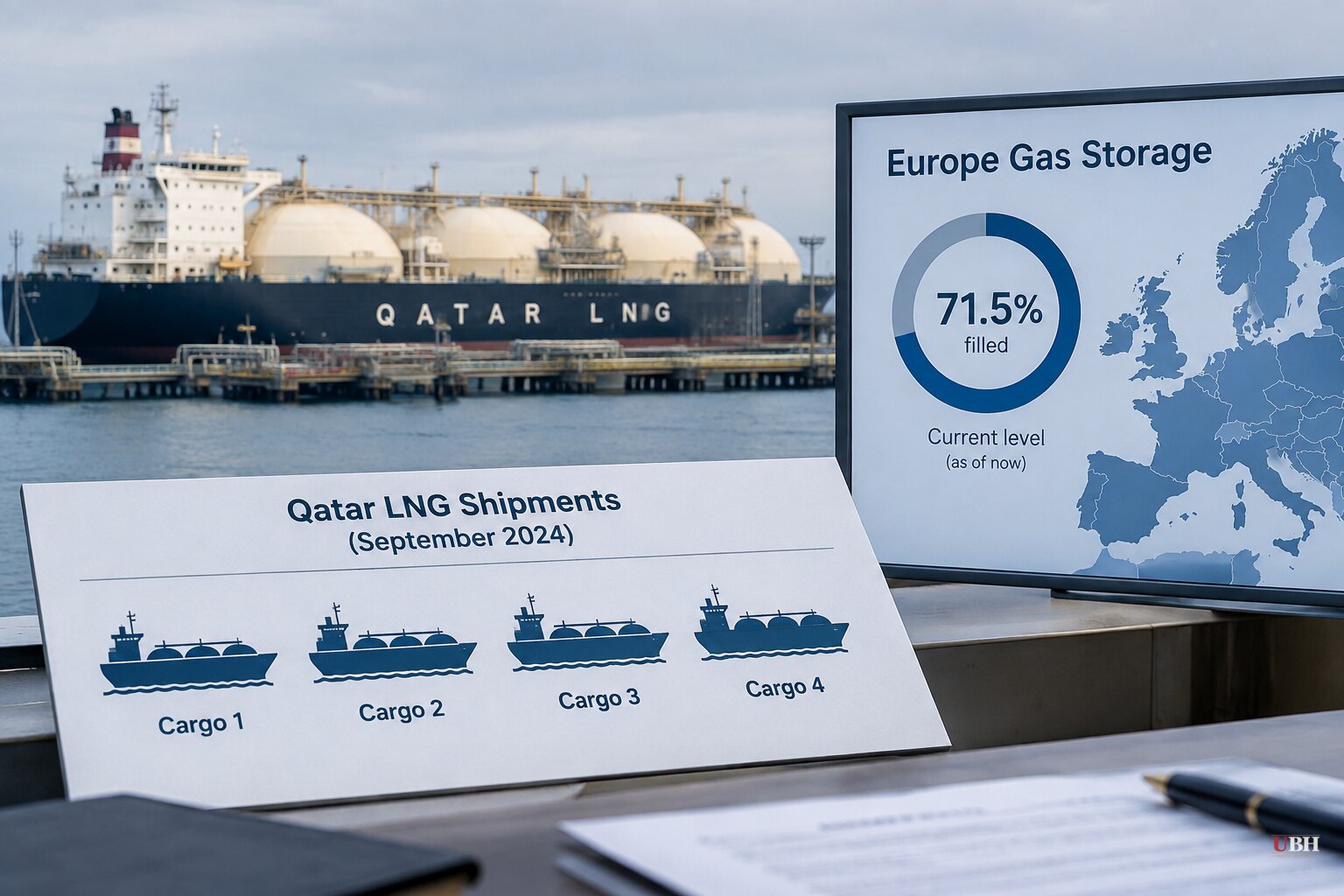
UBS energy analyst Nayoung Kim wrote in a Thursday note that EU gas storage sat at 71.50% full at the end of last week, against a 15-year average of around 88% for this point in the calendar. Kim projects storage will peak near 74% before the winter withdrawal season even starts, well below last year's 84% and the five-year average of 90%. By the end of winter, Kim expects the buffer to fall to around 25%.
That 25% figure matters because of where the physics start to bite. Erisa Pasko, lead European gas analyst at Energy Aspects, told Anadolu Agency that European withdrawal capacity, the rate at which gas can actually be pulled out of the ground and delivered during a demand spike, begins declining materially once inventories drop below roughly 40%, or about 44 billion cubic meters, and deteriorates significantly below 20%. UBS's forecast puts Europe right in that danger band by spring.
Qatar Has Nearly Stopped Shipping
The supply side of the problem is concrete. Kim's note says Qatar, one of the world's largest LNG exporters, shipped just four cargoes in September. That compares with 25 cargoes the month before June 2025 and a typical monthly average of around 30. Force majeure, the legal mechanism exporters invoke when they can't fulfill contracts, has been extended into November or early December for some buyers.
Anadolu Agency's reporting from September backs this up independently. Bill Farren-Price of the Oxford Institute for Energy Studies said current price pressure reflects "the tightness of global LNG markets due to the closure of the Strait of Hormuz and the loss of Qatari LNG." Massimo Di Odoardo of Wood Mackenzie went further, telling Anadolu that low European inventories, strong Asian demand and limited new LNG supply growth "almost guarantee elevated prices through this winter and into 2027."
Asia is making the competition worse. UBS's data shows weekly LNG inflows into Asia rose 12%, with combined arrivals into Japan and South Korea jumping 33% week over week. Asia's JKM benchmark now trades at more than a $1.50 per million British thermal units premium to Europe's TTF, which means Europe has to outbid Asian buyers just to keep cargoes flowing its way.
Storage Economics Are Broken, Not Just Supply
ChemAnalyst's reporting adds a piece UBS doesn't dwell on: the traditional summer-buy, winter-sell storage trade stopped making financial sense. At one point in March, buying gas for summer storage and selling it in winter would have produced a loss exceeding €8 per megawatt-hour before storage fees, according to ChemAnalyst. That's why traders didn't fill storage aggressively even when they had the chance. Germany, which holds the EU's largest storage capacity, is sitting at only around 57% full, per ChemAnalyst, the weakest major country in the bloc.
Governments are starting to respond to that market failure directly. Germany and the Netherlands are examining state-backed stockpiling mechanisms, while France and Italy have already rolled out government incentives to encourage injections, according to ChemAnalyst. French President Emmanuel Macron said on September 18 he would coordinate with European Commission President Ursula von der Leyen on a bloc-wide response, according to the Financial Times as cited by neglobal.eu. EU Energy Commissioner Dan Jorgensen urged countries on September 26 to sustain storage injections or cut gas and electricity use where necessary, Xinhua reported.
Prices Already Hit Household Bills
This isn't abstract for European households. Xinhua reported that Dutch TTF front-month gas traded around 72 to 73 euros per megawatt hour in late September, down from a mid-September peak above 80 euros but still more than double the roughly 32 euros per megawatt hour average from September 2025. Euro area annual inflation rose to 3.2% in August from 2.9% in July, with energy prices contributing 1.29 percentage points, according to Eurostat data cited by Xinhua. A German Chamber of Commerce and Industry survey of roughly 3,100 companies found 49% reporting rising electricity costs and 67% saying heating had become more expensive.
A reasonable counterargument exists. Tatiana Mitrova of Columbia University's Center on Global Energy Policy told neglobal.eu that a storage level near 70% "does not make shortages inevitable," and that winter security depends on continued imports, not stored volume alone. Prices have also already pulled back from their mid-September highs, and S&P Global Energy expects LNG imports into the EU and UK to rise 6.5% in the fourth quarter to around 491 million cubic meters a day, according to Business Today, with US cargoes now making up 62% of Europe's LNG imports.
That US share is rising for a structural reason, not just opportunism. Business Today reports the EU's planned ban on Russian LNG takes effect after the fourth quarter, with Russia's current 15% share expected to decline further. Norway continues supplying pipeline gas at around 308 million cubic meters a day. None of that changes the math UBS is pointing to: a smaller buffer, a tighter global market, and a winter that leaves almost no room for a cold snap or another Gulf disruption. ZeroHedge's coverage, pulled from the same UBS note, frames the situation as a reason for Europeans to "panic"; the underlying data from Anadolu, Xinhua and Business Today supports concern but not that characterization, describing a tight, manageable-if-nothing-goes-wrong market rather than a certain crisis.
One unverified detail from the UBS note deserves a flag: the claim that the Trump administration asked France and Germany to release emergency diesel supplies has not been independently confirmed by any other source reviewed here. Whether that request was made, and how Paris and Berlin respond, remains an open question heading into the coldest months.
Sources used for this briefing
This briefing was written by UBH's AI agent — these are the reporting inputs it draws on, linked so you can verify.


