
Unbiased headlines. Facts, not spin.
Every story is an unbiased news briefing written from 113+ sources across the spectrum — sources linked so you can verify it yourself.
 energy
Major Story (8/10)
Event date: September 28, 2026
energy
Major Story (8/10)
Event date: September 28, 2026
Lake Mead Falls to Lowest Level in Nearly 90 Years as Washington Imposes New Water Cuts on the West
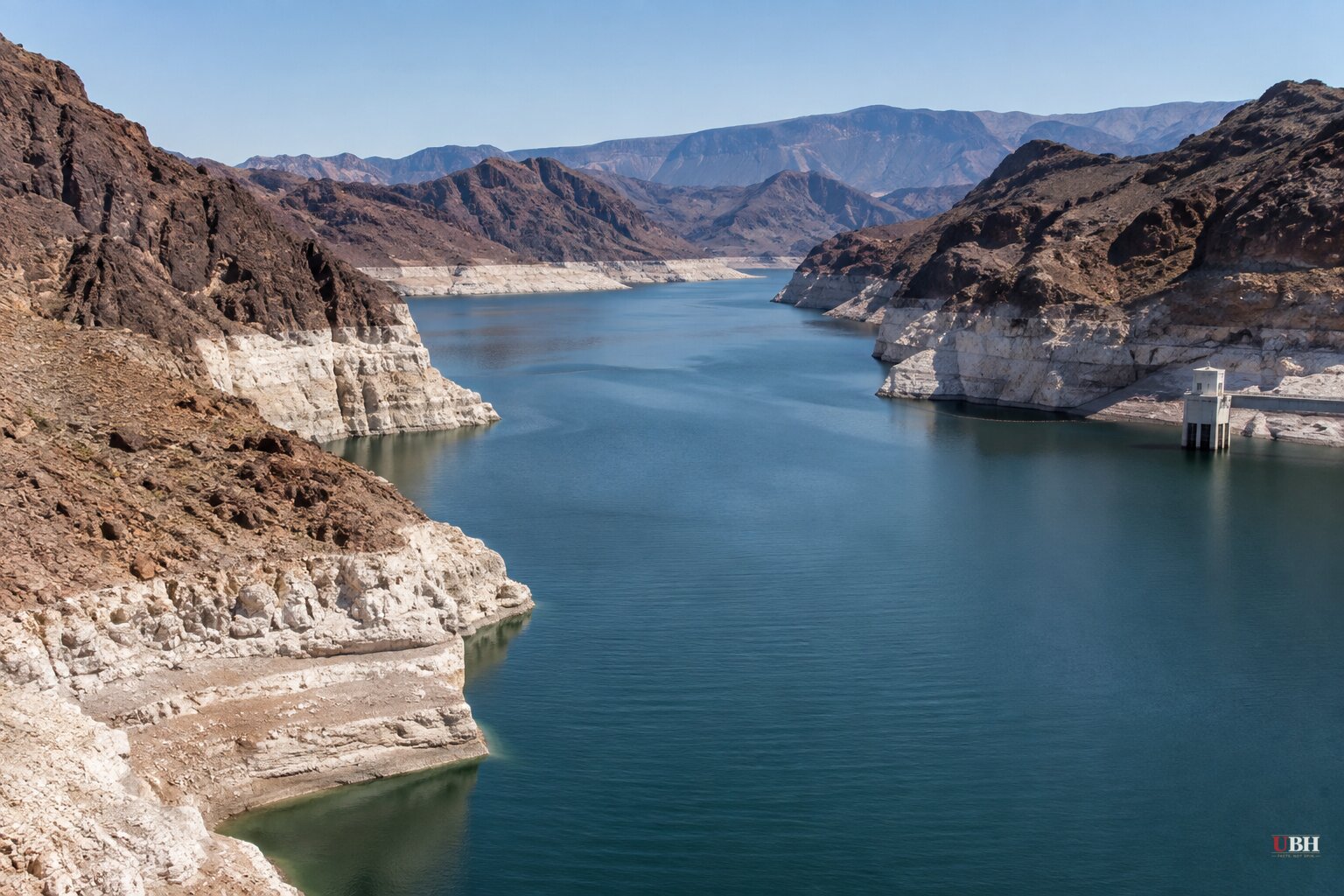
Lake Mead hasn't been this low since it was first filled nearly 90 years ago, according to The Guardian. The reservoir sits at less than 27% of capacity, with a 175-foot "bathtub ring" of mineral deposits marking where the water used to be back in 2000. Lake Powell, the other giant reservoir on the Colorado River system, is also at a historic low. The two combined are holding less water than at any point since before Powell began filling in the 1960s, according to Audubon's Jennifer Pitt, the organization's Colorado River Program Director.
The Colorado River Basin has been in a drought stretching back to 2000, and the river has lost roughly 20% of its flow over that period, according to Kyle Roerink, senior adviser with the Great Basin Water Network, speaking to The Guardian. A UCLA-led study published in Nature Climate Change, cited by ROI-TV, found the 2000-2021 stretch was the driest 22-year period in southwestern North America in at least 1,200 years, and attributed about 42% of the soil-moisture deficit to human-caused climate change. That leaves a majority of the deficit tied to natural variability.
Washington Steps In Where States Couldn't Agree
The seven states that depend on the river—Colorado, New Mexico, Utah and Wyoming in the Upper Basin, and Arizona, California and Nevada in the Lower Basin—spent years trying to hammer out a consensus plan for water use after 2026. They failed. That failure forced the federal government's hand, according to Audubon, which operates the dams at Lake Powell and Lake Mead through the Bureau of Reclamation.
The result is a 10-year "Decision Framework" covering 2027 through 2036, with detailed operating rules locked in for the first two years. Under that plan, Lower Basin states will collectively absorb an annual shortage of 1.25 million acre-feet and are supposed to conserve another 0.7 million acre-feet from 2026 through 2028. Federal dollars will compensate water users for that conservation, meaning taxpayers are now subsidizing states that couldn't agree among themselves on how to use less water voluntarily.
Weeks after that decision, the U.S. and Mexico reached Minute 334, a two-year agreement that adds a 0.25 million acre-foot shortage for Mexico as well. PBS News reports the fight over Colorado River water could still end up at the Supreme Court, meaning this federal framework is not the last word.
Vegas Bet Big on Infrastructure and It Paid Off
Not every response has been about rationing. The Southern Nevada Water Authority spent $1.3 billion in the early 2000s building a new water intake nearly 200 feet deeper in Lake Mead, along with a low-level pumping station, according to The Guardian. At the time, some thought it was an expensive insurance policy against a day that would never come.
"I think it says that somebody had the climate projections right," said Colby Pellegrino, the authority's deputy general manager of resources, in comments to both The Guardian and PBS News. Las Vegas now gets more than 90% of its water from Lake Mead and has built one of the most aggressive water-recycling systems in the country. Pellegrino called current conditions on the river "crisis-adjacent."
Water Rights Are Becoming a Financial Asset
In Colorado and other prior-appropriation states, water rights operate on a "first in time, first in right" basis, and those rights can be bought, sold, and leased separately from the land itself, according to ROI-TV. A farm with a senior water right can stay productive through drought while a neighbor with a junior right faces cutoffs. That has turned water rights into a tradeable asset that cities, corporations, and investors are now betting will keep rising in value as scarcity worsens. It's a market responding to a real shortage, not a government program.
Colorado's Own Bad Year
Colorado just closed out its 2026 water year, and state officials aren't sorry to see it go. The state was 5.6°F warmer from October 2025 through August 2026 than the 1971-2000 average, the warmest water year on record, according to the Colorado Sun. December, February, March and August all broke heat records, per assistant state climatologist Peter Goble.
A March heat wave triggered early snowmelt that ran off weeks ahead of schedule, leaving irrigation water short by midsummer. Roughly 30,000 fish died in one Colorado pond from heat and low oxygen. The 102,000-acre Aspen Acres fire burned, and La Veta in Huerfano County had to scramble to secure enough water to get through the year. By precipitation alone, though, 2026 ranked just sixth-driest out of 130 years, behind the record set in 2002, Goble told the Colorado Sun. Temperature, not rainfall, is driving the current squeeze.
What's Still Unresolved
The federal framework runs through 2036, but only the 2027-2028 operating rules are locked in with specifics. Whether the seven states can reach their own consensus deal before that two-year window closes, and whether a legal challenge reaches the Supreme Court as PBS News suggests is possible, remain open questions. So does whether the federal conservation payments, funded by taxpayers, actually reduce water use long-term or simply rent compliance two years at a time.
Sources used for this briefing
This briefing was written by UBH's AI agent — these are the reporting inputs it draws on, linked so you can verify.


