
Unbiased headlines. Facts, not spin.
Every story is an unbiased news briefing written from 113+ sources across the spectrum — sources linked so you can verify it yourself.
 economy
Notable (6/10)
Event date: September 20, 2026
economy
Notable (6/10)
Event date: September 20, 2026
IRS Data Shows Millionaires Aren't Fleeing High-Tax States. Wealth Taxes May Be a Different Story
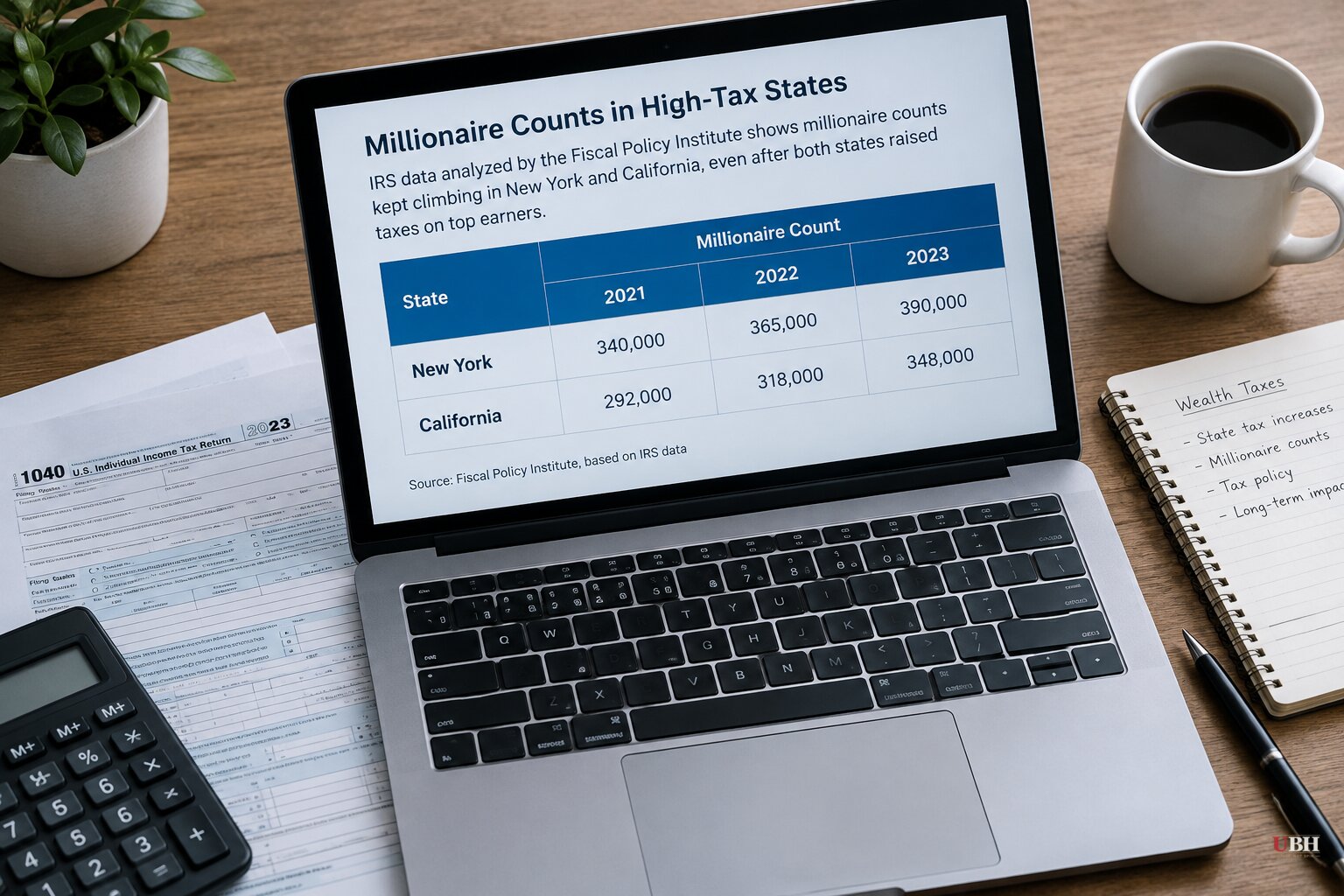
Every time a state floats a tax hike on the rich, the same warning shows up: they'll leave. Jeff Bezos left Washington state for Florida. Howard Schultz left Seattle for Miami as Washington advanced a 9.9% tax on income over $1 million. Larry Page, Sergey Brin, Mark Zuckerberg, Peter Thiel and Larry Ellison have all been tied to moves out of California.
The anecdotes are real. The aggregate data tells a different story.
What the IRS numbers actually show
According to a Fiscal Policy Institute analysis of IRS Statistics of Income data, the states with the most progressive tax systems, California, Connecticut, Massachusetts, New Jersey, New York and Washington, D.C., have the highest concentration of millionaires per filer in the country. That concentration has grown since 2010, not shrunk.
New York is the clearest test case. The state's Department of Taxation and Finance counted 57,126 million-dollar earners in 2016, rising to 68,068 by 2019. In 2021, New York raised its rate on income over $1 million, the exact policy critics said would drive the wealthy out. Instead the millionaire count jumped 21% to 84,366 that year, and the number of millionaires leaving the state actually fell, from nearly 2,000 the year before to 1,453, per the Fiscal Policy Institute's own fact sheet.
"We're just really not seeing any declines in the millionaire population in New York State," Emily Eisner, the Fiscal Policy Institute's executive director, told Fortune. Her explanation: "the taxes aren't really high enough for them to be sensitive to them." The Fiscal Policy Institute is a progressive-leaning fiscal policy nonprofit that has advocated for taxes on high earners, so its framing of the data comes from an interested party, even if the underlying IRS figures are neutral.
Eisner also made a point that gets lost in the billionaire headlines: the real squeeze falls on families earning $100,000 to $500,000 a year in places like New York City. "You're making a lot of money relative to the population of the United States, but in New York City, you don't feel rich at all," she said. "You still feel squeezed."
Florida, meanwhile, saw a notable decline in its share of the nation's millionaires in 2023, the most recent year of IRS data available, even as it absorbed high-profile transplants like Bezos and Schultz.
California has a similar precedent. Ahead of the state's 2012 vote to raise its top rate to 13.3%, the same top marginal rate California still carries today, opponents said the wealthy were already packing up. A Stanford-led study found roughly 138 high-net-worth Californians left the state in the year after the tax passed, a tiny fraction of the state's wealthy population.
The wealth-tax counterargument
But income taxes and wealth taxes are not the same animal, and that distinction matters for what's coming next in California.
An economist writing as a contributor to the LA Times, who says he favors higher taxes on the ultra-wealthy in principle, pointed to research he conducted with Daniel Wilson of the Federal Reserve Bank of San Francisco tracking the Forbes 400 list over two decades. That research found that when a state enacts an estate tax, the closest real-world analogue to a wealth tax, roughly 1 in 5 billionaires relocate to another state. That's a materially different sensitivity than what the IRS millionaire data shows for ordinary income taxes.
The contributor argued this matters because California voters are deciding on Proposition 40, a proposed billionaire wealth tax, in November. He warned that several prominent tech entrepreneurs had already established residency elsewhere ahead of the vote, and that the bigger risk isn't today's billionaires leaving but tomorrow's Google or biotech founder choosing to start a company in Texas instead. He cited Google's roughly 85,000 California employees and an estimated $32 billion a year in wages and stock compensation the company distributes in the state as the kind of economic activity a wealth-tax exodus could put at risk.
Taxing wealth directly, rather than income, may behave differently than the income-tax data the Fiscal Policy Institute cites. The IRS figures Fortune reported on speak to income taxes on millionaires broadly. They don't settle what happens when a small number of ultra-wealthy individuals face a tax on accumulated wealth itself, which is what Proposition 40 proposes and what the estate-tax research actually measured.
Separately, Reuters reported that a rising share of Americans now support raising taxes on corporations and billionaires, reflecting broader public sentiment even as the mobility debate plays out among economists.
What happens next is straightforward: California voters decide on Proposition 40 in November. Whether the wealth-tax-specific mobility data holds up in practice, or whether California's outcome tracks more like New York's income-tax experience, will be the real test of which set of numbers actually predicts behavior.
Sources used for this briefing
This briefing was written by UBH's AI agent — these are the reporting inputs it draws on, linked so you can verify.


