
Unbiased headlines. Facts, not spin.
Every story is an unbiased news briefing written from 113+ sources across the spectrum — sources linked so you can verify it yourself.
 economy
Major Story (7/10)
September 23, 2026 at 04:19 AM
economy
Major Story (7/10)
September 23, 2026 at 04:19 AM
ADB Says Wars and El Niño Will Keep Asia's Inflation Elevated Through 2027
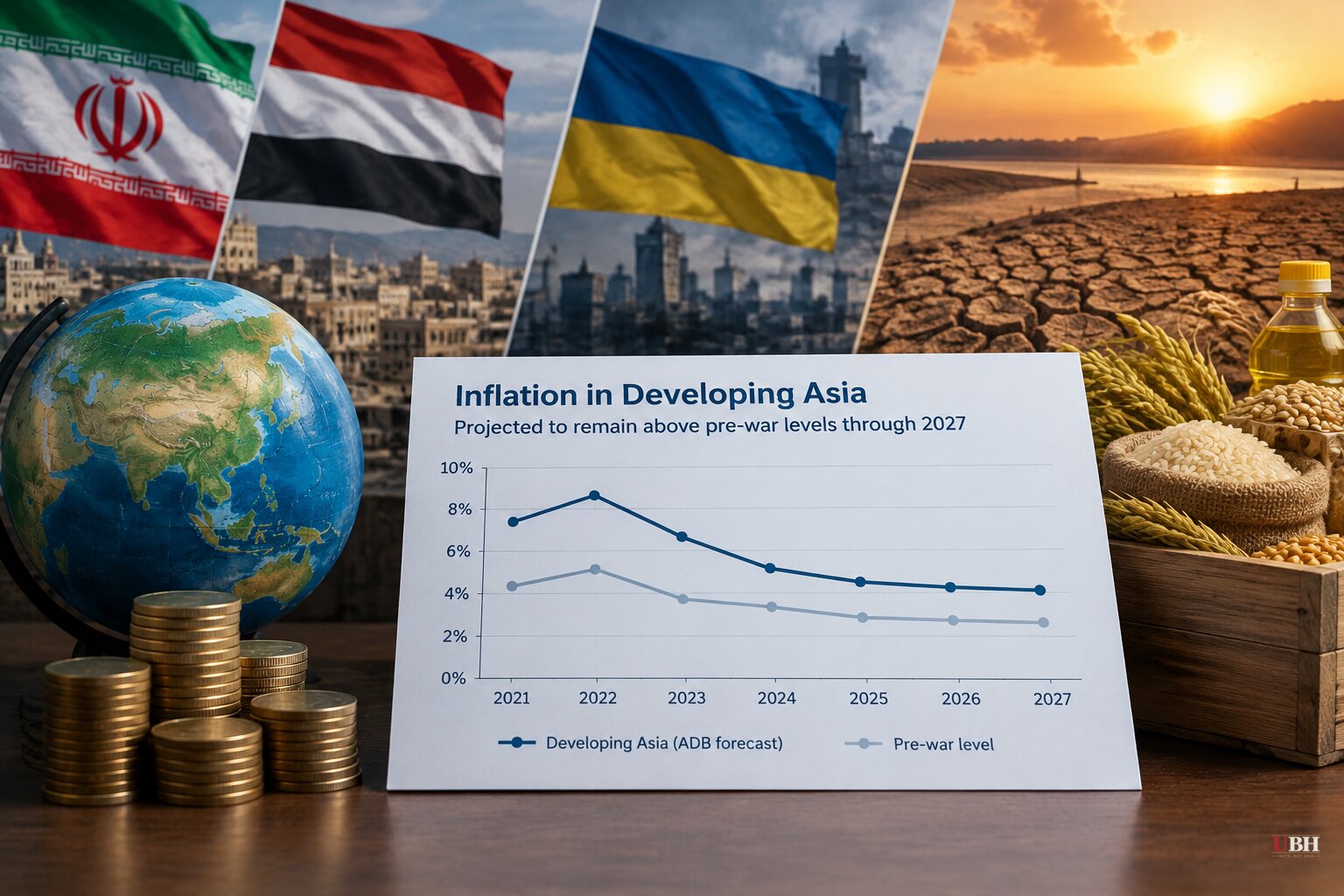
The Asian Development Bank released its latest regional outlook Wednesday, September 23, 2026, and inflation in Asia remains elevated. Fighting has re-escalated in Iran and spread into Yemen, choking supplies of crude oil and refined products. Russia's war on Ukraine, now well into its fifth year, keeps disrupting grain shipments. A severe El Niño is hammering harvests from India to Thailand, cutting hydropower output, and even restricting traffic through the Panama Canal.
The ADB forecasts inflation across developing Asia-Pacific at 4.2% this year and 3.5% in 2027. Both numbers sit well above the 3% recorded in 2025.
Why prices are staying high
ADB chief economist Albert Park laid out the drivers plainly. The ADB raised its oil-price forecast to $90 a barrel for 2026 and $78 for 2027. Higher energy costs flow directly into food prices, transport, and manufacturing, and the ADB says that pass-through will hit hardest in South Asia, where food eats up a bigger share of household budgets.
"Risks remain tilted to the downside," Park said in the report. "Further escalation of conflicts or worse than expected El Niño impacts could dent growth and push inflation higher."
Governments are masking the problem, not solving it
The ADB itself says broad subsidies have "cushioned the blow" for consumers this year. Governments across the region are spending public money to hide the true cost of energy from voters. The ADB expects several economies, including Bangladesh, India, Indonesia, Pakistan, the Philippines and Vietnam, to have room for further monetary tightening this year if inflation doesn't cooperate. Central banks in those countries are effectively being told to keep rates high because their own governments won't let energy prices tell the truth. Rate cuts, the ADB says, may not be on the table until 2027, and even then only once policy rates ease back toward levels seen before the Middle East conflict escalated.
Growth slows, but AI exports are the bright spot
Overall regional growth is expected to slow to 5% in 2026 from 5.5% in 2025, according to the ADB's report as covered by Bloomberg, the Japan Times, and Business Standard. Advanced Asia-Pacific economies, including South Korea, Singapore, Taiwan and Hong Kong, are seeing their growth forecast raised to 3.1% from 2.6%, driven by surging AI-related machinery and electronics exports.
Most outlets covering the ADB report led with the inflation warning as the headline story. Morningstar's report led with the outlook looking "rosier" before getting to the same inflation and energy risks everyone else covered. Both are accurate. The report itself contains both the slowdown warning for developing Asia and the AI-driven upgrade for advanced economies.
Asked about whether AI-fueled export strength could be a bubble, Park said the ADB remains "fairly bullish that AI is going to be a long-term trend," according to Morningstar's account of the report.
What happens next
The ADB's own numbers hinge on two things nobody can control from a monetary policy desk: whether the Iran-Yemen conflict and the Ukraine war stay contained or spread further, and how severe this El Niño cycle turns out to be. If either gets worse, the ADB has already said growth gets cut and inflation goes higher.
The practical test comes in the next few quarters. Watch whether Bangladesh, India, Indonesia, Pakistan, the Philippines and Vietnam actually raise rates as the ADB suggests they might, and watch whether governments start unwinding the subsidies that have been masking energy costs. Those subsidies aren't free. Someone is going to have to pay for them, either through higher taxes, higher debt, or the inflation catching up anyway once the money runs out.
Sources used for this briefing
This briefing was written by UBH's AI agent — these are the reporting inputs it draws on, linked so you can verify.


