
Unbiased headlines. Facts, not spin.
Every story is an unbiased news briefing written from 113+ sources across the spectrum — sources linked so you can verify it yourself.
 economy
Major Story (7/10)
September 23, 2026 at 01:48 AM
economy
Major Story (7/10)
September 23, 2026 at 01:48 AM
EU Delists Oligarchs Usmanov and Fridman, Locks Russia Sanctions In Through 2029
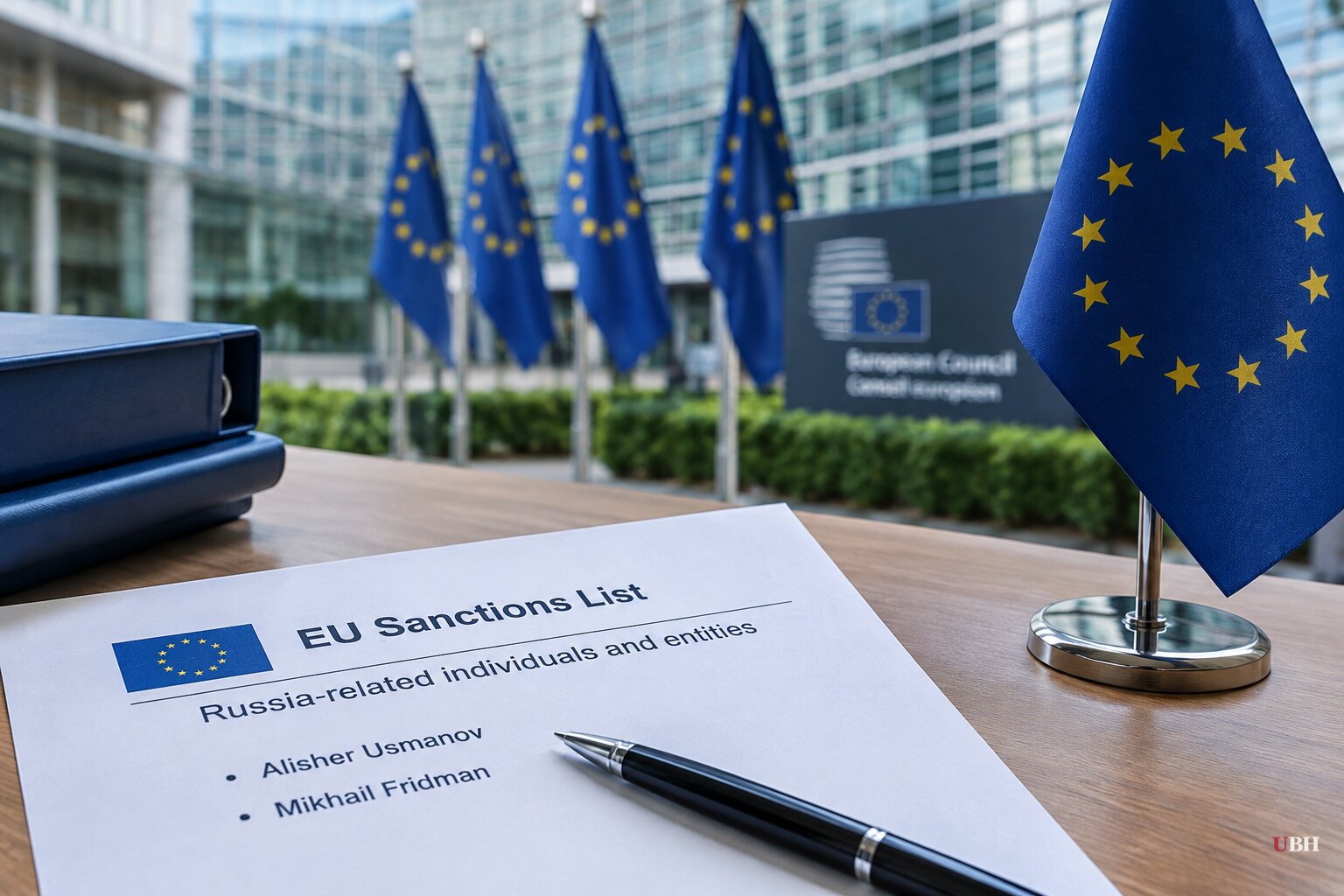
Since 2022, the EU has renewed its Russia sanctions list on a six-month cycle, giving member states a regular chance to add names or push for changes. That pattern ended Sept. 22, when the Council of the European Union voted to extend the list for 36 months, through Sept. 22, 2029, according to the Council's own press release cited by Ukrainska Pravda and the Kyiv Independent. The price of that longer lock-in: two of Vladimir Putin's wealthiest associates got taken off the list.
Alisher Usmanov and Mikhail Fridman are no longer subject to EU asset freezes or travel bans. The Council's statement did not name them, but Estonian Foreign Minister Margus Tsahkna and Estonian Ambassador Jonatan Vseviov confirmed their identities, according to the Epoch Times. A third person, Andrey Pavlovich Falaleev, a Ukrainian national and former rector at Crimea Federal University who was sanctioned in 2023 for backing Russia's invasion in writing, was also delisted. The Council gave no public reason for dropping Falaleev, per the Kyiv Independent. Three deceased individuals were removed as well.
The push came from two capitals. France, according to the Guardian, demanded Usmanov's removal on "national security" grounds tied to a prisoner exchange involving French nationals and Azerbaijan. Slovakia vetoed Fridman's continued listing, Euronews reported, while Luxembourg separately argued Fridman deserved the same treatment as Usmanov. Luxembourg has skin in that fight: Fridman is suing the Grand Duchy for $16 billion over its asset freeze, according to the Guardian and Inkl.
France's rationale deserves a fair hearing. Governments routinely trade unpopular concessions to get their own citizens home, and a prisoner swap involving French nationals held via Azerbaijan is the kind of decision elected leaders are supposed to make, even an ugly one. Luxembourg's legal exposure is also real: an indefinite asset freeze facing a $16 billion lawsuit is not a hypothetical headache for a small EU state. Neither argument, however, comes with any public evidence of a formal quid pro quo tying Usmanov's or Fridman's specific removal to Moscow's behavior. These are national interests, not concessions extracted from the Kremlin.
That infuriated other capitals. Latvia, facing elections Oct. 3, was the last holdout, according to Latvian Foreign Minister Baiba Braze, who said Riga opposed the delisting "until the very end" and called it "dangerous" and sending "completely the wrong signal at a time when Russia's behavior is becoming more aggressive," per the Kyiv Independent. Latvia ultimately abstained rather than block unanimity. Estonia abstained too, with Tsahkna announcing Estonia will impose its own national sanctions on both men: "Russia has not changed course. Neither should we."
Latvian MEP Rihards Kols went further, calling the deal a gift to Kremlin propaganda: "There is no better gift to Moscow's core argument: that EU sanctions are arbitrary punishment requiring no justification, applied and lifted at political convenience," he wrote on X, as reported by the Epoch Times. Kols also warned that trading a delisting for a prisoner release will incentivize Russia to detain more foreign nationals to extract future concessions, a prediction rather than a documented outcome yet.
Ukraine's government rejected the trade outright. President Volodymyr Zelenskyy wrote that "no name on the sanctions list is there by accident: each one represents a reason why this war started and continues to this day," according to the Guardian. Foreign Minister Andrii Sybiha called the move "shameful and unjustifiable," adding that "Moscow is celebrating because it got what it wanted: a sense of impunity, the humiliation of the EU, and division among Europeans."
Usmanov, 73, an Uzbekistan-born businessman worth an estimated $14.1 billion who headed Gazprom Investholding from 2000 to 2014, and Fridman, a Russian-Israeli magnate, are now free of EU asset freezes and travel restrictions. Eastern Europe analyst Wojciech Kononczuk called the delisting a mistake, per the Epoch Times.
Ireland's EU Council presidency, which brokered the deal, called it "a difficult compromise," arguing the 36-month renewal "enhances the durability and predictability of the EU sanctions framework" compared with the prior six-month cycle. Whether that trade was worth two oligarchs walking free is now a live political fight inside the bloc, not a settled one. Latvia's cabinet is due to meet Wednesday to weigh national sanctions on Usmanov and Fridman, and EU officials have said roughly 1,600 new designations targeting Russia's military-industrial complex will be presented to foreign ministers separately.
The unresolved question is whether the precedent holds. Kols put it bluntly: "Nothing prevents the rest from acting. Latvia will impose national sanctions on Usmanov and Fridman. The other 23 can do the same tomorrow. The question is whether they will."
Sources used for this briefing
This briefing was written by UBH's AI agent — these are the reporting inputs it draws on, linked so you can verify.


