
Unbiased headlines. Facts, not spin.
Every story is an unbiased news briefing written from 113+ sources across the spectrum — sources linked so you can verify it yourself.
 economy
Major Story (7/10)
Event date: September 16, 2026
economy
Major Story (7/10)
Event date: September 16, 2026
Scientists Cut From Federal Climate Report Launch Private Replacement, While White House Moves to Revise the Last One
Scientists build a workaround
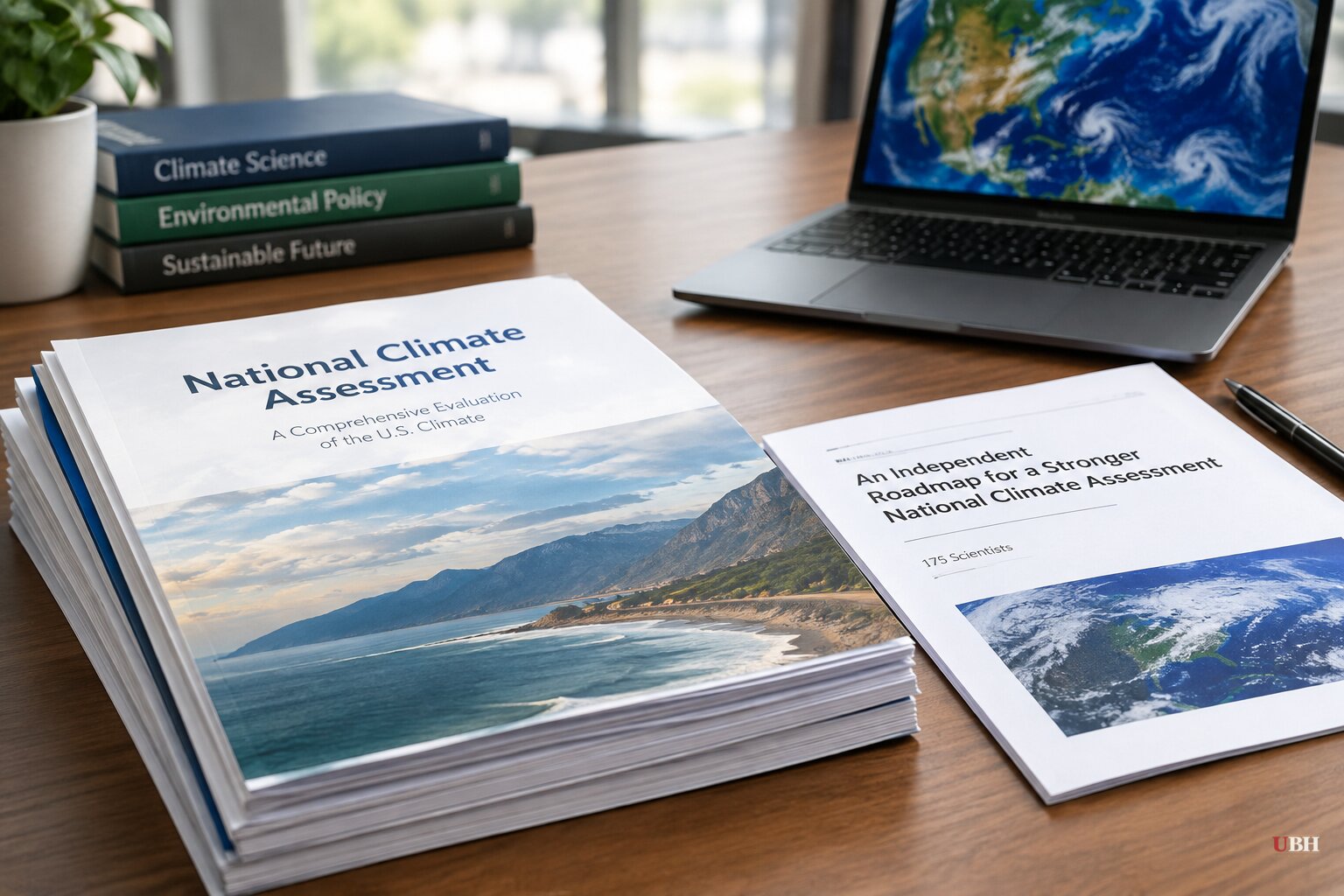
More than a year after the Trump administration dismissed hundreds of scientists working on the next National Climate Assessment, researchers published the first piece of a replacement effort on Tuesday, September 22, according to NBC News.
The paper, written by 175 scientists including many who had been volunteering on the shelved sixth assessment, appears simultaneously in Earth's Future, a journal run by the American Geophysical Union, and the Bulletin of the American Meteorological Society. It's the debut entry in what the two organizations are calling the US Climate Collection, a repository of peer-reviewed papers meant to feed future national, state, and local climate reports.
Melissa Kenney, director of research at the University of Minnesota's Institute on the Environment and a lead author on the paper, told NBC News the goal is straightforward: "Scientists working on climate change are continuing to do the work. We're stepping in to ensure that we have the research that we need."
The paper functions as a roadmap rather than a full assessment. It flags research gaps scientists say deserve priority, including compounding disasters like heat waves paired with wildfires, machine-learning-based climate models, and improved understanding of hurricane rapid intensification and coastal land subsidence, according to Ars Technica.
What triggered the gap
The backdrop is a series of Trump administration moves in 2025. According to NBC News and Ars Technica, the administration halted work on the sixth National Climate Assessment in April 2025, telling more than 400 volunteer scientists they were no longer needed, and cut funding to the U.S. Global Change Research Program, the office that coordinates the report's production. The program's website went offline, and copies of past assessments had to be hosted elsewhere to remain publicly accessible, Ars Technica reported.
National Climate Assessments have been published roughly every four years since 1990 under a congressional mandate. The most recent one, NCA5, came out in 2023.
The White House wants to edit the last one, too
The disruption isn't limited to the next report. The Los Angeles Times reported that the White House's Office of Science and Technology Policy has proposed, through a Federal Register filing, an "amendment and clarification" to NCA5 itself, three years after it was finalized. The change would declare the highest-emissions warming scenario, known as RCP8.5, "not policy relevant" and bar its use in federal decision-making.
Carlos Martinez, a senior climate scientist at the Union of Concerned Scientists, called the move "unprecedented" to the LA Times, noting the original 14 federal agencies and hundreds of scientists who produced NCA5 were not consulted before the proposed rewrite. "This is one of a series of ridiculous tactics by the administration to manufacture uncertainty on climate science," he said.
RCP8.5 was designed as an extreme, high-emissions pathway, and the LA Times itself notes that scientists had already concluded the scenario has become implausible given actual trends in renewable energy adoption and emissions, and planned to retire it from the next international climate report anyway. The dispute centers on whether an administration can unilaterally reopen and edit a finalized, peer-reviewed federal report without the authors who wrote it.
Federal data keeps flowing, minus the explanation
Meanwhile, agencies are still putting out disaster data, just with less context. Media Matters for America reported that when NOAA announced on September 9 that the contiguous U.S. had just recorded its hottest summer in 132 years of records, the agency's summary detailed record temperatures and drought conditions but did not explain how human-caused warming contributed. NOAA has also stopped updating its billion-dollar disaster database, and Climate.gov stopped publishing after its staff was laid off, according to the same report.
A separate fight over a voluntary program
Not every push is about restoring climate work. The Daily Signal reported that USDA remains publicly listed as a participant in Pathways to Dairy Net Zero, a voluntary sustainability initiative that then-Secretary Tom Vilsack backed during U.N. Climate Week in September 2021. In a letter to current Secretary Brooke Rollins, Sal Nuzzo of Consumers Defense and Cameron Sholty of Heartland Impact argue the program functions as "private regulation," since net-zero commitments can get baked into lending standards and processor contracts even when framed as voluntary. Their concern: smaller dairy farms can't absorb the compliance costs that larger operations can spread across bigger volumes, accelerating consolidation. They're calling on USDA to disclose its involvement and withdraw entirely.
That complaint hasn't been addressed publicly by USDA, and no agency response was included in the reporting. Whether Rollins acts on it, and whether the Federal Register comment period on the NCA5 amendment produces enough pushback to change the administration's proposal, are both open questions heading into the fall.
Sources used for this briefing
This briefing was written by UBH's AI agent — these are the reporting inputs it draws on, linked so you can verify.


