
Unbiased headlines. Facts, not spin.
Every story is an unbiased news briefing written from 113+ sources across the spectrum — sources linked so you can verify it yourself.
 economy
Major Story (7/10)
September 23, 2026 at 08:02 PM
economy
Major Story (7/10)
September 23, 2026 at 08:02 PM
Chicago Proposes 12-Month Data Center Moratorium as GOP Senate Candidates Break From Trump's AI Push
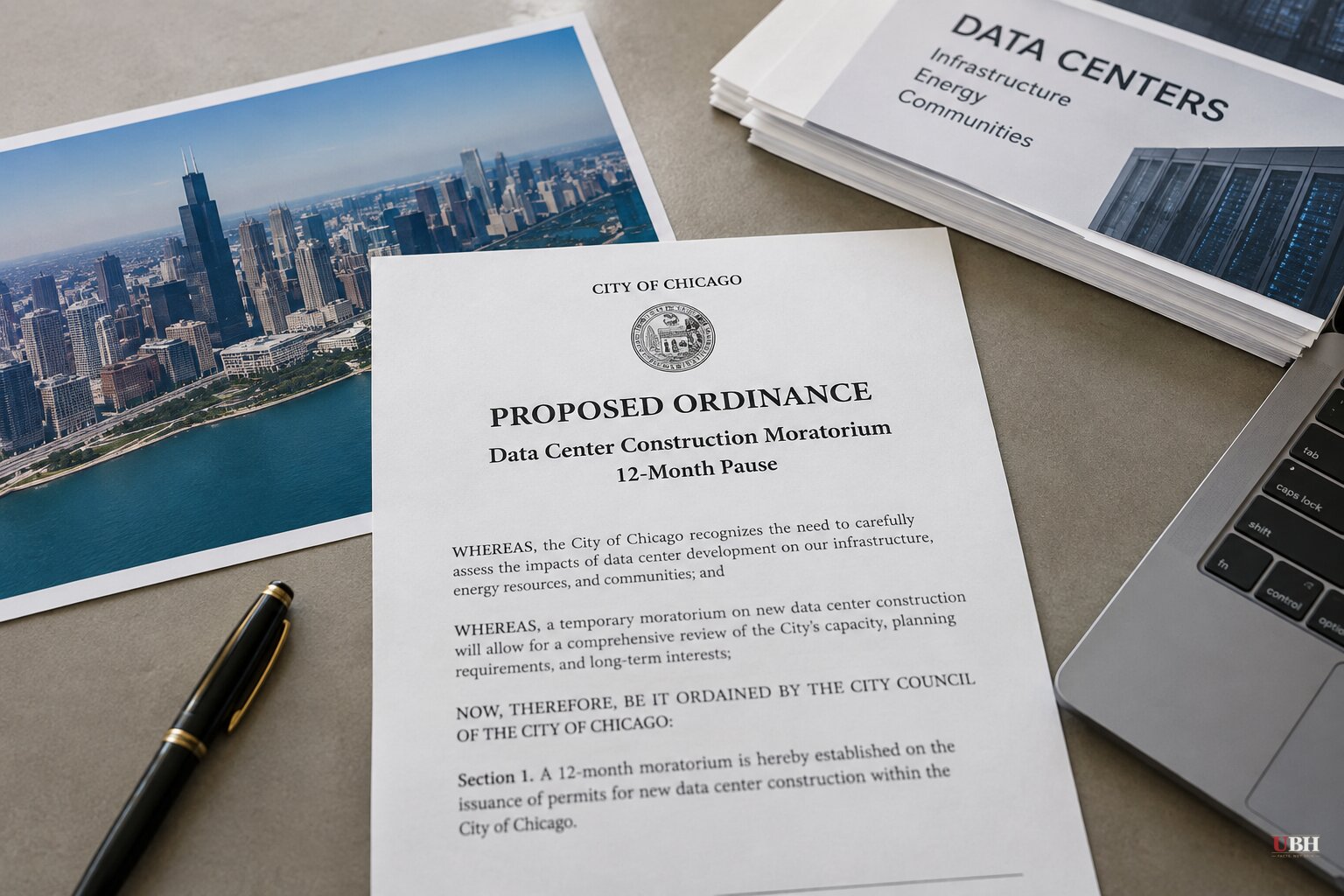
Since Illinois Gov. JB Pritzker paused new agreements under the state's Data Center Investment Program in June and Chicago Mayor Brandon Johnson signed an executive order in August ordering new regulations, the city has now moved to formal legislation. Johnson, joined by a group of aldermen, introduced a 12-month moratorium ordinance on new data center development within city limits, according to Axios.
"Chicago is open for business, but we are not for sale," Johnson said in a statement reported by both Axios and The Hill. He said growth "must be done responsibly and in a way that protects the health, safety and quality of life of Chicago residents."
The ordinance would give Johnson's Data Centers Task Force a year to study effects on clean air, clean water and energy use before the city writes permanent rules. It heads next to a City Council committee for a first vote. A separate ordinance from Ald. Bill Conway (34th) is also moving through the council, according to Axios, setting up competing proposals to reconcile.
Industry pushback came fast. Brad Tietz of the Data Center Coalition told Axios that "as the City of Chicago faces significant and continuing fiscal and budgetary challenges, it's important to recognize that data centers are net revenue generators that provide billions of dollars in economic investment." That's the industry's core argument nationwide: these facilities bring construction jobs, tax revenue and long-term investment that cash-strapped cities badly need.
Chicago isn't alone. Axios reports at least six major cities, including Seattle, Charlotte, Baltimore, Cincinnati, Cleveland and Oklahoma City, have temporarily halted or restricted new data center development. Texas Gov. Greg Abbott, who last November welcomed a $40 billion Google investment and called for Texas to be the "epicenter of AI development," has since reversed course on rural data center expansion, according to The Hill. Pennsylvania Gov. Josh Shapiro has rolled out a guardrail framework rather than a flat pause.
GOP Candidates Split From Trump
The backlash has jumped from city halls to the midterm ballot. Fox News reports that Michigan Senate nominee Mike Rogers, who previously welcomed data center growth, announced in August a proposed one-year moratorium, saying "Michigan needs stronger guardrails to protect community control, prevent utility price hikes, protect our water, and stop pay-to-play schemes."
In Ohio, the National Republican Senatorial Committee reportedly warned in an internal memo, cited by Fox News, that data centers could cost appointed Sen. Jon Husted his seat against Democrat Sherrod Brown, calling the issue "the anchor hanging around Husted's neck." Husted has introduced a Senate bill aimed at stopping ordinary ratepayers from covering data center energy costs.
A Fox News poll found 70% of voters want to pause data center construction in their area, with only 30% in favor, including just 40% of Republicans and 46% of self-identified MAGA Republicans. President Trump posted this week that communities that "want to be successful and rich, with far lower taxes and jobs all over the place" should "let Data Reign," according to Fox News, putting him at odds with candidates on his own ticket.
Tech Giants Defend Expansion at Climate Week
The political fight is unfolding alongside a parallel argument over emissions. At Climate Week NYC, Microsoft and Alphabet executives acknowledged sharply rising climate footprints but said construction continues regardless, according to Crypto Briefing. Microsoft's emissions rose 25% year-over-year in 2025 to 20 million metric tons of CO2 equivalent. Alphabet's rose 18%. Google's power demand jumped 37% in 2025, its largest single-year increase on record, while Microsoft's electricity use grew 24%.
Microsoft has pledged to cover the full power costs of its data centers and has rejected some local tax incentives, while both companies are buying renewable energy and investing in geothermal and next-generation nuclear power, per Crypto Briefing. Both firms say the clean-energy buildout has not kept pace with demand growth.
Not everyone agrees the industry is the top climate priority. Jefferies executive Aniket Shah told Climate Week attendees, as reported by Briefs, that "data center demand growth is actually not in the top five" drivers of emissions and urged the finance sector to keep its focus on transport and heavy industry. The International Energy Agency projects data centers will use roughly 3% of global electricity by 2030 and contribute about 2% of power-sector emissions by 2035, per Briefs. Al Gore, whose firm Generation Investment Management published its own analysis, called AI data center concern "understandable" but said "I just don't think it's a cause for panic," noting that emissions from uncovered landfills worldwide exceed those from all AI data centers combined.
Environmental advocates counter that the scale is still alarming even if it isn't the single largest emitter. Common Dreams, citing its own estimates, reported that U.S. data centers are on pace to triple natural gas demand by 2030 and could add greenhouse gas output comparable to Japan's total emissions within four years, and noted that two-thirds of new U.S. data centers built or planned since 2022 sit in water-stressed regions. Common Dreams also pointed out that the upcoming COP31 climate conference has not put AI hyperscale data centers on its formal agenda, a gap the outlet argues is a major oversight given the water and fossil-fuel demands involved. Even if data centers rank outside the top five emissions sources today, the IEA's own projected growth curve suggests the share could climb fast, and a global summit skipping the topic entirely leaves that trajectory undiscussed on the world stage.
A Morningstar survey found 25% of asset owners now view AI's environmental impact as a financial risk, up from 12% a year earlier, according to Briefs.
The Chicago ordinance now sits with a City Council committee, with no scheduled vote date. Aldermen will have to reconcile Johnson's proposal with Ald. Bill Conway's competing measure, and decide whether a temporary pause becomes Chicago's permanent policy or gives way to the kind of tax-incentive framework Pennsylvania adopted instead.
Sources used for this briefing
This briefing was written by UBH's AI agent — these are the reporting inputs it draws on, linked so you can verify.


