
Unbiased headlines. Facts, not spin.
Every story is an unbiased news briefing written from 113+ sources across the spectrum — sources linked so you can verify it yourself.
 economy
Major Story (8/10)
September 23, 2026 at 04:35 PM
economy
Major Story (8/10)
September 23, 2026 at 04:35 PM
Global Debt Tops $365 Trillion as IIF, OECD and IMF Warn Borrowing Binge Is Unsustainable
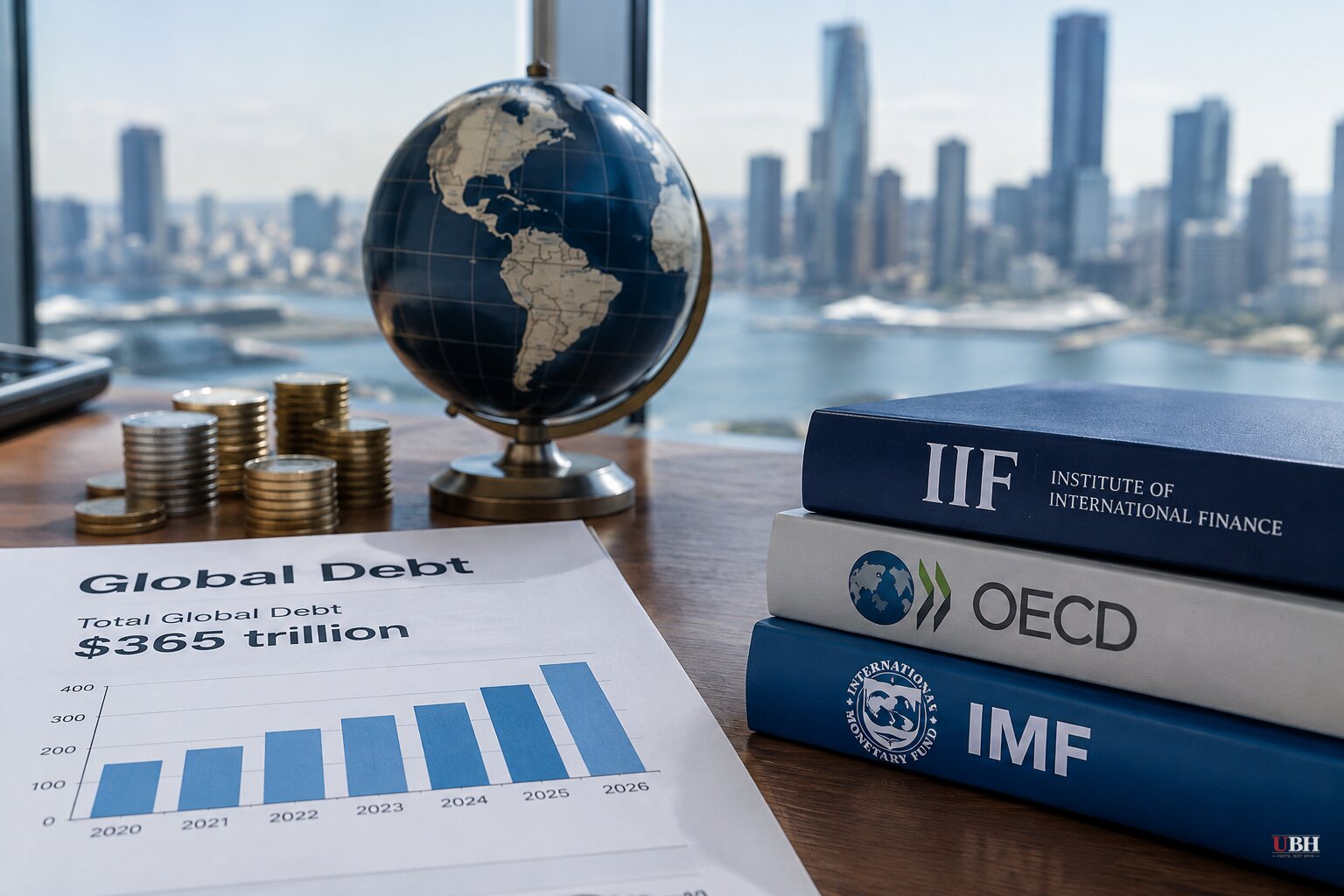
Global debt just hit its sixth consecutive quarterly record. The Institute of International Finance's Global Debt Monitor, published Wednesday, September 23, 2026, puts total worldwide borrowing at more than $365 trillion, spread across government, household, corporate and financial sectors in over 100 economies.
The numbers on how fast that pile grew differ slightly depending on who's counting. Crypto Briefing reports global debt stood near $353 trillion at the end of the first quarter of 2026, meaning the world added over $12 trillion in roughly six months. SCMP puts the six-month increase at $10 trillion. Either way, the direction is the same: up, fast, and led by two countries.
Emerging market debt alone rose $6.5 trillion in the first half of the year to more than $110 trillion, according to the IIF's data as reported by Crypto Briefing. China drove most of that surge through a combination of local government financing vehicles, property sector obligations and central government borrowing that now dwarfs every other developing economy combined.
The United States isn't innocent here either. The IIF singled out government borrowing in both China and the US as a particular concern, with fiscal deficits elevated in the world's two largest economies. CNN Business separately reported the US is carrying a "$40 trillion mountain of debt," and the 10-year Treasury yield climbed this week to its highest level in nearly three years.
The ratio that's lying to you
Global debt-to-GDP has held steady around 305%. On its face, that looks like stability. It is not.
Crypto Briefing's reporting on the IIF data explains why: inflation has pumped up nominal GDP figures, which flatters the debt-to-GDP ratio even as the actual dollar amount of debt keeps climbing to record levels. When a ratio looks flat while the numerator explodes, that's not stability. It's a mathematical trick that inflation is playing in the government's favor right now.
Emre Tiftik, the IIF's director of global markets and policy, told SCMP that this debt wave is different from past ones. Unlike 2008 or the Covid-19 pandemic, this buildup isn't a response to a sudden shock. It's structural.
Three institutions, one warning, same day
The OECD and IMF issued parallel warnings the same Wednesday, according to The Guardian. The IIF predicted a "structurally debt-intensive future" as governments and companies compete to fund new technology and cover the costs of aging populations, and it explicitly compared the fiscal position of the US, France, the UK and Japan to that of "debt-distressed emerging market sovereigns." That's a stark comparison for four G7 economies.
OECD Secretary General Mathias Cormann told reporters that thirty-year government bond yields are now at their highest levels in 15 years or more in six of the G7 economies, driving up borrowing costs for governments, businesses and households alike. IMF Managing Director Kristalina Georgieva told the BBC that advanced economies need to actively reduce their borrowing and bring down debt levels, not just stabilize the ratio.
Emerging market credit spreads have stayed near historical lows for parts of the year, according to Crypto Briefing, and access to international capital markets has remained resilient. Governments and corporations in developing countries are still issuing bonds without the kind of friction you'd expect at these debt levels. The IIF's counterpoint is that low spreads today don't guarantee low spreads tomorrow, especially once inflation cools and the GDP denominator stops flattering the ratio.
The war is making it worse
CNN Business tied part of the bond market stress directly to the US-Iran war, which began in late February 2026 and has now dragged on for more than six months. The conflict has pushed up US defense spending and oil prices, feeding inflation fears that are already baked into bond yields. Diesel prices have spiked 51% since the war began, and last month was the most expensive August for gas prices in US history, according to AAA data cited by CNN.
Germany's 10-year yield has hit levels unseen since 2011. The UK's 30-year yield hit its highest point since 1998. Japan's 10-year government bond crossed 3% on September 1, 2026, for the first time since October 1996. Fundstrat strategist Hardika Singh told CNN, "It feels like there is no end to the inflation problem, the war or the deficit in the near term."
UK Prime Minister Andy Burnham, in New York this week for the UN General Assembly, denied reports that he had been shocked by the state of Britain's public finances since taking power in July. "It's not the case that we were surprised when we came in, not least because I was in access talks and understood very clearly the position," he told reporters, according to The Guardian. "The truth of the matter is that because of the situation in the Middle East, the position changed, and has changed over the time I've been in. That's just the reality of the situation that we're in."
The IIF flagged the obvious political problem: with elections coming up in multiple countries, belt-tightening isn't popular with voters, and "the risk is that already-unsustainable debt trajectories continue to deteriorate." Whether any G7 government actually cuts deficits before the bond market forces the issue remains unclear.
Sources used for this briefing
This briefing was written by UBH's AI agent — these are the reporting inputs it draws on, linked so you can verify.


