
Unbiased headlines. Facts, not spin.
Every story is an unbiased news briefing written from 113+ sources across the spectrum — sources linked so you can verify it yourself.
 energy
Major Story (8/10)
October 4, 2026 at 11:32 AM
energy
Major Story (8/10)
October 4, 2026 at 11:32 AM
Iraq Routes Crude Past Hormuz for First Time in Decades as Trump Tells Iran 'Easy Way or Hard Way'
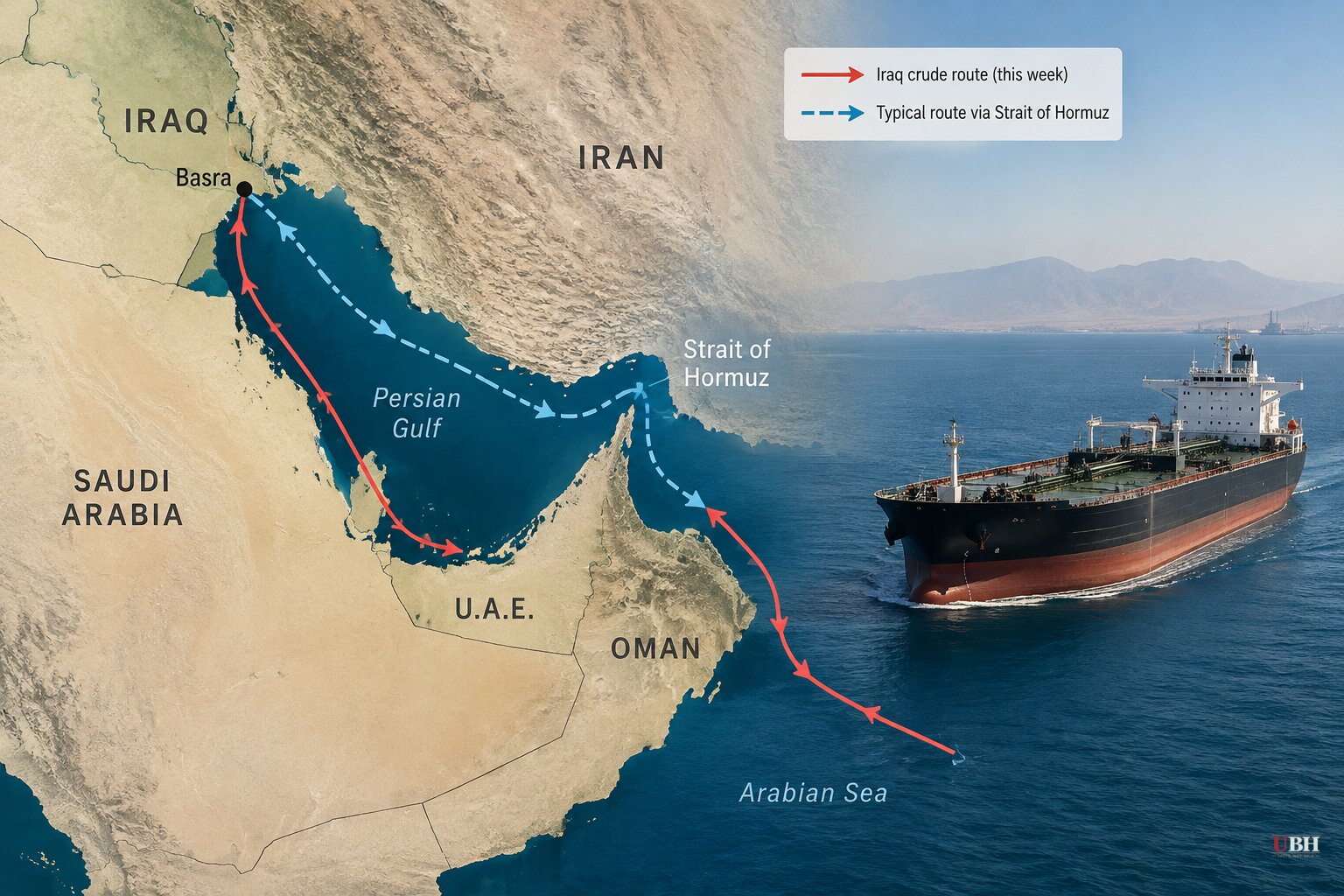
Since the US-Israel war against Iran began in February, oil flows through the Strait of Hormuz have swung from near-total shutdown to a partial, military-assisted recovery, and this week Iraq took a step its state oil company hasn't taken in decades: it sent crude past the strait entirely rather than through it.
Iraq ships oil around its own choke point
The state-run Iraqi Oil Tankers Company moved two million barrels of crude on a very large crude carrier beyond the Strait of Hormuz, according to its director general, Ali Qais Abdul Jabbar, who confirmed the shipment to the Iraqi News Agency. He said the company had been assigned this role for the first time in decades, shifting part of Iraq's sales away from the old free-on-board Basra port model so the State Oil Marketing Organisation can find better pricing elsewhere.
The company is now negotiating to buy its own specialized crude tankers, Abdul Jabbar said, to compete with regional shippers and rebuild a fleet that was largely destroyed during past wars and sanctions.
The stakes for Baghdad are enormous. Iraq, OPEC's second-largest producer, depends on oil for at least 90% of state revenue, and roughly 3.3 million barrels a day moved through Basra and Hormuz before the war, according to figures cited by The National and Gulf News. Iran's disruption of the strait since February forced Iraq to discount crude and watch buyers demand delivery outside the waterway. Oil Minister Bassim Khudair said last month Iraq had still managed to export three million barrels a day since the start of September, with plans to push to five million once pipelines to Fishkhabour and Baniyas and new Hormuz-area terminals are finished.
The 'Hormuz Shuttle' and a fragile recovery
Iraq's move comes alongside a broader scramble by Gulf producers to keep oil moving despite Iran's effective closure of the strait. Swiss energy analyst Alexander Stahel, in a newsletter cited by Fox News, described an operation he calls the "Hormuz Shuttle": roughly 116 tankers, led by the UAE's ADNOC starting in May with eleven very large crude carriers, running crude out through an Oman-hugging shipping lane, transferring it ship-to-ship, and doubling back for more. Stahel says Saudi Aramco and Kuwait have copied the model, with Qatar and Iraq also now using it, and that U.S. Central Command patrols the lane without the destroyer-heavy escorts of past decades.
Independent data backs up that oil is moving again, though not at the scale Fox's framing of outright victory suggests. CNN reported that Hormuz flows averaged 13.1 million barrels a day last week, according to tracking firm Kpler, about 80% of the 17.1 million barrels a day that moved before the war. Total Middle East crude flows, through and around the strait, are back to 98% of prewar levels, according to JPMorgan. Kpler's Matt Smith told CNN that volume shows "Iran is losing its influence" over the strait.
But CNN's reporting, drawing on JPMorgan's Natasha Kaneva, is far more cautious than Fox's framing. Kaneva told clients two weeks ago that JPMorgan has no reliable model for what happens next, and the bank estimates global oil inventories have fallen roughly 2 billion barrels since the war started. CNN's own conclusion is that the shuttle system and military escorts are propping up a situation that "cannot last forever," since the oil is a physical product and shrinking stockpiles eventually force prices higher regardless of how the shuttle performs. That's a meaningfully different read than Fox's opinion piece, which leans entirely on one analyst's declaration that Trump and the U.S. military have already beaten Iran.
Washington and Tehran, no deal yet
President Trump told reporters this week the U.S. would decide its next move on Iran "the easy way or the hard way," without elaborating, according to Gulf News. Iranian President Masoud Pezeshkian said Tehran has adopted a "new arrangement" to manage economic pressure, also without details.
Senator Chris Murphy arrived in Qatar and planned to travel to Saudi Arabia to assess war damage and discuss future U.S. Gulf policy, Gulf News reported. Iran's Foreign Ministry spokesman Esmaeil Baghaei said Washington's latest proposal to end the war still centers on Iran's nuclear program, while Tehran wants the reopening of Hormuz addressed first. Baghaei also said the return of IAEA inspectors to Iran has not been decided by Iranian leadership, and he criticized what he called the "volatility" of U.S. demands.
A separate dispute surfaced over Iranian diplomats at the United Nations. Axios, citing an unnamed U.S. official, reported that two Iranian diplomats refused to leave the U.S. despite a State Department order for Iran's entire UN mission to withdraw after September's General Assembly. Iran's Foreign Minister Abbas Araghchi rejected that account on X, saying all Iranian diplomats who attended the Assembly left on schedule except one who had departed earlier. Neither side has produced public documentation settling the discrepancy.
Meanwhile the fighting hasn't stopped. Yemen's Iran-aligned Houthis claimed they targeted an Aramco facility in Riyadh with missiles and drones, Gulf News reported. Separate missile debris in Saudi Arabia's Asir region injured an Asian expatriate worker and damaged a prayer room and several vehicles.
What happens next hinges on two unresolved questions: whether Baghaei is right that Hormuz's status must be settled before any nuclear talks resume, and whether JPMorgan's falling-inventory math forces a reckoning in oil prices before that happens. Neither side has set a date for the next round of negotiations.
Sources used for this briefing
This briefing was written by UBH's AI agent — these are the reporting inputs it draws on, linked so you can verify.


