
Unbiased headlines. Facts, not spin.
Unbiased Headlines is an independently owned news organization. We bring you the facts, not opinions, written fresh from 110+ named sources. Sources linked so you can verify it yourself.
 energy
Major Story (7/10)
IEA Says War Will Strip 150 Billion Cubic Meters From LNG Supply Through 2030; Bain Projects Trading Profits Could Turn Negative in a 2030-34 Glut
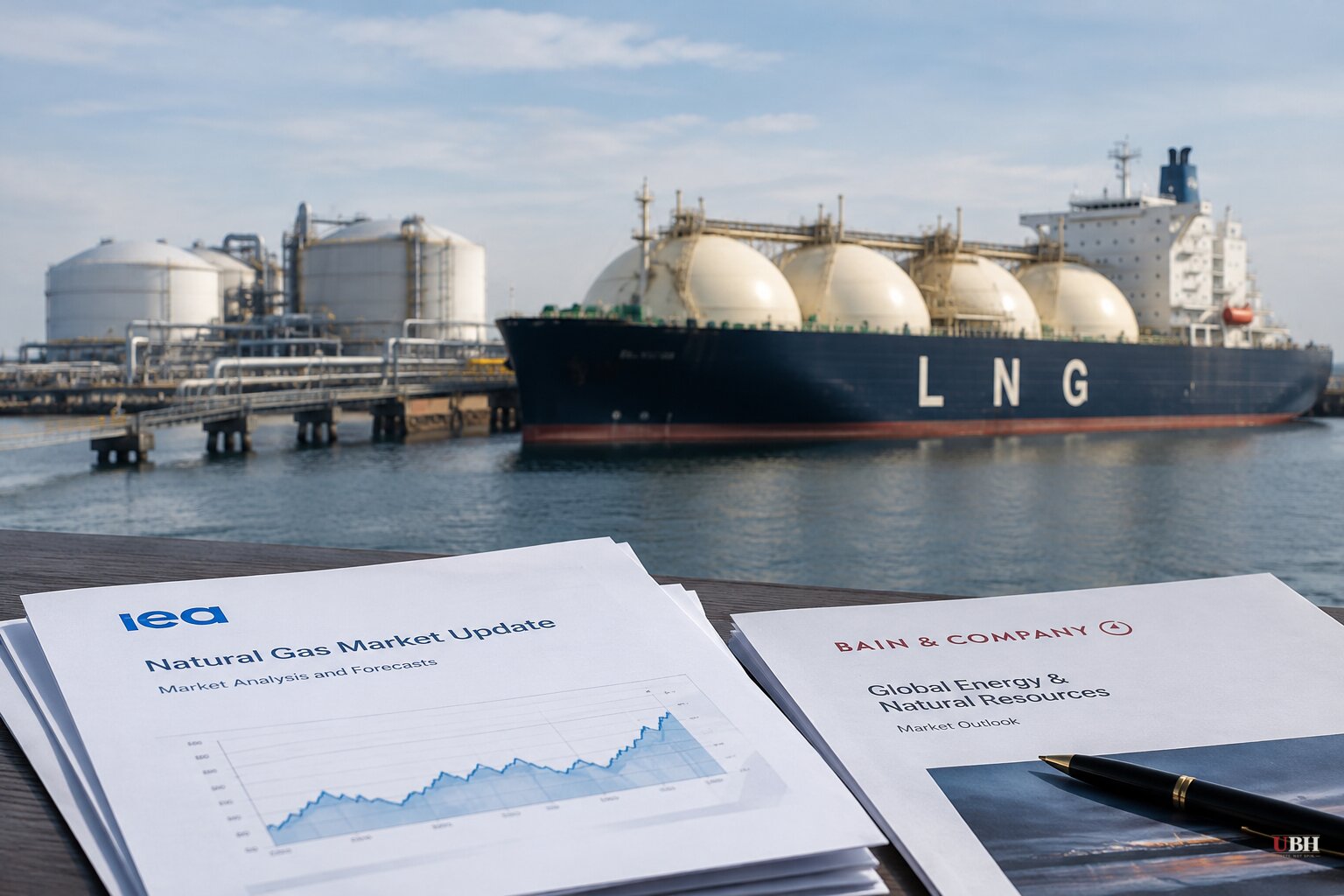
Since missile strikes in March damaged two production trains at Qatar's Ras Laffan facility, the global gas market has been rebuilt around scarcity. New analysis from the International Energy Agency and Bain & Company shows how long that scarcity lasts, and what comes after.
The IEA's supply count
The regional war will wipe about 150 billion cubic meters off global LNG supply between 2026 and 2030, the IEA said Tuesday, Nov. 17, in its Global Gas Security Review. That equals 15% of the new liquefaction capacity expected over the period. Most of the loss lands in 2026 and 2027.
The Ras Laffan damage took 12.8 million tons a year of capacity offline, roughly 17% of Qatar's total. QatarEnergy's latest assessment, cited by the IEA, is that restoring operations could take three years, a cumulative loss of more than 50 billion cubic meters.
The first train of the North Field East expansion is now expected online in the first half of 2027, later than the earlier end-2026 target. The four liquefaction projects that have reached final investment decisions since March are all in North America. None will produce before 2030.
In January, the IEA expected a sharp rise in LNG supply to ease the market in 2026. Instead, global LNG supply is on track to fall 3%, nearly 20 billion cubic meters, the biggest annual decline on record.
Demand is falling too
High prices are doing the rationing. The IEA expects global gas consumption to fall about 1.5% this year, the third annual decline since 2020. Asia-Pacific demand is forecast to drop 1.5% as power producers move toward coal. Europe is expected to fall 3% as industrial users cut back. In the Middle East, damage to production and processing facilities is expected to drive a 10% drop.
Some buyers have been priced out entirely. Pakistan twice rejected a September cargo priced at nearly $27 per million BTU, the IEA said.
Egypt has gone the other way. Its LNG imports rose 70%, or 6.5 billion cubic meters, in January-October, and net imports exceeded domestic production for the first time in July.
Europe's storage gap
EU gas storage stood at 75% at the end of October, the IEA said. That is below the bloc's 80% minimum target, which is itself a derogation from the regulation's 90%, and the lowest level since 2013.
The agency estimates the EU would need to inject 57 to 83 billion cubic meters next summer to return storage to average levels by November 2027. The five-year average injection is 50 billion.
Bloomberg has reported that May 2027 contracts are trading above November 2027 contracts, with the spread recently hitting a record. That reverses the usual pattern, in which summer gas trades at a discount to winter.
Bain: the windfall has an expiry date
Bain's analysis, published Nov. 18, looks past the shortage. It forecasts a supply glut from 2030 to 2034, with liquefaction utilization falling from 90% in 2026 to below 75%. Bain says that would be about as deep as the 2020 glut but would last five years instead of one.
Bain estimates annual gross LNG trading profits at about $20 billion in 2026. During the glut, it says, they could fall to roughly $5.5 billion. Gross profit per traded cargo could drop from about $6 million in the 2022-23 shock to about $1 million.
Then come the cancellation fees. Holders of Henry Hub-linked free-on-board volumes still owe liquefaction fees on cargoes they cannot place. If sanctioned production capacity arrives on time, about one in six U.S. cargoes could go unlifted, Bain says, costing around $5.8 billion a year. That could push the aggregate trading profit pool below breakeven.
Bain attributes the crowding to buyer behavior. Between 2022 and 2025, buyers signed long-term contracts of 15 years or more worth 211 million tons a year, more than half from U.S. projects. Spot and short-term deals rose from 34% of global LNG trade in 2019 to 43% in 2025, according to GIIGNL data.
"The LNG market is getting crowded in the middle," said Chung Yen Wong, a partner in Bain's Energy & Natural Resources practice. "Many became traders without meaning to, and this set up the next glut." Japanese companies now resell about 40% of the LNG they handle, he said, and importers in China, India and Turkey are following. "Today's LNG crunch may be traders' last windfall before the glut."
Oil producers eye the same swing
On crude, energy analyst Daniel Lacalle wrote in a Nov. 18 commentary that an oil company executive told him a month ago he was more worried about oversupply than about the geopolitical risk priced into markets. Lacalle argues that the removal of the geopolitical premium just as supply recovers could move prices faster than many expect.
He cites the IEA's finding that global oil supply rose 5.3 million barrels per day between August and October, and OPEC estimates showing OPEC+ members adding about 2 million barrels per day in October alone. He also points to the Pentagon's estimated $47.1 billion cost of the broader Iran campaign, which he says is not captured in crude benchmarks.
That is one analyst's reading, and it sits uneasily beside the IEA's gas outlook, which sees tightness persisting into 2027.
What to watch
Bain's glut timeline rests on sanctioned capacity arriving on schedule. The nearest checkpoint is the North Field East first train, now expected in the first half of 2027. The larger variable is next summer: Europe needs to inject up to 83 billion cubic meters of gas to recover, and the IEA has said Qatari capacity will take time to return even after Hormuz reopens.
Sources used for this briefing
5 links from 5 independent newsrooms (syndicated copies of the same report count once)
These are the sources it draws on, linked so you can verify.


