
Original briefings. Zero spin.
Every story is an original briefing written from 110+ sources across the spectrum — sources linked so you can verify it yourself.
 economy
Notable (6/10)
September 12, 2026 at 03:15 PM
economy
Notable (6/10)
September 12, 2026 at 03:15 PM
GM Announces Domestic Battery Push Days After Trump's DOT Blasted Ford Over China Ties
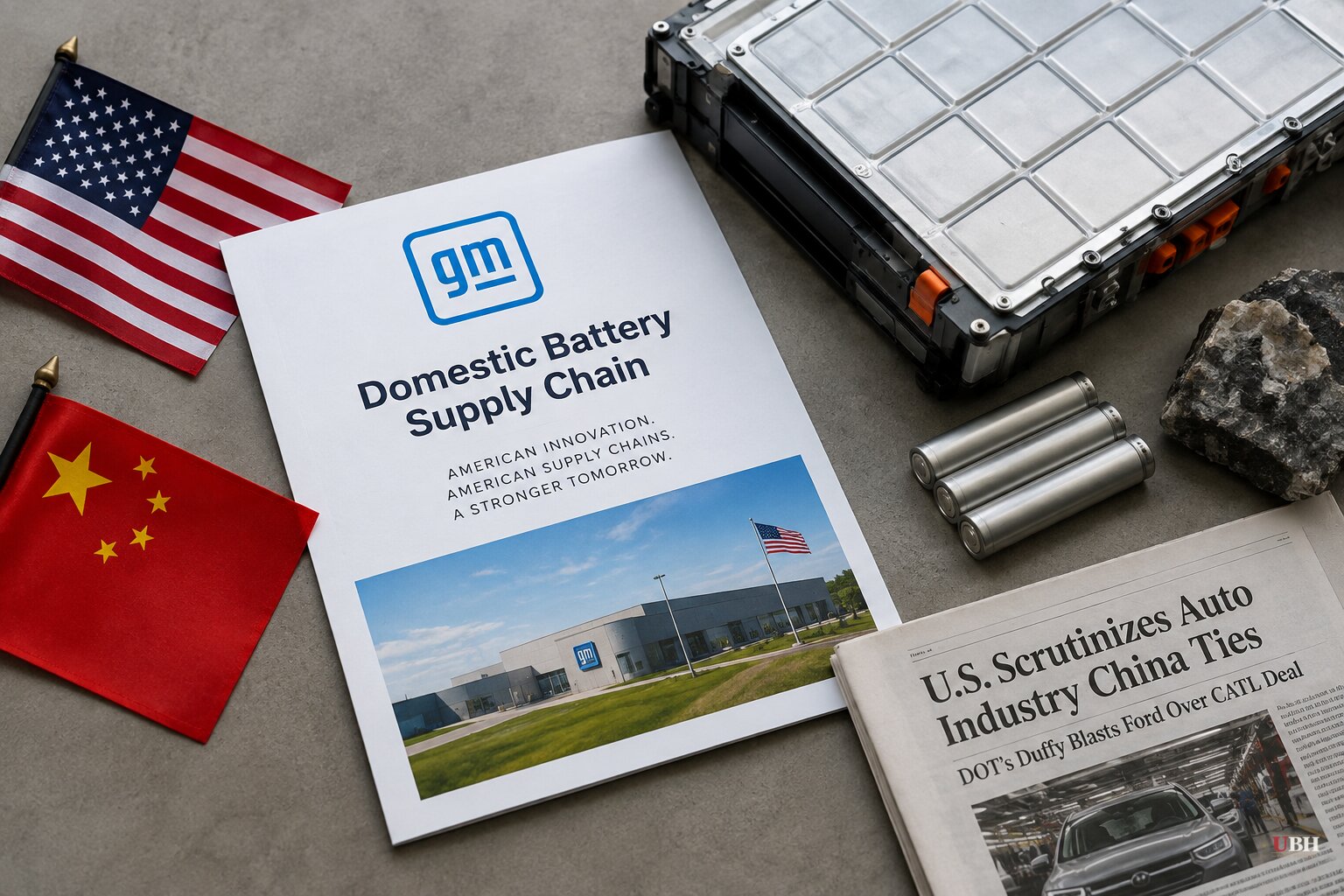
Since Transportation Secretary Sean Duffy sent his letter to Ford CEO Jim Farley on Wednesday, September 9, attacking the company's ties to Chinese battery maker CATL, the fallout has widened into a fight over who's really driving U.S. China-car policy, and why Ford got singled out.
General Motors is now stepping into the spotlight with its own announcement. GM vice president of battery and sustainability Kurt Kelty told CNBC the company is building what it hopes will be a fully domestic battery supply chain within two to three years. GM has partnered with Denver-based startup Peak Energy to develop sodium-ion battery cells, aiming to cut reliance on Chinese-controlled materials like lithium and ferrous sulfate. Commercial production is targeted for around 2029, according to Kelty.
GM's announcement landed just days after Duffy's letter accused Ford of "profound concern" over its licensing arrangement with CATL to build lithium iron phosphate batteries at its BlueOval Battery Park in Marshall, Michigan, according to CBT News. Duffy also flagged Ford's partnerships with Chinese firms Geely and BYD, and criticized Ford's plan to keep building the Lincoln Nautilus in China until 2030.
Ford Pushes Back Hard
Ford says it never got the letter directly from the DOT and learned about it through media inquiries, according to autoguide. The company called Duffy's letter "a wrongheaded attempt to capture headlines at the expense of a company that has done more for American manufacturing than virtually any other in the nation's history."
Ford's rebuttal, detailed by CBT News, points out it wholly owns and operates the Marshall plant through a subsidiary, and that the CATL arrangement is a technology-licensing deal, not a joint venture or foreign-owned facility. Farley gave an interview to The Wall Street Journal to make the same case, according to InsideEVs.
The pushback got an unlikely assist from the White House itself. By Thursday evening, the administration posted on X that "Ford is a GREAT American company and has done a tremendous job on increasing investments domestically and shoring production back to the U.S.," according to autoguide. This statement sits awkwardly next to Duffy's own letter from the same week.
Questions About GM's Role
Reporting from journalists Eric Starkman and Phoebe Wall Howard, cited by autoguide, points to General Motors as a possible force behind the pressure on Ford. GM CEO Mary Barra lobbied Congress in 2023 warning that Chinese battery licensing deals could hand China control over the U.S. auto supply chain, according to that reporting. Crain's Detroit Business reported GM was among the corporate players pushing back against regulatory approvals for Ford's Marshall facility.
Wall Howard's Shifting Gears newsletter also flagged a lobbying spending gap: GM spent $11.4 million on federal lobbying in the first quarter of 2026 compared to Ford's $696,000, roughly four times its usual 3-to-1 edge over Ford, per autoguide's reporting.
None of this proves GM orchestrated Duffy's letter. No DOT official, GM executive, or Trump administration spokesperson has confirmed any coordination, and GM has not commented publicly on the allegation. It remains a claim from independent reporting, not an established fact.
The Inconsistency Problem
InsideEVs reporter Tim Levin lays out the strongest case that Ford is being treated unfairly. GM itself uses Chinese-made batteries in the Chevy Bolt. Stellantis owns part of Chinese automaker Leapmotor and distributes its cars overseas. Slate uses LFP batteries built in the U.S. by China's Gotion. Duffy's letter doesn't accuse Ford of breaking any law, Levin notes, which makes the decision to target Ford specifically harder to explain on policy grounds alone.
There is a real national security dimension to the CATL question that Ford's defenders can't wave away. The Department of War, formerly the Department of Defense, lists CATL as a company with ties to China's military, according to CBT News. That's a documented designation, not a partisan talking point, and it's the strongest argument for why CATL specifically draws more scrutiny than a battery supplier without that flag.
A Senate committee has advanced a bill that would bar automakers with more than 15% Chinese ownership from selling cars in the U.S., according to InsideEVs, and a separate proposal would block Chinese-made cars from entering the U.S. through Mexico or Canada even if sold legally there.
Whether either bill reaches a floor vote, and whether the DOT follows Duffy's letter with any formal action against Ford, remains unresolved. So does the question InsideEVs raised first: what exactly Washington means when it says it wants to "disentangle" the U.S. auto industry from China, and whether that standard will get applied evenly across GM, Stellantis, Ford, and every other automaker still buying Chinese battery materials.
Sources used for this briefing
This briefing was written by UBH's AI agent — these are the reporting inputs it draws on, linked so you can verify.


