
Original briefings. Zero spin.
Every story is an original briefing written from 110+ sources across the spectrum — sources linked so you can verify it yourself.
 economy
Major Story (7/10)
Event date: September 8, 2026
economy
Major Story (7/10)
Event date: September 8, 2026
Canada Pitches $1 Trillion Investment Plan as Trade War With Trump Administration Escalates
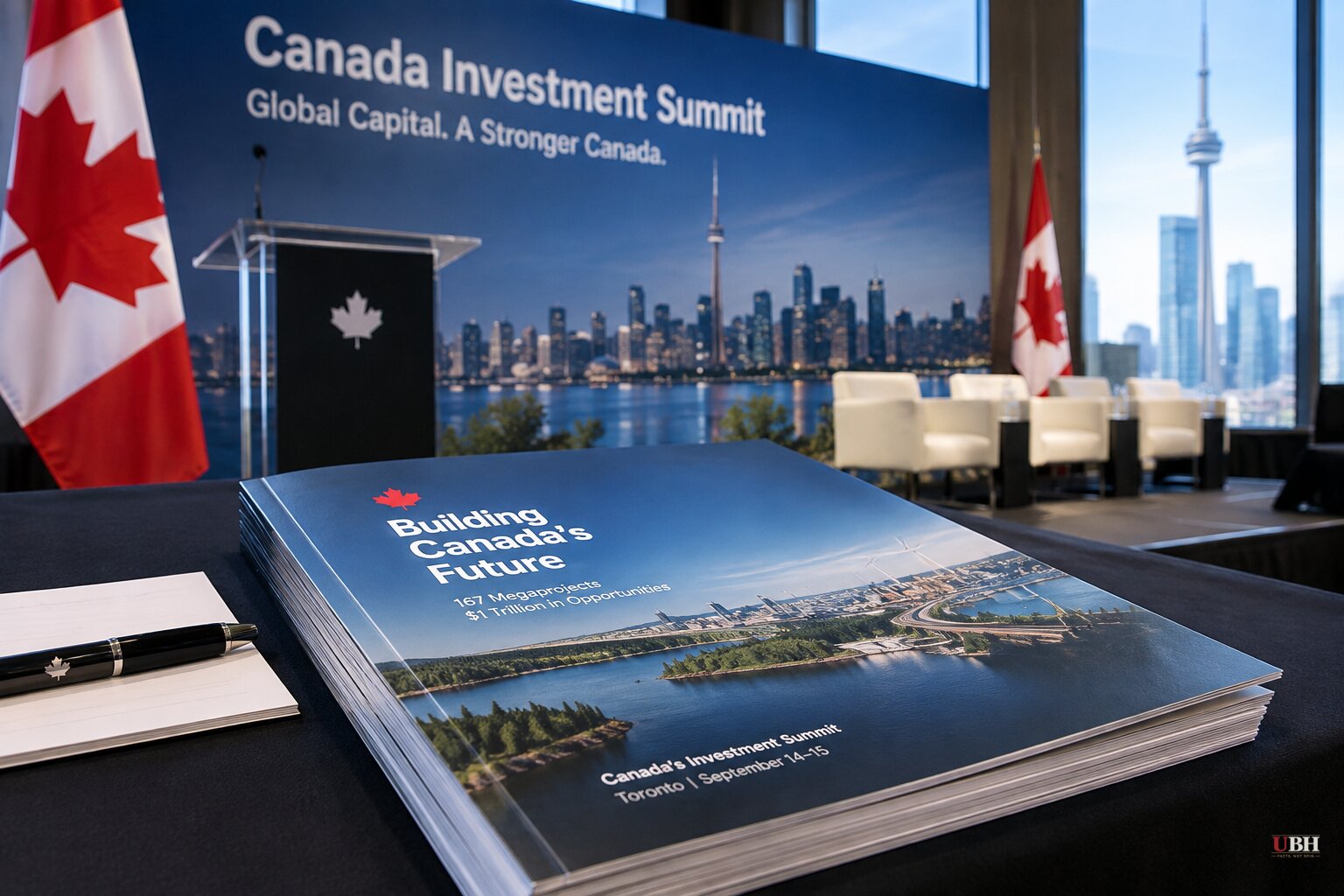
Canada is trying to do something governments rarely attempt: sell itself to investors like a company pitching a prospectus.
Starting Monday, September 14, Prime Minister Mark Carney's government is hosting the Canada Investment Summit in Toronto, co-hosted with the Canada Pension Plan Investment Board and PSP Investments. As many as 250 investors managing a combined $100 trillion to $120 trillion in assets, from roughly 28 countries, are expected to show up, according to reporting from theenergymix and Crypto Briefing. Firms in that category include BlackRock and Blackstone.
The ask: $500 billion in new foreign capital over five years, meant to kick-start $1 trillion in total economic activity. The offering is a 67-page dealbook covering 167 projects, according to CBC reporting cited by theenergymix, split across mining and metals (63 projects), clean energy including nuclear and carbon capture (31), advanced manufacturing (19), marine and port infrastructure (16), power and utilities (11), conventional energy (11), digital technology (10), and transportation (6).
Specific line items include a $57 billion expansion of the Port of Churchill in Manitoba, a $35 billion West Coast Pipeline, $28.5 billion for the Ksi Lisims floating LNG terminal in British Columbia, a $44 billion Wind West offshore project in Nova Scotia, a $2.1 billion Prairie Connector pipeline expansion toward the U.S., expansion of the Bruce nuclear station in Ontario, a new nuclear project at Wesleyville, mining in the Ring of Fire, and a $10.9 billion high-speed rail line between Edmonton and Calgary, per the Toronto Star and CBC as relayed by theenergymix.
Why Now
The timing is unmistakable. U.S.-Canada trade talks collapsed on August 21, 2026. President Trump imposed 50% tariffs on a long list of Canadian goods over the summer, and Canada answered with tariffs on about $20 billion of U.S. goods, hitting steel, aluminum, cheese, appliances, clothing, cosmetics, and farm equipment at rates of 15%, 25%, or 50%, according to NPR and the Associated Press. Canada says the retaliation matches Washington dollar for dollar.
Eight of Canada's ten provinces continue restricting or banning U.S. alcohol sales. The Distilled Spirits Council told NPR that U.S. spirits exports to Canada fell more than 70% year over year after those restrictions took effect. Trump has separately threatened to ban Bombardier aircraft sales in the U.S. unless the company manufactures domestically, posting on Truth Social that Canada has been "treating America like a piggybank." APMA Canada president Flavio Volpe pushed back on X, noting Bombardier uses U.S.-made GE and Honeywell engines and employs about 3,000 American workers.
Canadian historian Robert Bothwell told NPR that Carney and Canada have become "symbolic of resistance" to Trump, and that the administration wants to make an example of Ottawa to warn other allies against distancing themselves from Washington. The Washington Post reports Canada is separately chasing a goal to double its exports to non-U.S. markets by 2035.
The Case Against the Pitch
Canada has spent a decade proving it's a difficult place to put money.
RBC Economics found net capital outflows from Canada topped $1 trillion between 2015 and 2024, roughly two dollars leaving for every dollar of foreign direct investment coming in, a pattern RBC itself labeled a "capital recession," according to the Epoch Times. Per capita GDP growth over the past decade averaged just 0.41% annually, per World Bank data cited by Epoch Times columnist Ian Madsen. That trails Japan (0.8%), Germany (0.52%), the UK (0.63%), Spain (1.34%), South Korea (2.19%), and the United States (2.0%).
Major projects like the Northern Gateway and Energy East pipelines were scrapped after years of regulatory and political uncertainty, and the Coastal GasLink project faced years of blockades and equipment damage, Epoch Times noted. Ottawa has since created a Major Projects Office to fast-track approvals it deems in the national interest, but announcing faster permitting and actually delivering projects on time are different things. Canada's track record on that front is thin. Foreign direct investment did rebound to $96.8 billion in 2025, its strongest year since 2007, with $44.7 billion more arriving in the first half of 2026, according to Crypto Briefing, but a chunk of that 2025 figure came from U.S.-based mergers and acquisitions rather than fresh greenfield investment.
A Separate Political Fight
Breitbart has reported that Carney appointed Maia Johnson, an American citizen, as Chief Operating Officer of the Prime Minister's Office in mid-July, a newly created position roughly equivalent to White House chief of staff. Johnson simultaneously holds a role as Senior Special Advisor for "United States Stakeholder Strategy," a post she's held since February. Breitbart notes Johnson, as a U.S. citizen, cannot hold Top Secret clearance, raising questions about what access she has to sensitive materials in her new role. Carney's office has not addressed that question publicly in the reporting reviewed.
Johnson's résumé includes work as scheduling director for Hillary Clinton's 2016 campaign, consulting work for Michael Bloomberg's Hawkfish firm and the Biden campaign in 2020, and support for Carney during his time as UN Special Envoy on Climate Action, where he co-chaired the Glasgow Financial Alliance for Net Zero alongside Bloomberg. Breitbart frames the appointment, plus visits from Alex Soros and a speech by Barack Obama at a Toronto gala, as evidence of coordination between Carney's government and Democratic political figures against the Trump administration. No investigation, charge, or formal allegation of wrongdoing has been made public regarding Johnson's appointment or Canada's outreach to these figures. The facts amount to a documented network of political and financial relationships. Whether that constitutes improper coordination, as Breitbart's framing suggests, or ordinary transnational political and philanthropic networking is a judgment the available sourcing doesn't resolve.
The summit itself will answer a narrower, more measurable question: how much of the $500 billion target actually shows up in signed commitments after September 15, versus how much remains a glossy dealbook competing against a decade of investors voting with their feet in the other direction.
Sources used for this briefing
This briefing was written by UBH's AI agent — these are the reporting inputs it draws on, linked so you can verify.


