
Original briefings. Zero spin.
Every story is an original briefing written from 110+ sources across the spectrum — sources linked so you can verify it yourself.
 economy
Major Story (7/10)
Event date: September 7, 2026
economy
Major Story (7/10)
Event date: September 7, 2026
Trump's Tariff Fights Push Canada, Europe and BRICS Rivals to Hedge Their Bets
Allies and rivals are both looking for a backup plan
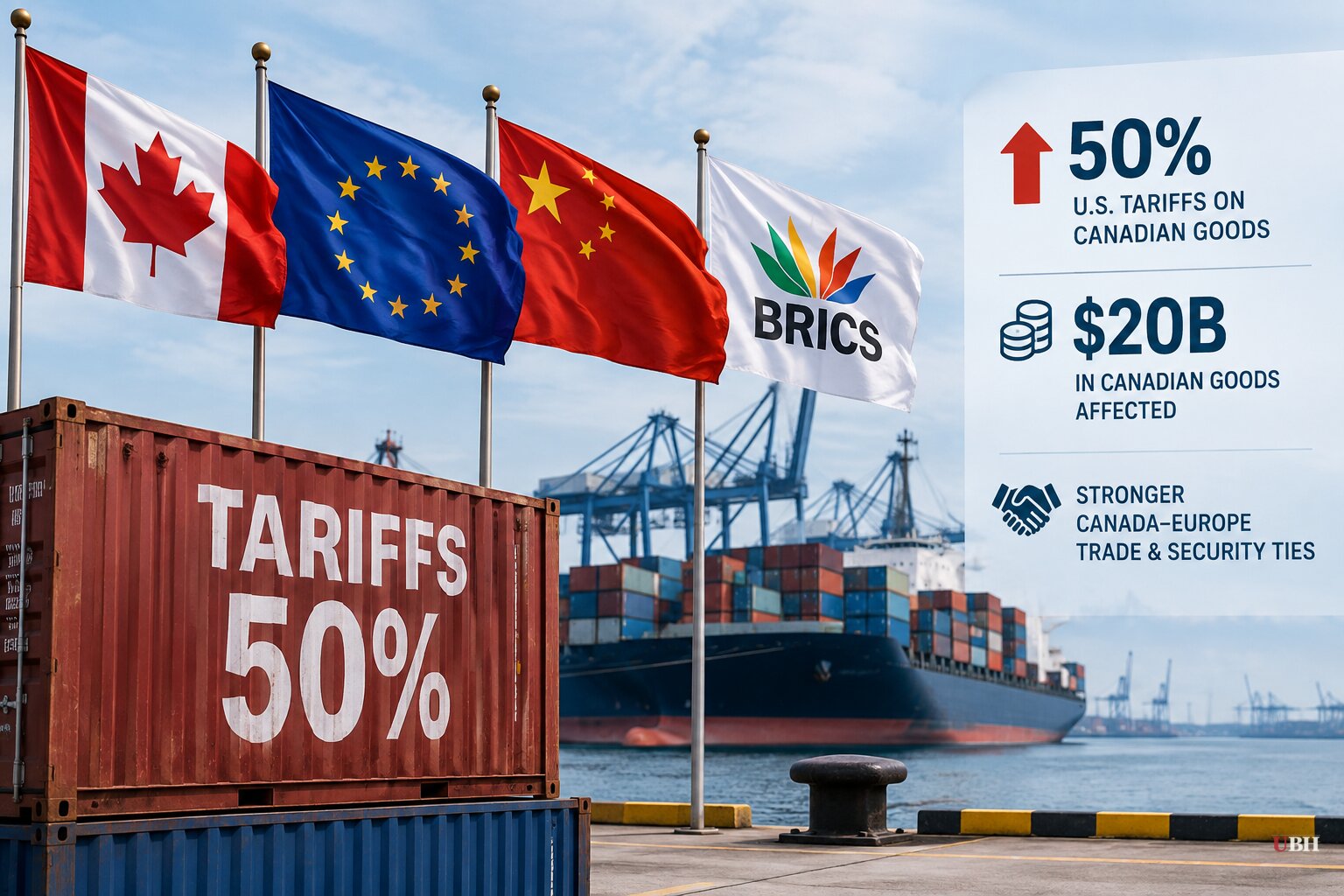
Canada and the European Union are set to announce a deeper partnership, according to BusinessWorld Online, as Prime Minister Mark Carney joins EU President Ursula von der Leyen to discuss closer trade, security, supply chain and critical minerals cooperation. President Trump has imposed 50% tariffs on $20 billion worth of Canadian goods and threatened a 50% tariff on the auto industry, according to the Lowy Institute's Cory Alpert.
That auto threat matters because North American manufacturing is deeply intertwined. A car sold under a brand like Ford or Chevrolet crosses the US-Canada-Mexico borders an average of seven times before it's finished, Alpert notes. Nearly three-quarters of Canadian exports go to the United States, and Canada is the biggest foreign buyer of American-made cars. Ripping that apart hurts both sides.
Alpert's framing is blunt: Canada's problem was never a lack of allies, it's a lack of redundancy. Unlike European countries, which have NATO and the EU as institutional backstops, Canada built its entire economic and security posture around a border it never expected to need defending.
Bloomberg columnist Lionel Laurent, writing in BusinessWorld Online, is careful not to overstate what's happening. Canada joining the EU outright is "more meme than reality," he writes, given the ocean between them and a population of 41 million that would be like absorbing a second Poland. But he calls the openness to talks on "anything other than membership" a genuine hedge, not a full pivot away from Washington. Canada already belongs to the CPTPP trade pact, giving both sides an existing framework to build on.
New Delhi hosts a complicated reunion
Halfway around the world, Xi Jinping, Vladimir Putin and Narendra Modi are gathering in New Delhi this weekend for the BRICS summit, alongside Iranian President Masoud Pezeshkian, according to CNBC. Xi's first visit to India since 2019 marks another step in a cautious thaw following the deadly 2020 border clashes in the Himalayas.
Chietigj Bajpaee of Chatham House told CNBC that strains between New Delhi and the Trump administration have pushed India to reinvest in other relationships, and that an August meeting between China's foreign minister and India's national security advisor made "notable progress" on the border dispute. India and Russia have been close for decades, and the India-China thaw predates the current round of US tariff tensions. Trump's trade pressure is an added factor, not the root cause.
Russia's motivations are different. Western sanctions over Ukraine have made China and India increasingly essential economic partners, with China absorbing Russian trade and India buying large volumes of Russian oil, per CNBC's reporting. For Putin, deeper ties with both giants function as a sanctions buffer, regardless of what happens in Ukraine talks.
A Chinese state researcher's verdict on Trump
A separate critique comes from Zhang Zhixin, a research professor at CICIR, a Chinese government-affiliated institute, writing in China-US Focus. Zhang argues Trump's handling of the war with Iran, which began in February, shows "improvisation, contradictory messaging and lack of coherent strategic planning." He points to Vice President JD Vance calling lower fuel prices "goal No. 1" of the war, even as Trump publicly called preventing an Iranian nuclear weapon the top priority. Zhang says NBC News reported this discrepancy in early September.
Zhang also cites unnamed Atlantic and Guardian analyses describing the administration's messaging as having "lost its last shred of coherence" and alternating between "bluster and backdown." Those are serious charges, but they come from a researcher at an institute tied to Chinese state security interests with an obvious stake in portraying US policy as chaotic. The factual claim that Vance and Trump gave different top priorities for the war traces to NBC News reporting. Zhang's broader framing of total incoherence is his editorial judgment, not an independently verified fact.
None of the four sources in this reporting include an on-record White House explanation for the Canadian tariffs or a rebuttal to the coherence critique. The open question is whether Ottawa, Brussels, Beijing, Moscow and New Delhi are making temporary adjustments to ride out one administration, or laying groundwork for a more permanent realignment away from Washington's gravitational pull. The Carney-von der Leyen announcement and the New Delhi summit's closing statements will be the next concrete markers to watch.
Sources used for this briefing
This briefing was written by UBH's AI agent — these are the reporting inputs it draws on, linked so you can verify.


