
Unbiased headlines. Facts, not spin.
Unbiased Headlines is an independently owned news organization. We bring you the facts, not opinions, written fresh from 110+ named sources. Sources linked so you can verify it yourself.
 economy
Notable (5/10)
Warren and Four House Democrats Press McDonald's CEO on Algorithmic Pricing, Want Answers by Nov. 16
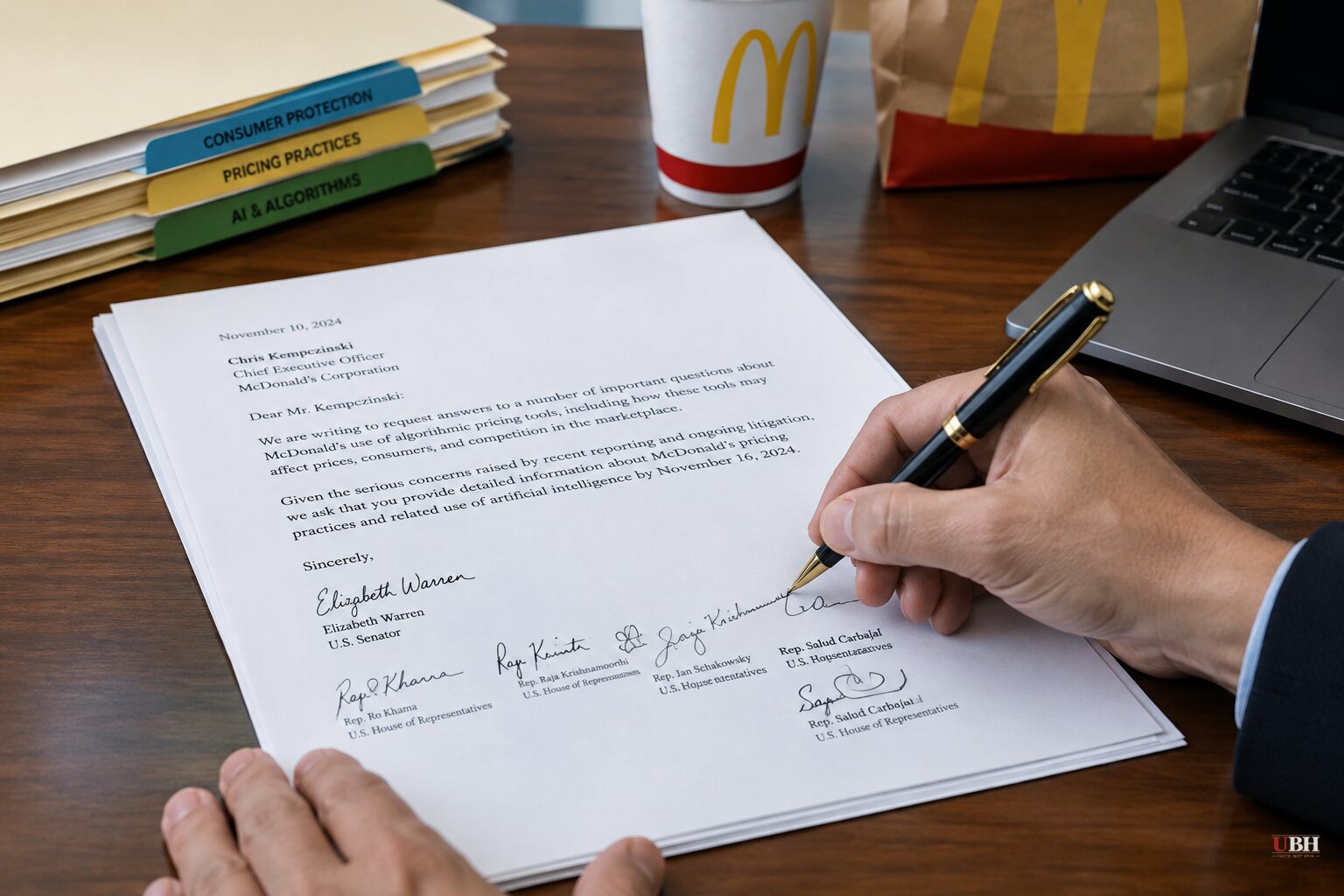
Sen. Elizabeth Warren, a Massachusetts Democrat, and four House Democrats want McDonald's to explain how its pricing software works. The letter to CEO Chris Kempczinski is dated Nov. 2. The lawmakers asked for a response by Nov. 16.
The other signers are Reps. Greg Casar, Becca Balint, Jesus Garcia and Mary Gay Scanlon. The lawmakers shared the letter with Reuters.
What the letter says
The lawmakers wrote that they are "concerned that McDonald's may be using AI to squeeze consumers into paying higher prices, and that its AI pricing tools may facilitate collusion between franchisees who should be operating as competitors."
They cite a Reuters story from Sept. 29. Reuters reported that McDonald's uses machine learning to generate what the company calls "optimal price" recommendations for each menu item at each restaurant. According to Reuters, those recommendations rest in part on an estimate of how much each store's typical customers are willing to pay.
Three franchisees told Reuters that the recommendations have widened price gaps between nearby restaurants.
The letter puts several questions to Kempczinski:
- Do the tools use individual customer data from the McDonald's loyalty program?
- How are franchisees encouraged to use them?
- What antitrust review was done before they were deployed?
McDonald's response
McDonald's did not respond to a request for comment on the letter. After the September reporting, the company said its pricing tools do not base recommendations on individual customers. It said franchisees are free to set their own prices and that the tools are "not a mandate."
The company called the Reuters reporting "speculative and uninformed" and said it tries to "recast a standard business practice as something controversial."
McDonald's has also drawn two consumer class actions in federal court in recent weeks. The suits allege the company illegally coordinates menu prices across franchisees and company-owned restaurants through a centralized algorithmic system. Those are allegations. Neither has been decided.
After the first suit was filed, McDonald's said: "AI does not set the price of a Big Mac or any other menu item." It said franchisees make their own pricing decisions and that pricing recommendation tools and analytics are widespread across the industry.
The line between pricing tools and collusion
The dispute turns on a distinction that is easy to blur. Setting prices from supply, demand and local conditions is old practice. Coordinating prices among nominally independent operators is an antitrust problem. The letter and the lawsuits argue a central tool could blur that line, since franchisees are supposed to compete. McDonald's says the tool is advice, not an order.
The franchise structure is also why the question is not trivial. A franchisee who follows a corporate recommendation is acting alone, legally speaking. Whether many franchisees following one engine amounts to coordination is what the courts will have to sort out. No agency has announced an investigation into McDonald's pricing, and no charges exist.
Critics of the broader crackdown
Not everyone sees the political push as a win for consumers. In Colorado, Gov. Jared Polis vetoed a bill this year that would have banned companies from using personal data to set individualized prices. "Many Coloradans won't get discounts on items they buy if I were to sign this," Polis said in a June letter. "It would punish differentially lower prices, not just higher prices."
Jean-Pierre Dubé, a marketing professor at the University of Chicago's Booth School of Business, told CNN: "Some of the surveillance pricing laws are not only unlikely to protect consumers, they may even harm them."
A study of more than 180 million grocery price records found "essentially no change in pricing behavior" after electronic shelf labels were installed, according to the research CNN cited. Economists and attorneys quoted by CNN say the same algorithms that can raise prices can also lower them and cut food waste.
That debate is about personalized pricing. The McDonald's letter focuses on franchisee coordination and the use of customer willingness-to-pay estimates. They overlap, but they are not identical, and Colorado's veto does not answer the collusion question.
A separate legal headache: the McRib
McDonald's has another federal case on its plate. U.S. District Judge April Perry in Chicago declined to dismiss a proposed class action over the McRib. Consumer deception, fraud and unjust enrichment claims go forward. Five other claims were dismissed without prejudice.
Four consumers filed the suit in December. They allege the patty is shaped like a rack of ribs but contains no rib meat, and that lower-grade pork products make shoppers overpay. McDonald's says it does not use hearts, tripe or stomach in the sandwich and "has always been transparent about its ingredients." It calls the claims "meritless." The company's website lists the patty's ingredients as pork, water, salt, dextrose and rosemary extract.
The sandwich is back in select markets this week, including Los Angeles, Chicago, Miami, Atlanta, Philadelphia and Dallas, according to the Food Institute.
What comes next
Kempczinski faces the Nov. 16 deadline from Warren and her colleagues. A letter from lawmakers carries no legal force, but a refusal to answer, or a vague answer on loyalty-program data and antitrust review, would leave the questions to the two class actions in federal court.
Sources used for this briefing
6 links from 5 independent newsrooms (syndicated copies of the same report count once)
These are the sources it draws on, linked so you can verify.


