
Unbiased headlines. Facts, not spin.
Unbiased Headlines is an independently owned news organization. We bring you the facts, not opinions, written fresh from 110+ named sources. Sources linked so you can verify it yourself.
 economy
Notable (6/10)
EPA Ends 2005 Livestock Air Emissions Agreement, Says Data Too Old to Use
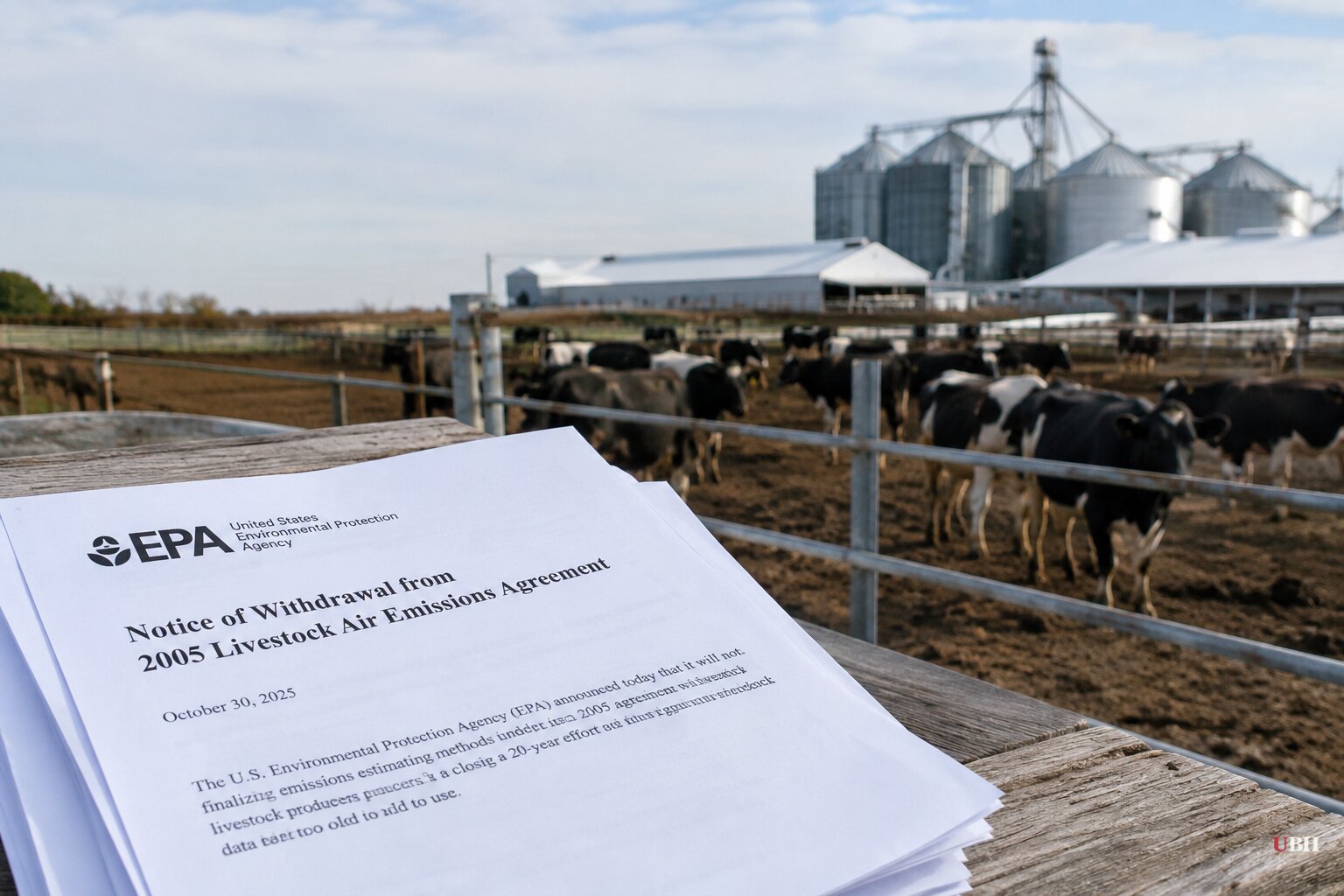
The Environmental Protection Agency said Friday, Oct. 30, that it is ending a 20-year effort to measure air pollution from large livestock and poultry operations. The announcement landed just days before today's midterm elections.
The agency will not finalize emissions estimating methods under the 2005 Animal Feeding Operations Consent Agreement and Final Order. The decision affects about 2,600 animal feeding operations, representing nearly 14,000 individual farms.
How a 2005 deal became a 20-year wait
The agreement dates to the early 2000s. The EPA had tried to enforce Clean Air Act limits against concentrated animal feeding operations, or CAFOs. The industry pushed back, arguing there was no reliable way to measure what the farms emit.
The EPA's answer was a deal. Participating operations got safe harbor from enforcement in exchange for joining an industry-funded study, the National Air Emissions Monitoring Study. It collected data on ammonia, hydrogen sulfide, particulate matter and volatile organic compounds at hog, broiler, egg and dairy operations from 2005 to 2007.
The stated goal was a scientifically sound way for farms to determine whether they must apply for Clean Air Act permits or file notifications under the federal Superfund law (CERCLA) and the Emergency Planning and Community Right-to-Know Act.
That method never arrived. A 2017 report from the EPA's Office of Inspector General faulted the agency for slow-walking the work, according to Inside Climate News. A public comment period on revised draft methodologies closed in August 2025.
What the EPA says
The agency's explanation is that the data has aged out. Many participating facilities changed ownership, closed or upgraded their housing and manure management over two decades, and agency scientists concluded the original data was too narrow and obsolete to build workable benchmarks.
"Good science requires good data, and these data are too old and too limited to support methods that farms could rely on," said Abigale Tardif, acting assistant administrator for the EPA's Office of Air and Radiation. "We would rather tell farmers that plainly than issue numbers we cannot stand behind."
Jeffrey Hall, assistant administrator for the Office of Enforcement and Compliance Assurance, said farmers have lived for two decades with the threat that "at any moment, the EPA could come out with a new emissions framework that treats farms like major industrial facilities and requires farmers to scramble to seek onerous permits." He said the action "advanced the rule of law by resolving the long-obsolete obligations" under the 2005 agreement.
Deputy Agriculture Secretary Stephen Alexander Vaden also backed the move, saying farmers have been under threat from "an activist EPA implementing a burdensome and unnecessary framework" that could bring "potentially massive fines and legal costs."
The objection from environmental groups
Food & Water Watch, which has tracked the proceedings from the start and filed dozens of lawsuits over them, sees it differently. Legal director Tarah Heinzen said: "As EPA has been saying it's proceeding with this plan, it's been dismantling all of its own tools to regulate emissions."
Inside Climate News reports that the Trump administration and Congress have also stripped requirements for factory farms to report air pollutants under CERCLA and the Right-to-Know Act. On paper, CAFOs still need Clean Air Act permits and must report emissions. In practice, the consent agreement has shielded them from enforcement for more than 20 years.
The health stakes are the group's central argument. Livestock operations emit fine particulate matter, ammonia, nitrogen oxides, sulfur dioxide and volatile organic compounds. Research cited by Inside Climate News links these emissions to nearly 12,700 deaths a year in the United States.
What the record shows
Both sides agree on one thing: the project failed on its own terms. Twenty years, an industry-funded study and a federal inspector general's criticism produced no usable estimating method. Taxpayers and farmers alike got a long period of legal limbo.
They disagree on what follows. The EPA and USDA say ending the effort frees farmers from an open-ended threat of industrial-style permitting. Food & Water Watch says it removes the last pending path toward measuring and regulating the emissions at all.
Whether Food & Water Watch challenges the decision in court is an open question. The group has a track record of suing over this agreement.
Sources used for this briefing
3 links from 3 independent newsrooms (syndicated copies of the same report count once)
These are the sources it draws on, linked so you can verify.


