
Unbiased headlines. Facts, not spin.
Unbiased Headlines is an independently owned news organization. We bring you the facts, not opinions, written fresh from 110+ named sources. Sources linked so you can verify it yourself.
 economy
Notable (6/10)
BMW Cuts 2026 Auto Margin Forecast to Between -0.5% and 0.5%, Its Second Cut in Five Months
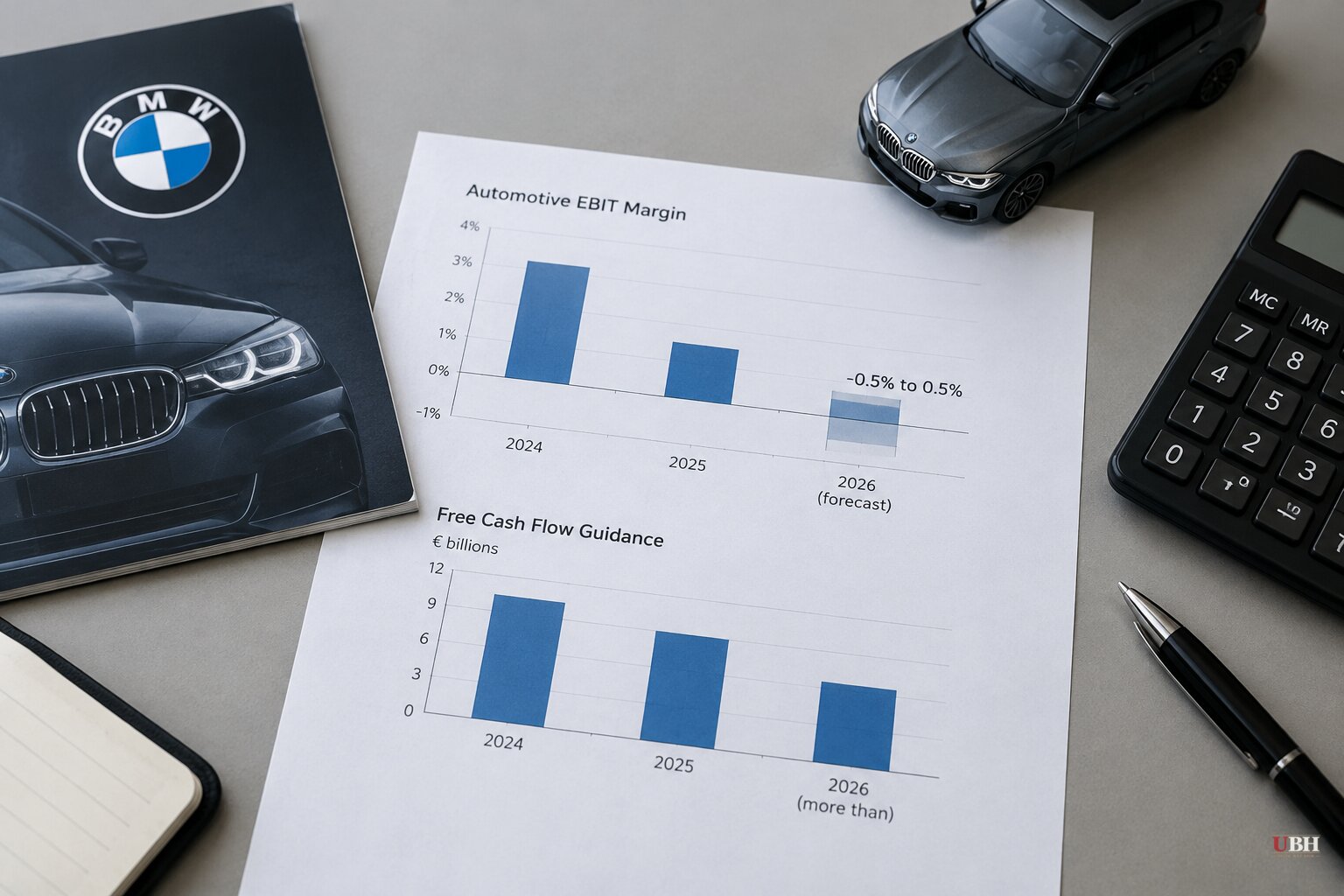
BMW cut the profit outlook for its core car business on Tuesday, Nov. 3, for the second time in five months. The company now expects a 2026 automotive EBIT margin between negative 0.5% and positive 0.5%.
That is down from 1% to 3%. In June, BMW had already lowered the range from 4% to 6%.
A premium carmaker guiding to a range that includes a loss is not a small adjustment.
What BMW changed
BMW blamed a "non-operating hit" to profit from its decision to "expand and intensify portfolio and structural measures." It also cited accelerating job cuts and weaker demand in China.
The revised numbers:
- Automotive EBIT margin: negative 0.5% to positive 0.5%, from 1% to 3%.
- Automotive deliveries: a "moderate decrease" of 5% to 9.9%, replacing the earlier "slight decline."
- Return on capital employed: negative 1% to positive 1%.
- Automotive free cash flow: still above €2.5 billion ($2.8 billion).
BMW also said that without the new structural and portfolio measures, it sees the margin above 2%.
Frankfurt-listed shares were 3.4% lower at 2040 GMT. The company reports third-quarter results Wednesday, Nov. 4.
The restructuring behind the number
CEO Milan Nedeljković took office in May. He is pushing a global workforce reduction of roughly 8,000 jobs, about 5% of the total headcount. BMW has also said it will cut about 100 senior managers at its Munich base.
BMW now says it will cut management functions faster than announced. Its redundancy programme is moving ahead of schedule, which brings larger severance payments in the fourth quarter.
BMW is taking the charges now rather than spreading them out.
Not all of it is China
China is the central problem, but BMW's own explanation is mixed. The company said sales of new models on its Neue Klasse platform are running high enough to require extra production shifts, which adds near-term costs.
That is the strongest case against reading this as a pure demand collapse. The cash flow target is intact. BMW delivered about 2.5 million vehicles last year, and it is still guiding to more than €2.5 billion in automotive free cash flow. Part of the margin hit comes from one-off charges, by the company's own description.
The analysis from investingLive makes the same point, saying investors may treat the cut as less severe than a pure demand shock. It adds that a range including a loss is still "a striking signal." Those are that outlet's judgments, not BMW's.
The delivery forecast, however, is not one-off. BMW now expects deliveries to fall by as much as nearly 10% this year, and it ties that to China.
The China squeeze
BMW is not alone. Mercedes-Benz slashed its profit outlook last week, also citing prolonged weakness in China. Volkswagen is running its own restructuring program.
The pattern is the same across the German premium brands. Chinese buyers are increasingly choosing cheaper domestic brands, which removes what used to be a reliable profit stream.
Data from the China Passenger Car Association shows the weakness at the luxury end. CPCA Secretary-General Cui Dongshu said imports totaled 21,000 units in September, down 49% from a year earlier. For the first nine months, imports were 290,000 units, down 20%.
Imported luxury brands were hit hard, according to figures reported by Chinese outlet Yicai. Jaguar sold 6 vehicles, against 1,937 a year earlier. Maserati sold 17, down 79.5%.
These are import figures, not BMW's China sales. They show how weak demand is at the top of the market.
Why demand is weak is disputed. Analysts cited by the Epoch Times point to China's slowing growth, a sluggish property market and weak consumer confidence. Xu Zhen, a senior professional in China's finance sector, also blamed fear of scrutiny. He said in the "political atmosphere of 'common prosperity,'" driving a luxury car "may lead to audits, fines, and tax payments." That is one commentator's view. Neither BMW nor the CPCA has said it.
What Wednesday has to answer
BMW's own filing shows the restructuring is costing money before it saves any. The charges land in 2026. The savings from 8,000 fewer jobs and thinner management come later.
The third-quarter report on Wednesday, Nov. 4, is due to show how large the restructuring charges are. It will also show whether China demand is stabilizing, and whether BMW's pre-charge margin above 2% holds.
Sources used for this briefing
6 links from 5 independent newsrooms (syndicated copies of the same report count once)
These are the sources it draws on, linked so you can verify.


