
Original briefings. Zero spin.
Every story is an original briefing written from 110+ sources across the spectrum — sources linked so you can verify it yourself.
 economy
Major Story (8/10)
September 12, 2026 at 10:07 AM
economy
Major Story (8/10)
September 12, 2026 at 10:07 AM
Trump Escalates Pressure on Iran With New Sanctions and $10 Million Bounties as BRICS Leaders Meet in Delhi
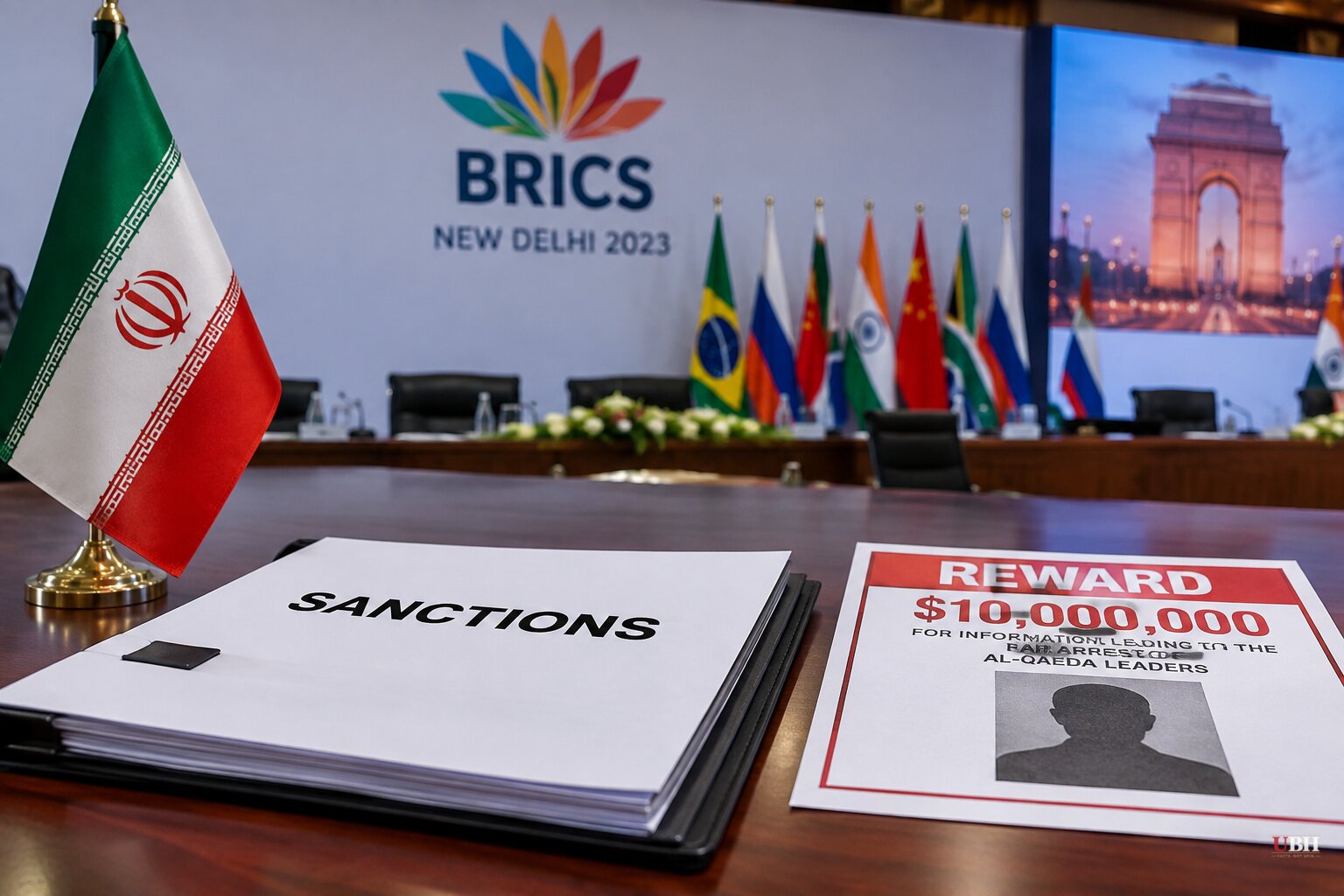
Since BRICS leaders signed off on their joint declaration in New Delhi this week, the Trump administration has moved on a separate but overlapping front: ratcheting up economic and military pressure on Iran, one of the bloc's 11 members.
Treasury Secretary Scott Bessent said the new measures amount to the "toughest sanctions in history" and are designed to "collapse" the Iranian regime, according to Breitbart. Iran responded Friday by vowing a "devastating" military response, per the same report, though no retaliatory strike had been confirmed as of Saturday.
On the same day, the State Department's Rewards for Justice program announced bounties of up to $10 million each for information on three senior al-Qaeda figures it says are based in Iran: Sayf al-Adl, Abd al-Rahman al-Maghrebi and Yasin al-Suri, according to Fox News. The announcement landed on the 25th anniversary of the September 11 attacks. The State Department alleges the men "utilize Iran as a safe haven to execute violent attacks against the United States and its allies." No indictment, extradition request, or independent verification of Iranian government knowledge or complicity has been reported.
A Pipeline, a Border, and an Investigation
The pressure campaign isn't limited to Tehran directly. Saudi Arabia said Friday that drones launched from Iraqi territory struck its East-West Pipeline, forcing the kingdom to shut down the route that lets it move crude to the Red Sea without passing through the Strait of Hormuz, Fox News reported, citing Reuters. Iraqi Prime Minister Mohammed Shia al-Sudani ordered an investigation and dismissed the military commander responsible for the area, and Iraqi forces closed the Shalamcheh border crossing with Iran while hunting for those responsible.
Separately, Anthropic said it blocked accounts in Houthi-controlled northern Yemen after users tried to get its Claude chatbot to help design guided missiles, including a hypersonic glide weapon, according to a company report cited by Fox News. Anthropic said the attempt failed and no operational weapon resulted. A Houthi political bureau member denied the group relies on AI tools for its weapons programs.
None of these individual incidents were caused by the BRICS summit. They land in the same week Iranian President Masoud Pezeshkian stood in New Delhi and told the gathering Iran "will not surrender" to U.S. strikes, a claim this outlet has already covered. The timing puts Washington's Iran pressure campaign and the BRICS summit's anti-coercion rhetoric on a collision course.
The Recruitment Agent Argument
An Al Jazeera opinion piece by Ilan Kapoor, a professor of critical development studies at York University, argues that Trump's willingness to use tariffs and dollar-system access as leverage is giving BRICS members a reason to cooperate even when they agree on almost nothing else. Kapoor notes the bloc's 11 members, Brazil, China, Egypt, Ethiopia, India, Indonesia, Iran, Russia, Saudi Arabia, South Africa and the UAE, together represent nearly half the world's population and about 40 percent of global GDP, yet have no shared ideology or security policy. He points to the same regional splits this outlet covered: Iranian and Emirati diplomats clashing in New Delhi in May, and India and China only recently stabilizing a border relationship that produced deadly skirmishes in 2020 and 2021.
Kapoor's argument is that shared vulnerability to U.S. financial leverage, not shared politics, is what BRICS actually offers its members. That's his interpretation, not a settled fact. The dollar is nowhere close to losing its dominance. The IMF says it held 57.1 percent of global foreign-exchange reserves in the first quarter of 2026, versus just 2 percent for China's renminbi. No BRICS common currency exists or is imminent, despite recurring predictions around every summit.
The strongest case for Washington's approach, made by Bessent and Trump officials, is that sanctions and tariff threats are the tools available to punish a regime the U.S. accuses of sponsoring terrorism and funding proxy wars through the Houthis and other groups, and that half-measures haven't worked in the past. The strongest case against it, which Kapoor makes explicitly, is that coercive tools aimed at isolating adversaries can end up pushing unrelated trading partners like India and Brazil toward alternatives out of pure self-interest, regardless of whether they sympathize with Iran at all.
Whether Bessent's sanctions actually destabilize Tehran, whether Iran follows through on its threatened response, and whether Iraq's investigation into the pipeline drone attack identifies who launched it are all open questions heading into next week.
Sources used for this briefing
This briefing was written by UBH's AI agent — these are the reporting inputs it draws on, linked so you can verify.


