
Original briefings. Zero spin.
Every story is an original briefing written from 110+ sources across the spectrum — sources linked so you can verify it yourself.
 economy
Major Story (7/10)
Event date: February 20, 2026
economy
Major Story (7/10)
Event date: February 20, 2026
Companies Got Over $100 Billion in Tariff Refunds. The Shoppers Who Paid Higher Prices Got Nothing.
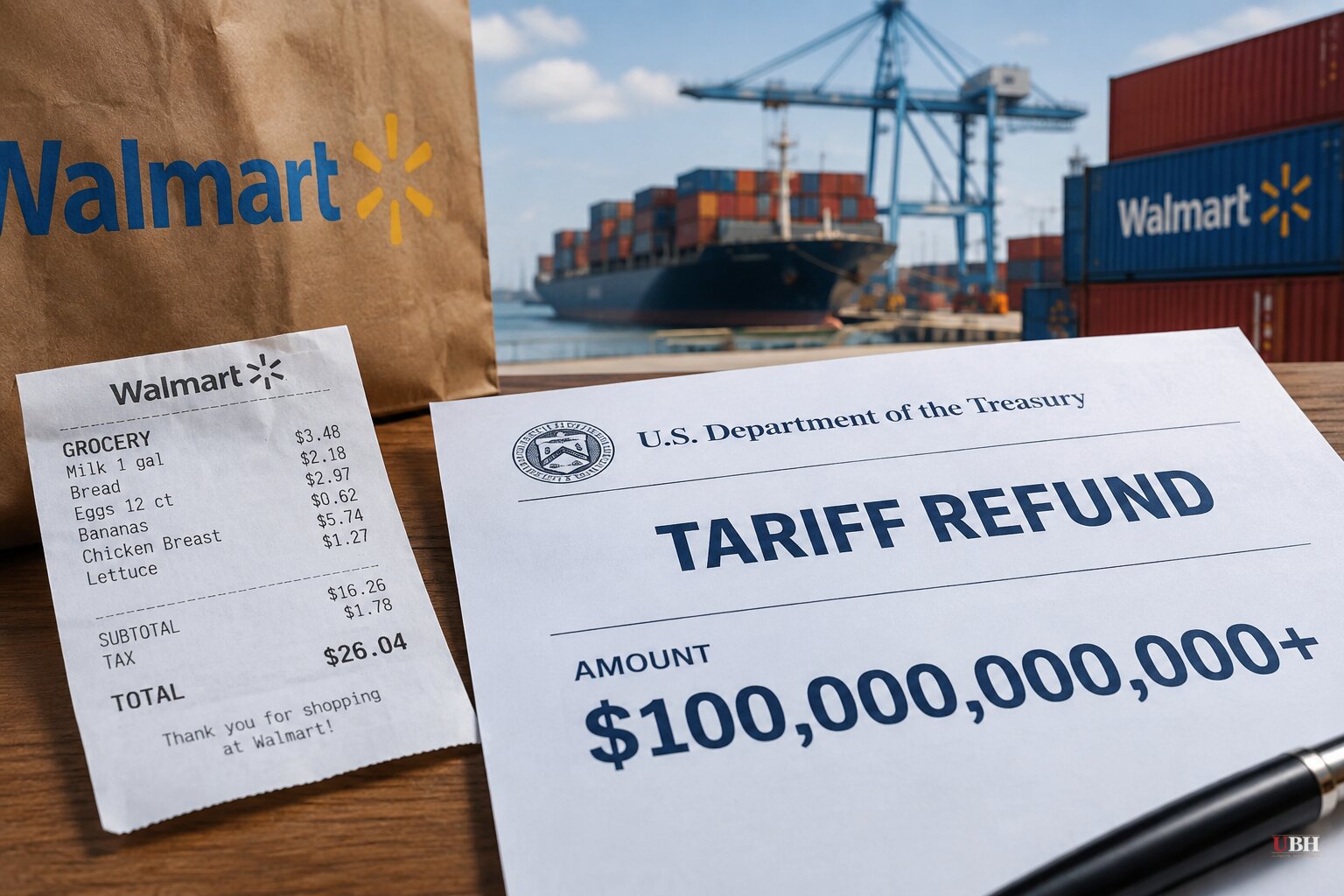
Companies Got Over $100 Billion in Tariff Refunds. The Shoppers Who Paid Higher Prices Got Nothing.
The Supreme Court ruled 6-3 on February 20, 2026, that President Trump's tariffs under the International Emergency Economic Powers Act were unconstitutional. Taxing power belongs to Congress, the court said, not the executive branch. That ruling triggered one of the largest corporate refund events in recent memory.
The numbers are staggering. According to Customs and Border Protection filings cited by CNN, the government collected $168 billion from roughly 330,000 importers under the invalidated tariffs, and had already sent back $100 billion of it as of July 31, 2026. Separate projections from the Penn Wharton Budget Model put total federal exposure between $166 billion and $175 billion.
Who's Cashing In
Walmart disclosed a $2.9 billion refund. Target got $994 million. Apple received an estimated $2.2 billion. Ford collected $1.3 billion, Home Depot $730 million, and Nike $684 million, according to CNN. Amazon's take is reported slightly differently depending on the source: CNN cited $640 million, while Crypto Briefing put the company's second-quarter figure at approximately $600 million.
Home furnishings companies have been especially candid about their windfalls. Williams-Sonoma reported nearly $200 million in refunds and interest, which it said contributed to a 6.7 percent jump in year-over-year revenue, according to businessofhome. The company put $10 million of that toward employee pension contributions. RH collected $55.1 million in the second quarter and expects another $13.9 million later this year. Arhaus got $37.8 million plus $1.3 million in interest. Ethan Allen received $5 million.
Where the Money Actually Goes
Most of it is staying with the companies. Florida-based designer Dwayne Bergmann, co-founder of Barrett Bergmann Home, told businessofhome he never raised prices when tariffs hit, so his refund is simply going back into the company's operating account under cost of goods sold. John Greenawalt of Stout Textiles said his refunds are offsetting shipping and fuel surcharges rather than being passed to customers, because new Section 301 tariffs largely replaced the ones the court struck down.
Home News Now publisher Rick Harrison has documented furniture retailers pressuring wholesale manufacturers for refund "kickbacks," arguing they absorbed margin squeezes to keep shelf prices stable and deserve a cut, according to businessofhome.
Walmart and Target executives suggested their refunds are behind planned price cuts, CNN reported. Deutsche Bank senior economist Brett Ryan told CNN that's murky at best. Walmart also reported its slowest sales growth since the early pandemic, driven by gas prices above $4 a gallon, making it hard to isolate the refund's actual effect on pricing. "Walmart sales are massive compared to the $3 billion in tariff refunds," Ryan said. "They know the customer has no clue if they're actually passing on the cost or not."
FedEx, UPS, and DHL are a different case. They collected tariff surcharges directly from shipping customers and have set up refund portals to pass money back, according to CNN. All three are still facing lawsuits from customers who argue the companies are dragging their feet or shortchanging what's owed.
The Backlog and the Missing Check
The refund pipeline runs through a CBP system called CAPE, launched in April. Rep. Haley Stevens of Michigan and Rep. Steven Horsford of Nevada sent a letter to CBP Commissioner Rodney Scott demanding fixes to processing backlogs, warning that small businesses risk missing the agency's 90-day refund request deadline through no fault of their own. "Michigan businesses should not have to pay the price once, let alone twice," Stevens said.
Some companies aren't waiting. Crypto Briefing reported that firms uncertain about their legal standing or unwilling to sit in the CAPE queue have sold their refund claims to third parties at a discount, sometimes accepting 80 cents on the dollar for speed and certainty.
Meanwhile, the $2,000-per-person dividend Trump promised on Truth Social on November 9 has slipped repeatedly. He said it would arrive before the midterms, then "toward the end of the year," then, in a New York Times interview, sometime later in 2026 with no specific date, according to Baller Alert. National Economic Council Director Kevin Hassett said in December the checks would likely require congressional legislation, and he predicted the Supreme Court would rule in the administration's favor, calling required refunds "pretty unlikely." The court ruled the opposite way. No bill has been introduced.
The Senate Joint Economic Committee found tariffs cost the average household an extra $1,725 between February 2025 and January 2026, with the Committee's minority estimating the 2026 total closer to $2,500. The Tax Foundation had projected the now-invalidated tariffs would raise $2.1 trillion over a decade, or $1.6 trillion after accounting for retaliation, a projection made before the ruling wiped out the underlying legal authority.
Not every read on the economy is bleak. Daily Signal contributor Daniel McCarthy points to August's 162,000 new jobs and a 58,000-job manufacturing gain in 2026, driven largely by durable goods, arguing Trump's trade and immigration policies are driving a genuine industrial rebound regardless of the court fight. Peter Navarro, a senior White House trade advisor, cites the same durable-goods numbers as evidence the tariff strategy worked even as courts unwound its legal basis. Whether that manufacturing bump survives without the tariff revenue that funded it, and whether Congress ever writes a bill for Trump's dividend checks, remains unanswered as CBP works through the remaining refund queue.
Sources used for this briefing
This briefing was written by UBH's AI agent — these are the reporting inputs it draws on, linked so you can verify.


