
Unbiased headlines. Facts, not spin.
Unbiased Headlines is an independently owned news organization. We bring you the facts, not opinions, written fresh from 110+ named sources. Sources linked so you can verify it yourself.
 energy
Major Story (8/10)
Event date: October 22, 2026 ·
Gas Holds at $4.29 as Trump Invokes Defense Production Act and Consumer Sentiment Sinks to Second-Lowest on Record
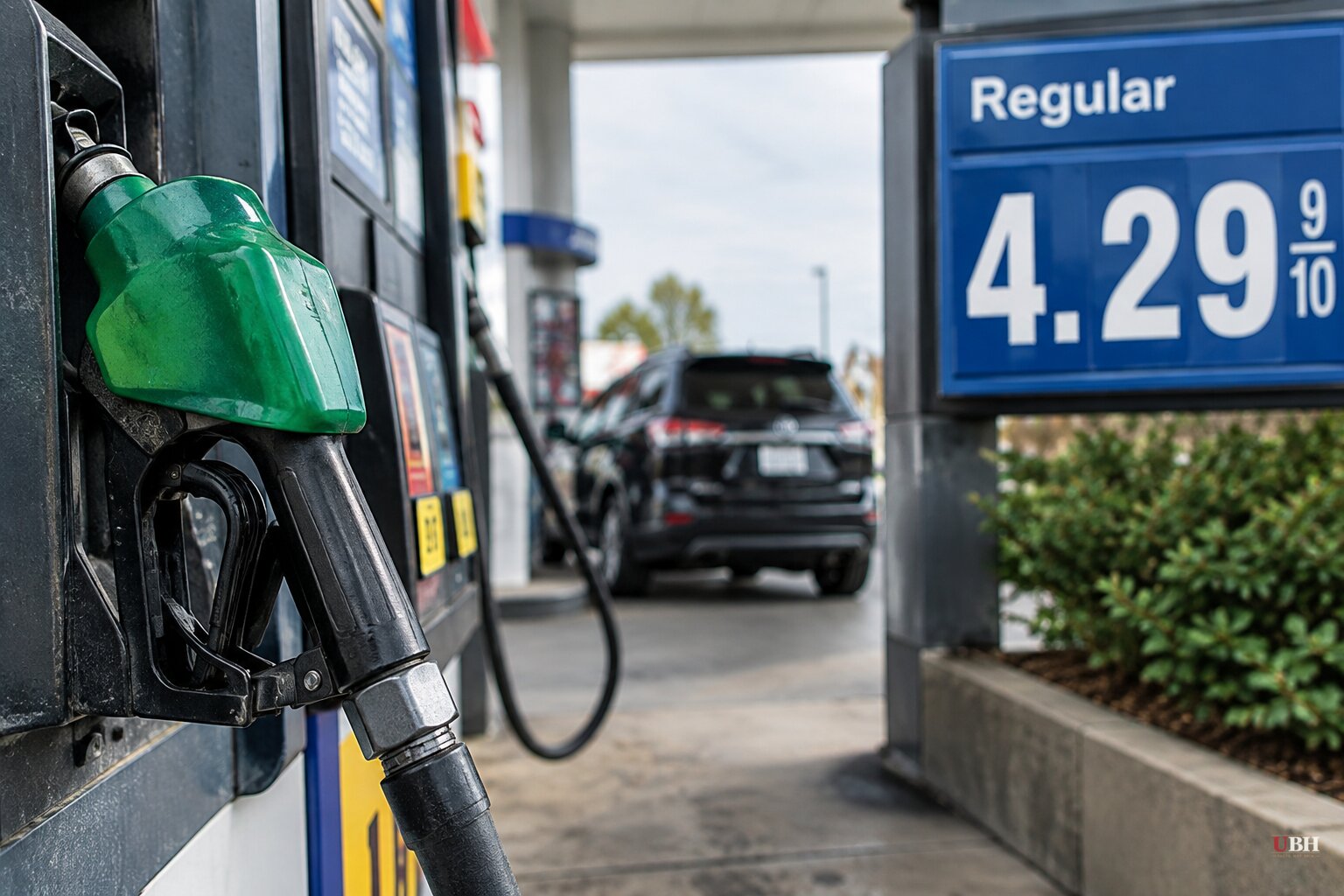
Since the war with Iran began on Feb. 28, gasoline has climbed from $2.93 a gallon to $4.29, and the latest developments show neither prices nor voter patience improving before the Nov. 3 midterms.
The White House reaches for the DPA
President Trump said Thursday, Oct. 22, that his administration will invoke the Defense Production Act to spend $150 million on boosting U.S. gasoline and diesel production. The Energy Department said the money will raise refining output by millions of gallons per day and lower fuel prices.
A White House official said the funds will expand capacity and modernize existing infrastructure, which the official described as much faster than building a new refinery. The announcement followed a meeting between Trump and refiners.
The presidential determination says industry cannot be expected to deliver the capacity in time because of "constrained financing, long lead times, permitting and infrastructure bottlenecks, and supply chain limitations." Trump said that "without immediate Federal action, United States defense capabilities will remain vulnerable to disruption." The Secretary of War was directed to use the powers to speed domestic petroleum production.
Petroleum analysts are skeptical it will move prices. "I don't think that's really going to have any impact," said Patrick De Haan of GasBuddy. Tom Kloza, chief energy adviser at Gulf Oil, said DPA money could speed some refinery expansions but that short-term benefits are unlikely. "There is no slack in U.S. refining, so production can't be added regardless of political will," he said. Bringing units back to service typically takes months and calendar quarters.
The U.S. already makes more fuel than it burns. It produces about 5.3 million barrels a day of distillate, the category that includes diesel, and consumes about 3.6 million. But oil is priced on a global market, and the Iran war and the Russia-Ukraine conflict have disrupted shipments.
Prices at the pump
AAA put the national average for regular gasoline at $4.29 on Friday, Oct. 23, up about two cents from Thursday. Diesel was about $6.30 a gallon, according to The Guardian's reading of AAA data; CBS News cited $6.32. That is roughly 40% above last year for gasoline and 74% for diesel.
Gasoline did fall six cents over the week ending Thursday, which AAA attributed to the switch to cheaper winter-blend fuel and lower driving demand. AAA said fuel prices can dip 10 to 30 cents a gallon during winter months. It also said "high crude oil prices are preventing steep declines at the pump" and that October is poised to be the most expensive October ever for gas, following similar records in August and September.
Crude is moving the wrong way. Brent futures were at $116.13 a barrel at 9:50 a.m. EDT Friday, up more than 2.6% from Thursday's close, and West Texas Intermediate was around $103. Brent had been $72.87 on the eve of the war.
The September CPI reading showed 3.7% annual inflation, up from 2.4% in February.
Escalation risk in the Gulf
The latest jump follows a deadly week in Saudi Arabia. A Wednesday attack on King Fahd International Airport killed two people, a Saudi citizen and an Indian national living in the kingdom, and injured eight, according to Saudi Arabia's civil aviation authority as reported by the Associated Press. Houthi rebels reportedly claimed responsibility on Telegram and said they also targeted the Saudi Defense Ministry in Riyadh and an Aramco facility in Yanbu, where a fire broke out. The group did not provide evidence of the strike on the ministry.
An earlier suspected Houthi missile attack on King Khalid International Airport this month reportedly killed 14 people and prompted the airport to close. The U.S. Embassy in Riyadh said the State Department expects hostilities between Saudi Arabia and the Houthis to escalate rapidly.
Gregory Brew of Eurasia Group said there is "broad consensus that escalation is coming and that it could diminish flows of oil out of the Middle East." ING commodities strategists Warren Patterson and Ewa Manthey wrote Friday that "re-escalation seems the most likely path" and that their expectation of $80 Brent for the fourth quarter "is looking unattainable."
Trump gave a different picture at a rally Thursday in Sioux City, Iowa. He said maritime escorts have helped reopen shipping lanes for non-Iranian oil exports and that "more oil came out of the Hormuz Strait over the last week than at any time previous, including before the war." He said oil prices will fall for consumers once the war ends. He also acknowledged a diplomatic problem: "The problem we have is we wiped out their leaders," leaving him no viable counterpart to negotiate with.
Voters feel it
The University of Michigan's October consumer sentiment index, released Friday, was the second-lowest reading since records began in 1978. The record low of 44.8 came in May, when the national average for gasoline hit a four-year high of $4.56. Sentiment is 10% below a year ago and 15% below February.
Joanne Hsu, director of the Surveys of Consumers, said 56% of respondents spontaneously cited higher prices as hurting their personal finances, a share that has risen four months in a row. "These increases are seen across the political spectrum, with Republicans exhibiting the largest proportional rise," she said. Year-ahead inflation expectations rose to 4.7% from 4.6%, and long-run expectations to 3.5% from 3.4%. She also said 85% of respondents called it a bad time to buy a home, and cited the recent hike in interest rates as a factor.
The politics are plain in the polling. A Politico poll on Oct. 10 found that even if Trump cut gasoline by $1 a gallon, most voters polled would not be likely to be swayed to vote Republican.
Earlier this month Trump announced a string of diesel measures: wider use of off-highway "red dye" diesel, a temporary lift of sanctions on Russian diesel imports, and a one-time $8 billion diesel subsidy for farmers. Andrew Critchlow of Dow Jones Energy calculated that the initial 2.24 million barrels of Russian diesel covers about 14 hours of U.S. diesel demand. Ed Hirs of the University of Houston put the effect of the moves at "Zero. No elaboration needed." Energy analysts told The Guardian that voters will not see lower prices by Nov. 3.
The next measurable test comes in the final eleven days of the campaign. AAA's winter-blend dip of 10 to 30 cents is the main downward force on gasoline, and it is working against Brent near $116 and a Gulf that analysts at ING and Eurasia Group expect to get worse.
Sources used for this briefing
6 links from 6 independent newsrooms (syndicated copies of the same report count once)
These are the sources it draws on, linked so you can verify.


