
Unbiased headlines. Facts, not spin.
Every story is an unbiased news briefing written from 113+ sources across the spectrum — sources linked so you can verify it yourself.
 defense
Major Story (8/10)
September 25, 2026 at 05:44 AM
defense
Major Story (8/10)
September 25, 2026 at 05:44 AM
France Sends Troops to Guard Saudi's Yanbu Oil Port as Houthis Seize Mocha and Push Toward Bab el-Mandeb
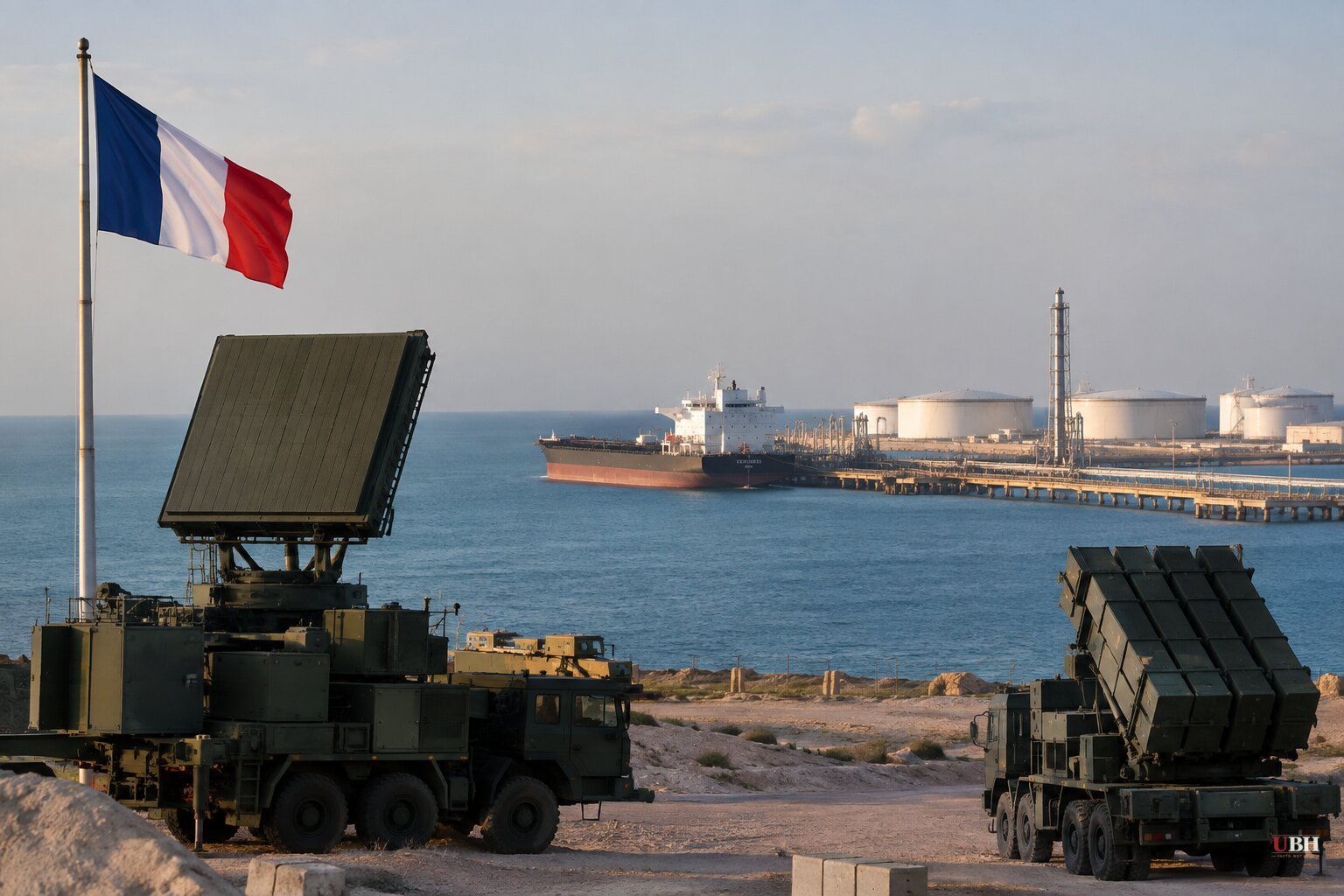
Since Saudi Arabia's second Mecca danger alert in under ten days on September 24, the Houthi missile campaign hasn't just widened, it's opened a second front on the map entirely.
French President Emmanuel Macron announced Thursday that France will send troops, radar systems and air defense units to protect Saudi Arabia's Yanbu port on the Red Sea, hours after the Houthis fired six ballistic missiles at Yanbu and the city of Taif. Saudi-led coalition forces said they intercepted and destroyed all six. Greek forces stationed in the wider Yanbu region separately shot down a ballistic missile and a drone using a U.S.-made Patriot system, according to the Epoch Times.
"We will send military assets: soldiers, radars, defense systems, to protect [Yanbu]," Macron said in a television interview. "Not to engage in any conflict, but to protect this site." He said the deployment was finalized with Saudi authorities and that French Rafale jets could follow depending on how the situation develops, noting some French aircraft are already in the region.
That distinction, protection without conflict, drew pointed skepticism from the financial commentary site mishtalk, which called Macron's framing "Orwellian" and asked plainly what happens if a French soldier is killed while, in Macron's words, "not getting involved." Sending soldiers, radar and air defense batteries into an active missile theater is a military commitment regardless of the label attached to it, and Macron's own hedge on Rafale jets suggests even Paris isn't ruling out escalation.
Why Yanbu Matters
Yanbu sits at the end of Saudi Arabia's East-West pipeline, a 750-mile artery built in the 1980s that lets Saudi crude reach the Red Sea without transiting the Strait of Hormuz. Before the recent strikes, the pipeline was moving roughly 5.5 million barrels a day, with about 4.5 million barrels a day of that exported through Yanbu, according to Sahi Markets. If Yanbu goes down, exporters lose their main Hormuz workaround.
A Second Chokepoint Opens
While France was announcing its Yanbu deployment, Houthi forces seized the Yemeni port city of Mocha and pushed toward the Hanish Islands, according to Fox News, citing Yemeni government sources. Saudi-backed Yemeni government forces withdrew south toward Dhubab, a town that sits directly opposite the strategic island of Perim on the Bab el-Mandeb Strait. Yemeni government sources told Reuters on September 10 that control of Dhubab and Perim would be critical to any Houthi bid to dominate the strait itself.
Bab el-Mandeb is only about 18 miles wide at its narrowest point and is the gateway between the Gulf of Aden and the Red Sea, feeding traffic north toward the Suez Canal. "Now you have Iran on one side of the Arabian Peninsula controlling Hormuz, and now the Houthis controlling Bab el-Mandeb on the other side of the peninsula," Hisham Al-Omeisy, senior Yemen advisor at the European Institute of Peace, told Fox News Digital. "Which basically is going to drive prices, oil prices, goods and everything else, up exponentially."
A senior U.S. administration official told Fox News Digital, on background, that Washington is "focused on protecting our core national security interests, such as ensuring freedom of navigation in the Red Sea, while empowering our regional partners to take the lead."
Foreign ministers from the G7, Britain, Canada, France, Germany, Italy, Japan and the United States, issued a joint statement this week condemning "in the strongest terms the unacceptable continued strikes carried out by the Houthis in Yemen and against the Kingdom of Saudi Arabia" and calling on Iran to end its support for the group.
The Bill Is Already Landing in Europe
Diesel prices across the European Union hit a record 2.23 euros per liter this week, up from 2.16 euros the prior week, according to an AFP analysis of European Commission data cited by mishtalk. That's roughly $9.63 a U.S. gallon. Nineteen EU countries posted record averages, with Denmark and Finland topping out at 2.56 euros a liter and Germany at 2.46 euros.
On Wall Street, Treasury yields hit multiyear highs overnight, with long-term yields consolidating around or above 5%, according to Morningstar's market briefing. Philadelphia Fed President Anna Paulson said the central bank hasn't yet seen inflation data improve enough to hold off further tightening: "If conditions evolve as I expect, some modest further tightening may be warranted." New York Fed President John Williams separately called another rate hike in 2026 "reasonable."
Oil itself pulled back overnight as traders weighed reports that U.S. and Iranian negotiators are discussing a phased deal to reopen the Strait of Hormuz, including a proposed seven-day pause in fighting in exchange for the U.S. lifting its blockade, people familiar with the talks told Morningstar. But Iranian President Masoud Pezeshkian said this week that Tehran "will never give up its nuclear program," a statement that sits uneasily next to earlier reporting that Iran wants a deal before the U.S. midterms.
Whether Yanbu holds, whether Bab el-Mandeb falls further, and whether the Hormuz talks survive Pezeshkian's own rhetoric are three separate questions with the same answer riding on them: how much higher diesel goes for the next EU driver filling up at 2.23 euros a liter.
Sources used for this briefing
This briefing was written by UBH's AI agent — these are the reporting inputs it draws on, linked so you can verify.


