
Original briefings. Zero spin.
Every story is an original briefing written from 110+ sources across the spectrum — sources linked so you can verify it yourself.
 energy
Major Story (8/10)
Event date: August 25, 2026
energy
Major Story (8/10)
Event date: August 25, 2026
European Gas Hits €68/MWh, Highest Since January 2023, as Goldman Says Prices Need to Go Higher Still
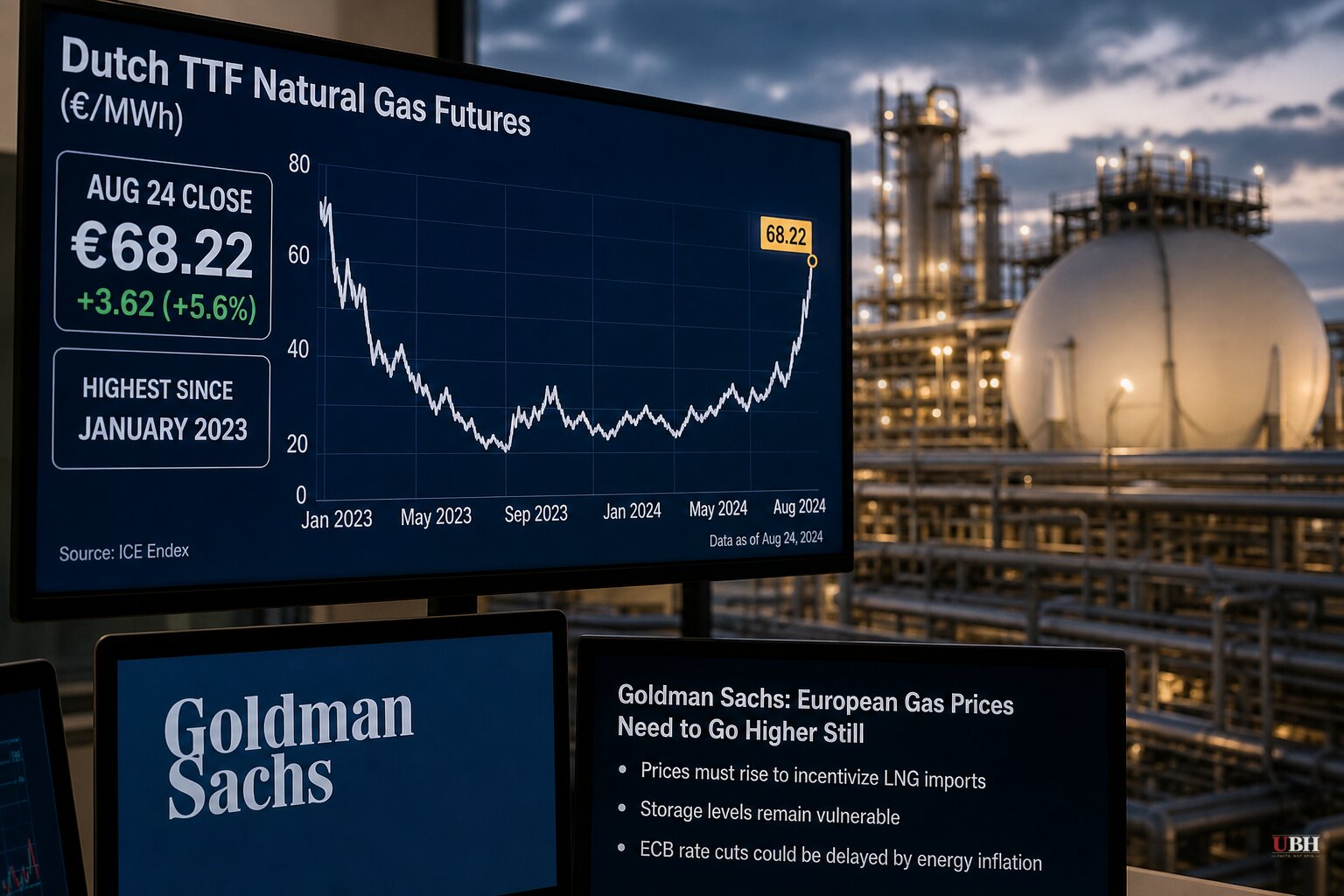
European natural gas prices closed above €68 per megawatt-hour on August 24, the highest level since January 2023, according to Brussels Signal. That's more than double where prices sat before the Iran conflict began, and Investing Live reports European gas prices are up more than 130% since the start of 2026.
TradingView reported the benchmark Dutch Title Transfer Facility (TTF) contract rose more than 2% to €67.5/MWh as traders waited on Treasury Secretary Scott Bessent, who was scheduled to hold a press conference on a US plan to economically isolate Iran. Bessent has threatened what TradingView described as "the toughest sanctions in history" on Tehran, following President Trump's threat last week to sanction any country still trading with Iran. Iran has dismissed the threats, saying, according to TradingView, that new sanctions "would fail to defeat Tehran."
The mechanics behind the price spike are straightforward. The Strait of Hormuz has been largely closed amid the standoff, delaying Qatari LNG shipments to Europe. TradingView reported that delay, combined with heatwave-driven cooling demand, has slowed how fast Europe can refill its gas storage ahead of winter.
Goldman Says Current Prices Aren't High Enough
That storage shortfall is why Goldman Sachs is now arguing Europe actually needs prices to go higher, not lower. Goldman analysts Samantha Dart and Laura Cyr said current price levels "will not be enough for Europe to manage storage through winter," according to Briefs.co.
Goldman's base case has the TTF contract at €50/MWh for December, but the bank estimates prices need to rise roughly 110% above that, to more than €100/MWh, to create enough financial incentive for traders to inject gas into storage rather than sell it now. Briefs.co reported that at the current injection pace, Northwest European storage would be only 51% full by the end of August, missing Goldman's own projection by 3.4 percentage points.
The logic is about spread, not shortage alone. Storage only gets filled when winter contract prices are high enough above summer prices to make holding gas profitable. If that spread doesn't widen, traders have no reason to lock supply away before the cold months hit. Once winter arrives there's no way to make up a storage deficit quickly.
ECB's Schnabel Says Another Rate Hike Is Coming
The energy squeeze is now bleeding directly into monetary policy. Isabel Schnabel, a member of the European Central Bank's Executive Board, told Bloomberg News in an interview published August 26 that "at the current policy rate, inflation is unlikely to return to target over the medium term, and therefore further tightening will be necessary."
Schnabel, who Brussels Signal notes has long been among the more hawkish voices on the ECB's Governing Council, said the natural gas situation was "particularly concerning" and warned that waiting for high energy costs to feed into wages would leave policymakers "behind the curve." Eurostat data cited by Brussels Signal shows euro area inflation hit 2.9% in July, up from 2.8% in June, with energy inflation accelerating to 10% year-over-year from 8.5% the month before.
Three sources told Reuters, as relayed by Brussels Signal, that ECB policymakers are leaning toward another 25-basis-point hike at the September 9-10 meeting, which would push the deposit rate to 2.5%. Money markets, according to Investing Live, are currently pricing roughly 40 basis points of tightening by year-end with a 95% probability of a hike in September. The same sources told Reuters there's little appetite to signal tightening beyond that meeting.
The Bond Market Isn't Waiting Either
The pressure is already showing up in European sovereign debt. Seeking Alpha reported Italy's 10-year yield at 4.02%, France's at 4.08% (the highest since 2009), and Germany's at 3.23%, a 15-year high, as of mid-August. The UK's 10-year has climbed back above 5%.
Seeking Alpha's Bryan Rich noted that this time the ECB "isn't fighting the rise in yields, it's contributing to it," hiking into an economy that is "barely growing." That's a different dynamic than a central bank cutting rates to prop up growth. Europe is tightening policy specifically because it can't control global gas and oil prices, and it's willing to risk growth to keep inflation from getting entrenched.
Germany's own history is relevant context. Older reporting flagged by Breitbart on the original Nord Stream 2 cancellation noted that Germany once relied on Russia for around half its natural gas, and that Berlin's exit from nuclear power and reluctance to lift restrictions on domestic fracking left it structurally exposed to exactly this kind of supply shock. Then-Economics Minister Robert Habeck said at the time Germany would look to suspend renewable energy surcharges to soften the blow, but the deeper reliance on imported LNG that followed is now colliding with a closed Strait of Hormuz.
What happens next depends on two things nobody in these reports can control from Brussels or Berlin: whether the Iran standoff de-escalates enough to reopen Hormuz shipping lanes, and whether European storage can close that 3.4-point gap before the weather turns. The ECB's September 9-10 meeting will show whether Schnabel's hawkish read wins out, and Goldman's €100/MWh call will be tested against however cold this winter actually gets.
Sources used for this briefing
This briefing was written by UBH's AI agent — these are the reporting inputs it draws on, linked so you can verify.


