
Original briefings. Zero spin.
Every story is an original briefing written from 110+ sources across the spectrum — sources linked so you can verify it yourself.
 energy
Major Story (7/10)
Event date: July 15, 2026
energy
Major Story (7/10)
Event date: July 15, 2026
Rhine Hits Lowest July Flow on Record, Dutch Potato and Bosnian Corn Harvests Collapse
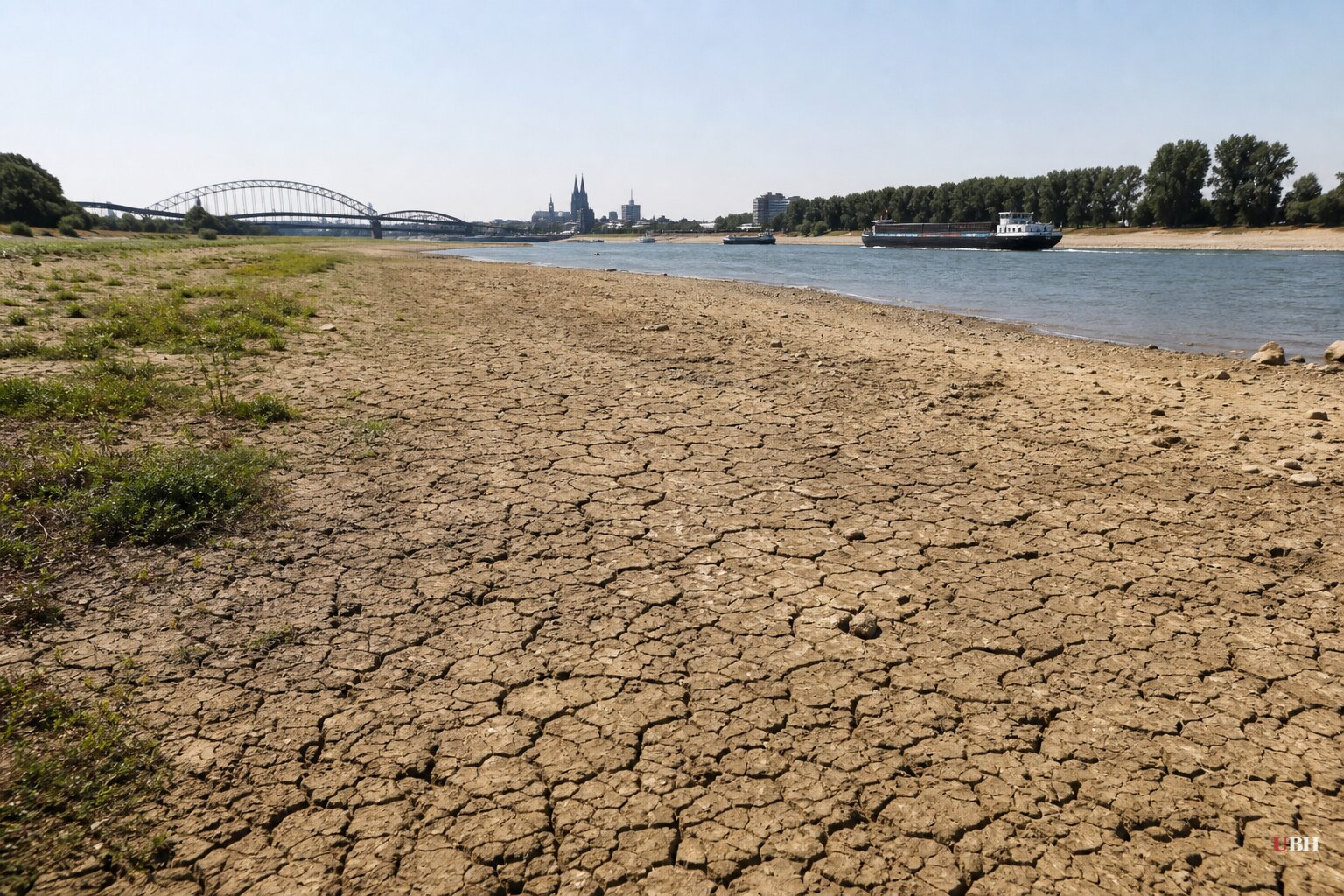
The Rhine river, one of Europe's main commercial arteries, is running at its lowest recorded flow for the month of July. Deltares, the Dutch water research institute, reported the river's daily average flow at Lobith fell to 771 cubic meters per second on July 15, 2026, breaking the prior record set in 1976. By August 4, the flow had dropped further to around 640 cubic meters per second, prompting Rijkswaterstaat, the Dutch national water management agency, to escalate the situation to its "actual water shortage" phase, according to Deltares.
Locks are being closed to stop water pressure loss that can destabilize riverbanks and dikes. Withdrawal bans on surface water and groundwater are in force in multiple regions to prevent saltwater from pushing inland and contaminating freshwater supplies, Deltares said.
The Numbers Behind the Dry Ground
According to nltimes.nl, citing Dutch newspaper AD, regional precipitation deficits in Noord-Holland and Zuid-Holland have now exceeded the benchmark set during the infamous drought summer of 1976. Nationally the deficit remains 10 to 15 millimeters below the 1976 mark as of early August, but the water board Hoogheemraadschap van Delfland is recording the worst deficit in the country at 332 millimeters and has declared "code black," closing locks and banning surface water extraction outright, including for watering gardens, parks and farmland.
Arjen Koomen, a water management adviser at engineering firm Arcadis, cautioned that the precipitation deficit alone doesn't tell the whole story. "That does not immediately say everything about the actual effects," Koomen said, pointing to groundwater levels, soil structure, river discharge, salinization and water supply options as equally important factors. Right now, he noted, most of those factors are offering little relief.
Potatoes, French Fries and a Bad Harvest
The drought's clearest damage is showing up in the fields. The Associated Press reported from Wolphaartsdijk in the Netherlands, where farmer Maarten Janse is spreading compost, straw and manure over cracked soil trying to keep it viable, even as broader restrictions bar many Dutch farmers from pulling irrigation water from streams and drainage channels.
Another Zeeland farmer, Hendrik Jan ten Cate, is looking at potato plants that withered a month ahead of schedule, with a noticeably smaller harvest. His potatoes go into French fries for companies including McDonald's. "People want long fries," ten Cate told the AP, holding up an undersized potato. "That's going to be tough this year." Ten Cate is among the farmers still permitted to irrigate, and he still expects his harvest to come in roughly a third below average. "It's not just the drought that is the problem," he said. "It is also the sun, the dry air and especially the hot days we have had this year."
In Bosnia, where agriculture accounts for roughly 5% of GDP and 10% of employment according to the AP, grain farmer Slavisa Lukic said repeated heat waves have devastated his corn. He used to harvest 6 to 7 tons per hectare; this year he expects 1.5 to 2 tons, if he gets a harvest at all. Clover fields that once grew abundantly on his land, he said, have all but disappeared.
Triodos, a Dutch bank focused on sustainability, estimated in an analysis cited by the AP that the combined heat waves and drought could shave 1% off European Union GDP for 2026, roughly 180 billion euros, or about $208 billion.
Rivers Running Dry, Boats Running Aground
The Straits Times and Phys.org, both drawing on reporting from Nijmegen, described a Rhine so low that a new beach has emerged where none existed months earlier, and a pedestrian ferry has been pulled from service. Restaurant boat captain Leon Berkers told the outlets he's operated on the river for up to 35 years and has never seen it this low. "We can't even fill the coffee cups to the brim or they spill," his 19-year-old son Linus added.
Marthe Wens, a water and climate risk researcher at the Institute for Environmental Studies at Vrije Universiteit Amsterdam, said the dried-out grass and early-turning trees make it "feel like we're in the south of France." She also flagged a slower-moving danger: buildings sitting on peat bog foundations that shrink and crack as the ground beneath them dries out.
Shipping has taken a direct hit too. Wens noted that both inland carriers and the industries relying on the goods they move are being squeezed by the low water.
What's Actually Driving It, and What's Still Unclear
The AP's reporting attributes the drought to a combination of what it calls "accelerated human-caused global warming" and a strong El Niño pattern battering European fields this summer. That framing reflects the AP's editorial judgment on causation. The Dutch and Belgian technical sources, Deltares and nltimes.nl, stick to measured river flows and precipitation deficits without assigning a single cause, treating this as a confluence of low rainfall, high heat and high evaporation demand.
All sources agree on one point: the Netherlands, a country built around keeping water out, is now confronting the opposite problem. Rijkswaterstaat has held its "actual water shortage" classification since mid-July, and Deltares says a temporary bump in Rhine flow from rainfall is expected before levels likely drop again. Whether Dutch water infrastructure, designed over centuries for flood control, can be redesigned fast enough to retain scarce freshwater remains an open question as water managers and researchers look ahead to the fall.
Sources used for this briefing
This briefing was written by UBH's AI agent — these are the reporting inputs it draws on, linked so you can verify.


