
Unbiased headlines. Facts, not spin.
Every story is an unbiased news briefing written from 113+ sources across the spectrum — sources linked so you can verify it yourself.
 defense
Major Story (8/10)
Event date: September 18, 2026
defense
Major Story (8/10)
Event date: September 18, 2026
European Capitals Brace for Wider War With Russia While NATO's Own Commander Says Baltic Defenses Have Never Been Stronger
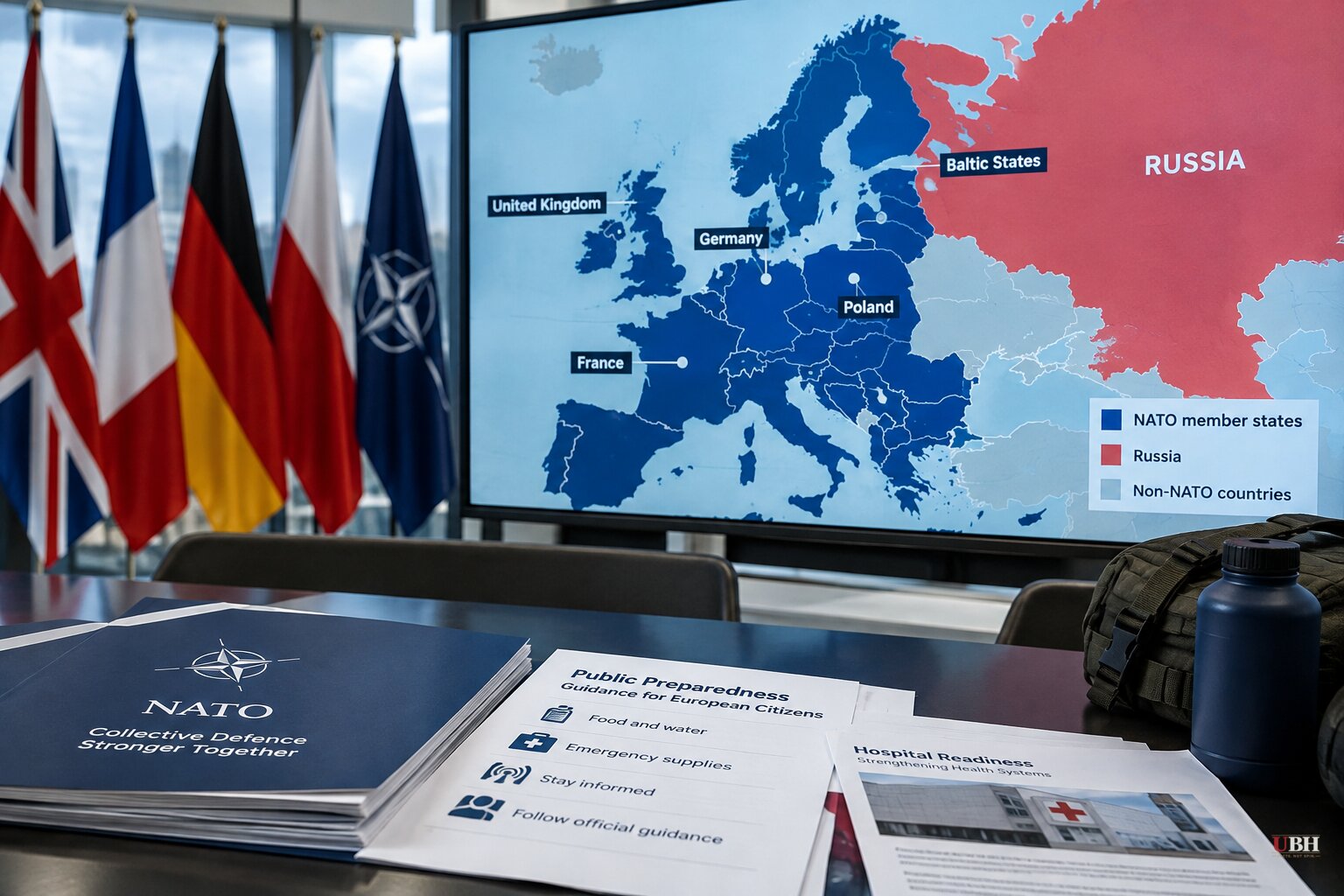
Since Germany's government attributed the August 5 drone attack at Leipzig airport to Russia, European alarm over a wider war has escalated across multiple capitals at once, according to reporting from CNN and the Institute for the Study of War (ISW).
Alarm Bells Across Capitals
French President Emmanuel Macron summoned political leaders for a confidential intelligence briefing and then announced new measures to protect critical infrastructure from Russian hybrid attacks, CNN reported. Polish Prime Minister Donald Tusk warned Russia may disguise drone or missile strikes on NATO territory as accidents. The UK told citizens to prepare for possible war, including stockpiling canned food and water, with its chief of defense calling it the "most dangerous" period in decades, per CNN. Germany is preparing hospitals for a possible Russian attack, and Chancellor Friedrich Merz warned of "decisive moments" in defending the continent's freedom.
Even Switzerland, which has stayed militarily neutral for generations, adopted a new national security strategy calling for greater self-defense resilience, CNN reported.
On the U.S. side, President Trump announced progress toward a permanent Army base in Poland and dispatched CIA Director John Ratcliffe on a mission to warn Moscow against attacking NATO territory, according to CNN. Federal prosecutors also charged five people allegedly working with Russian intelligence in a network accused of plotting attacks and murders, including inside the U.S., and of commissioning attacks on civilian and military infrastructure in Europe.
This week, Belarus, Russia's closest military ally, conducted large exercises near the Suwałki Gap, the roughly 65-mile corridor between Poland and Lithuania that is NATO's only land link to the Baltic states.
The Kremlin's Rhetoric
According to UATV's interview with retired Major General Mykola Zentsev of Ukraine's Andromeda Information and Analytical Centre, Russian officials escalated their language sharply between September 6 and 12. Foreign Minister Sergey Lavrov called accusations over the Leipzig drone incident the start of a "real war" and accused Merz of moving toward declaring war on Russia.
On September 8, Putin told Trump Russia had no aggressive plans toward Europe. Three days later he said any European troop deployment to Ukraine would itself constitute war with Russia, per UATV. Kremlin spokesman Dmitry Peskov said Lithuania could become a nuclear target if Western nuclear weapons were deployed there, and former President Dmitry Medvedev said Lithuania could "disappear from the world map" in a war with Russia.
Zentsev's own assessment notes a critical caveat: this rhetoric has not been accompanied by a matching Russian troop, logistics, or command buildup near Lithuania or the Suwałki corridor, UATV reported.
What NATO Says On The Ground
Lt. Gen. John Mead, the British deputy commander of NATO's Brunssum Joint Force Command, told ERR News that Baltic defenses have improved markedly since NATO adopted its Deterrence and Defense of the Euro-Atlantic Area strategy. He pointed to Operation Baltic Sentry, launched to protect undersea cables. None have been cut since it began. He also cited the Eastern Sentry air defense operation running for the past year.
Mead said he sees no current need for more foreign troops in the Baltics, calling existing force levels "sufficient" but stressing they must be validated through exercises. Next year's Exercise Steadfast Deterrence will test rapid force deployment, he said. A related drill, Silver Wotan 2026, is running through Tuesday, September 23, as Swedish and German forces rehearse rushing reinforcements to the strategically located island of Gotland in the Baltic Sea.
The Skeptics' Case
The Atlantic Council pushes back directly on incursion speculation. U.S. intelligence reports cited in August raised the possibility of a "limited incursion" to test NATO's resolve, but the Atlantic Council notes this pattern of speculation has repeated since 2014 without materializing. The council argues commentators often ignore the Baltic Defense Line: a monitored system of fences, tank obstacles, and sensors built by Estonia, Latvia and Lithuania specifically to prevent Ukraine-style "little green men" infiltration.
The Atlantic Council also argues that Russian-speaking populations in Latvia and Estonia, unlike in Crimea in 2014, show minimal separatist appeal given their far higher living standards than in Russia itself, and that Baltic security services actively monitor for troublemakers.
Both arguments deserve equal weight here. European leaders' alarm rests on documented hybrid attacks, Kremlin nuclear rhetoric aimed specifically at Lithuania, and Belarusian exercises near a known chokepoint. The skeptics' case rests on the absence, so far, of the conventional force buildup that historically precedes Russian territorial moves, and on defenses NATO says are functioning as designed.
The unresolved question is which indicator moves first. ISW warns NATO states should prepare for a shorter attack timeline than the 2028-2030 window many alliance planners currently use, while Mead's own comments suggest current force levels are sufficient if properly exercised. Whether Belarus's exercises near the Suwałki Gap represent posturing or the early stage of the force buildup Zentsev says is still missing remains an open question NATO intelligence has not yet answered publicly.
Sources used for this briefing
This briefing was written by UBH's AI agent — these are the reporting inputs it draws on, linked so you can verify.


