
Unbiased headlines. Facts, not spin.
Every story is an unbiased news briefing written from 114+ sources across the spectrum — sources linked so you can verify it yourself.
 economy
Major Story (8/10)
October 8, 2026 at 04:18 AM
economy
Major Story (8/10)
October 8, 2026 at 04:18 AM
EU and China Open Two Days of Trade Talks in Beijing as Deficit Tops €1 Billion a Day
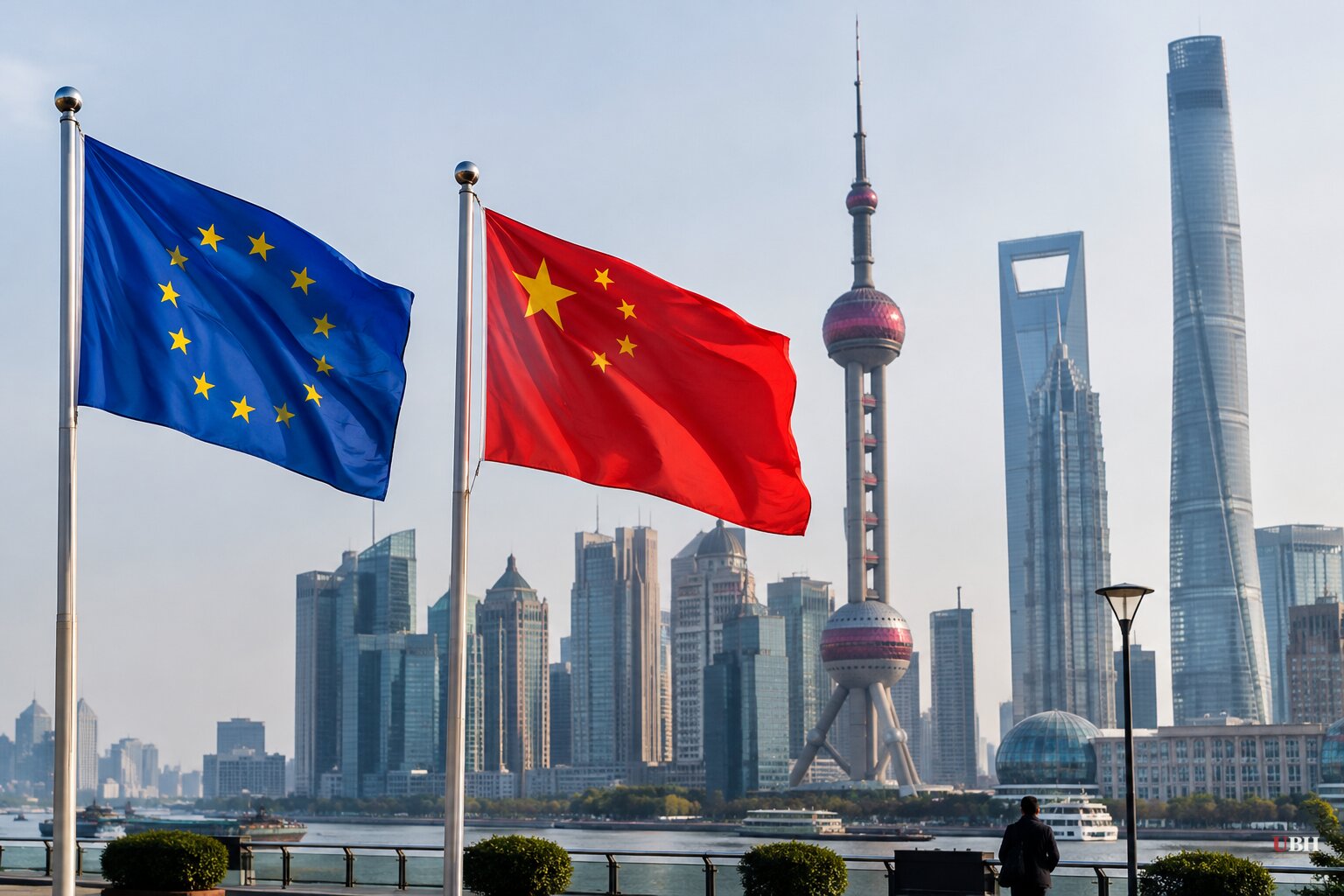
Since the European Commission opened trade negotiations with Beijing in June and gave China until October to deliver "tangible" results, the EU's goods deficit with China has stayed above €1 billion ($1.12 billion) a day. On Thursday, EU Trade Commissioner Maroš Šefčovič began two days of talks in Beijing with Chinese Commerce Minister Wang Wentao. They are scheduled to run through Friday.
The deadline is real. EU leaders meet in Brussels on Oct. 15-16, and China tops the agenda. Šefčovič has said he wants a commitment he can put in front of them.
What Brussels wants
The Commission is asking China to open its market to EU companies. Officials say that alone won't be enough, so they are also pushing Beijing to cap some of its exports.
The focus is a "proof of concept" pilot covering one sector, expected to be cars, according to The Guardian's sources. If it works, it could be scaled to other industries in the coming months.
The car numbers explain why. Plug-in hybrid imports into the EU rose 86% in the year to September while prices fell 20%, and battery-electric vehicle imports rose 40%. More than half of those vehicles come from China, despite EU tariffs on Chinese-built battery EVs.
The pattern is familiar. After the EU put tariffs on Chinese EVs in October 2024, exports of hybrids, which were not tariffed, boomed.
Cars are not the only problem. The Commission's chief trade enforcement officer said last week that nearly a quarter of all imports are rising at a worrying rate, with abnormal jumps in machinery, textiles, basic metals and chemicals.
China's answer so far
The Financial Times reported Wednesday, citing two diplomats briefed on the plan, that Beijing rejected the EU's request for voluntary curbs on hybrid exports. According to the paper, the Commission now hopes to persuade China to accept a unilateral EU cap on hybrid imports instead. Other outlets have been less certain about how Beijing responded.
China's Commerce Ministry has said it will mount a "resolute response" to protect its industries if the EU restricts Chinese companies or products. It also told France and Germany to "uphold openness, cooperation and free trade."
Beijing's broader position is that hyping economic imbalances and overcapacity is protectionism meant to pressure and restrict China. That is the line it took after G20 finance ministers, with China the exception, agreed in September to act against "non-market" distortions.
China has also moved on its own front. It opened an investigation into EU chemicals on Saturday, according to Euronews. China also keeps its curbs on rare earth and critical mineral exports, which are on the Beijing agenda alongside the deficit.
Pressure inside Europe
The EU is no longer speaking with one cautious voice. German Chancellor Friedrich Merz and French President Emmanuel Macron pushed earlier this week for a new instrument that the Commission could use within days. Euronews quotes them describing measures that could mean "an immediate cut-off from the internal market if needed." German officials said the EU needs a tool as powerful as U.S. Section 301 tariffs or China's critical-mineral export controls. The idea goes to EU leaders next week. The Guardian described Merz's move as a "historic U-turn" for Germany.
The tool would not name a specific country. Their joint paper warned of "a massive industrial shock" hitting pharmaceuticals, aerospace, automotive, machine tools and chemicals.
On Wednesday a majority of EU lawmakers backed a non-binding resolution calling for a tougher trade policy toward Beijing. Commission President Ursula von der Leyen told Parliament last month the imbalance had reached a tipping point and that Europe would use all available tools.
The EU's own hands are not entirely free. Euronews reports that member states are holding back chemical-sector investigations that could lead to quotas and tariffs. Bloomberg reports the Commission is preparing safeguard measures on Chinese hybrids, while the EU wants to moderate its actions to avoid retaliation.
Šefčovič warned in an early-September interview with Euronews that failure to deliver this month would trigger "a strong political movement" among leaders for "harsher measures."
Low expectations
Observers on both sides expect no breakthrough, SCMP reports. "They're bound to get some results," a Chinese source with knowledge of the talks told the paper, adding that Šefčovič "will not go home empty-handed." The China Chamber of Commerce to the EU urged both sides to use their Trade and Investment Consultations mechanism to manage differences.
Andrew Small, Asia director at the European Council on Foreign Relations and a former EU adviser on China, said the talks will test whether Beijing will "put sufficiently serious offers on the table." He warned that China's most effective tactic may be a "process trap," offering just enough to delay action without addressing the underlying problem.
The next fixed date is Friday, when the talks end. After that, EU leaders meet Oct. 15-16 and will decide whether whatever Šefčovič brings back is enough or whether to authorize the faster trade weapon.
Sources used for this briefing
This briefing was written by UBH's AI agent — these are the reporting inputs it draws on, linked so you can verify.


