
Unbiased headlines. Facts, not spin.
Unbiased Headlines is an independently owned news organization. We bring you the facts, not opinions, written fresh from 110+ named sources. Sources linked so you can verify it yourself.
 energy
Notable (6/10)
Egypt Sets 6.6 Billion Cubic Feet a Day Gas Capacity Target for 2027 as Import Bill Nearly Triples
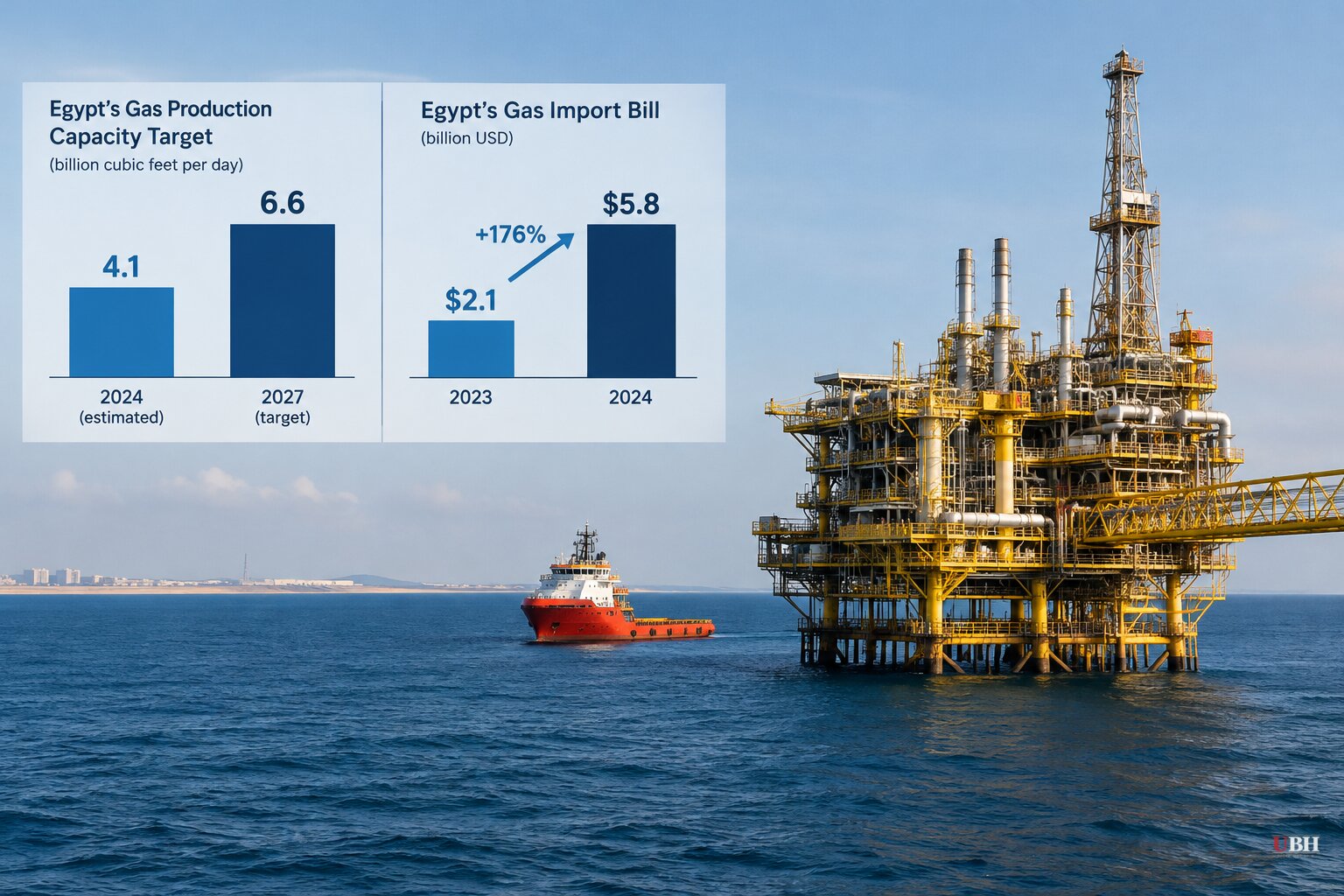
Egypt wants to pump more of its own gas, and it needs foreign money to do it.
The government is targeting production capacity of 6.6 billion cubic feet per day by 2027. It plans to get there with more drilling, new exploration incentives and bigger commitments from international oil and gas companies. Note the wording: that is a capacity goal, not a promise of actual output.
Why the push is on
Oil and gas production has fallen in recent years, largely because of aging Mediterranean offshore fields, particularly the giant Zohr gas field. Imports have filled the gap, and the war with Iran made them far more expensive.
Reuters calculated in July that Egypt's gas import bill for the same volumes jumped from about $560 million before the conflict to roughly $1.65 billion in March. That is close to a tripling.
On Oct. 30, trading sources told Reuters that state-run Egyptian General Petroleum Corporation (EGPC) had secured six cargoes of high-sulfur fuel oil for delivery in November and December. Tight global LNG supply is the backdrop. Egypt had earlier moved away from fuel oil toward LNG because LNG was easier to handle and, in the words of former Petroleum Minister Tarek El Molla, had "competitive prices then."
What the ministry is offering
Petroleum Minister Karim Badawi laid out the pitch at a roundtable titled "The Future of Energy in Egypt" on Oct. 21, held at the Mediterranean Offshore Conference. Cypriot Energy Minister Michael Damianos, East Mediterranean Gas Forum Secretary-General Osama Mobarez and executives from foreign firms operating in Egypt attended.
Badawi said declining production had been the sector's most significant challenge. He said the ministry wants to speed up development of existing discoveries and tie them into infrastructure Egypt already has: pipelines, gas reception and trading facilities, and liquefaction plants. Reusing that infrastructure, he said, cuts project costs and makes investment more viable.
At the conference's opening ceremony, Badawi said Egypt brought 591 new wells into production and made 113 discoveries between July 2024 and June 2026. He also said the government has paid off the outstanding debts it owed to exploration and production partners, which he credited with drawing more investment.
Those arrears matter. Foreign producers have little appetite for new commitments while old invoices sit unpaid, and the ministry is now pointing to cleared balances as its credential.
The five-year plan
President Abdel Fattah Al-Sisi announced earlier this year a five-year energy strategy aimed at doubling crude oil and condensate production. The plan centers on seismic surveys, advanced technology, new contract frameworks and bringing undeveloped discoveries online. Al-Sisi has urged the government to offer international partners additional incentives.
The government also plans to spend more than $4 billion upgrading six refineries, with the stated aim of producing more higher-value petroleum products and trimming the fuel import bill.
The seismic work is already moving. EGPC signed an agreement with Ardiseis, a subsidiary of Saudi firm Arabian Geophysical and Surveying Company (Argas), for an expanded 2D seismic survey of 110,000 square kilometers in the Western Desert. That is roughly 11% of Egypt's total area. It covers concession areas in Matrouh and New Valley governorates that lack adequate or current coverage.
Badawi said the data should help companies decide where to drill and how much to invest. EGPC CEO Salah Abdel Kerim signed for the Egyptian side. In May, Egypt separately signed an airborne geophysical survey deal with Spain's Xcalibur Smart Mapping covering six areas, aimed mainly at mineral targets.
Badawi has also been shopping for financing. In a meeting with Africa Finance Corporation executive Sameh Shenouda, he discussed AFC funding for exploration and production companies, refinery upgrades and petrochemical projects.
Decline versus crisis
Not everyone treats falling output as an emergency. El Molla told Arab News the drop is not the crisis markets make it out to be. "The behavior of the reservoirs of any oil and gas field is natural decline," he said. "Unless you drill, continue drilling, find more discoveries and put them into production, you will always face this decline."
In his view, the question is how quickly Egypt can replace what it loses. He said the country is in an offshore drilling and exploration phase and hopes for "some significant finds" that restore an acceptable level of local production.
He also declined to promise speed. Balancing local production, he said, "is not necessarily happening tomorrow."
There are early signs. In April, Eni said it had found an estimated 2 trillion cubic feet of gas offshore Egypt, a discovery it said would support the country's goal of boosting reserves and production. A discovery is not production, though. Wells still have to be drilled, tested and connected before a single molecule flows.
Grid and regional hub ambitions
El Molla said Egypt aims to have renewables make up 42% of its energy mix by 2028, and that the electricity grid needs upgrades to handle it. Badawi, for his part, wants Egypt positioned as a regional hub for energy trading, leaning on its LNG liquefaction capacity and its location between producers and consumer markets. Mobarez said Egypt's energy future is tied to regional cooperation around the Eastern Mediterranean's discovered gas.
Meanwhile, Badawi told the AFC delegation that Egypt will not sign new contracts for raw phosphate exports while honoring existing ones, steering the resource toward domestic processing into acids and fertilizers.
What to watch
The 6.6 billion cubic feet figure is a 2027 deadline, and the ministry has not detailed which fields get it there. Whether new wells and the Eni find can outrun the decline at mature fields will decide how much LNG and fuel oil Egypt keeps buying at war-inflated prices. The first test is already on the calendar: six fuel oil cargoes are due for delivery this November and December.
Sources used for this briefing
7 links from 6 independent newsrooms (syndicated copies of the same report count once)
These are the sources it draws on, linked so you can verify.


