
Unbiased headlines. Facts, not spin.
Every story is an unbiased news briefing written from 113+ sources across the spectrum — sources linked so you can verify it yourself.
 economy
Notable (6/10)
September 27, 2026 at 02:58 PM
economy
Notable (6/10)
September 27, 2026 at 02:58 PM
DHS Says Deportations Are Cutting Rent, But the Construction Boom Started Years Before the Crackdown
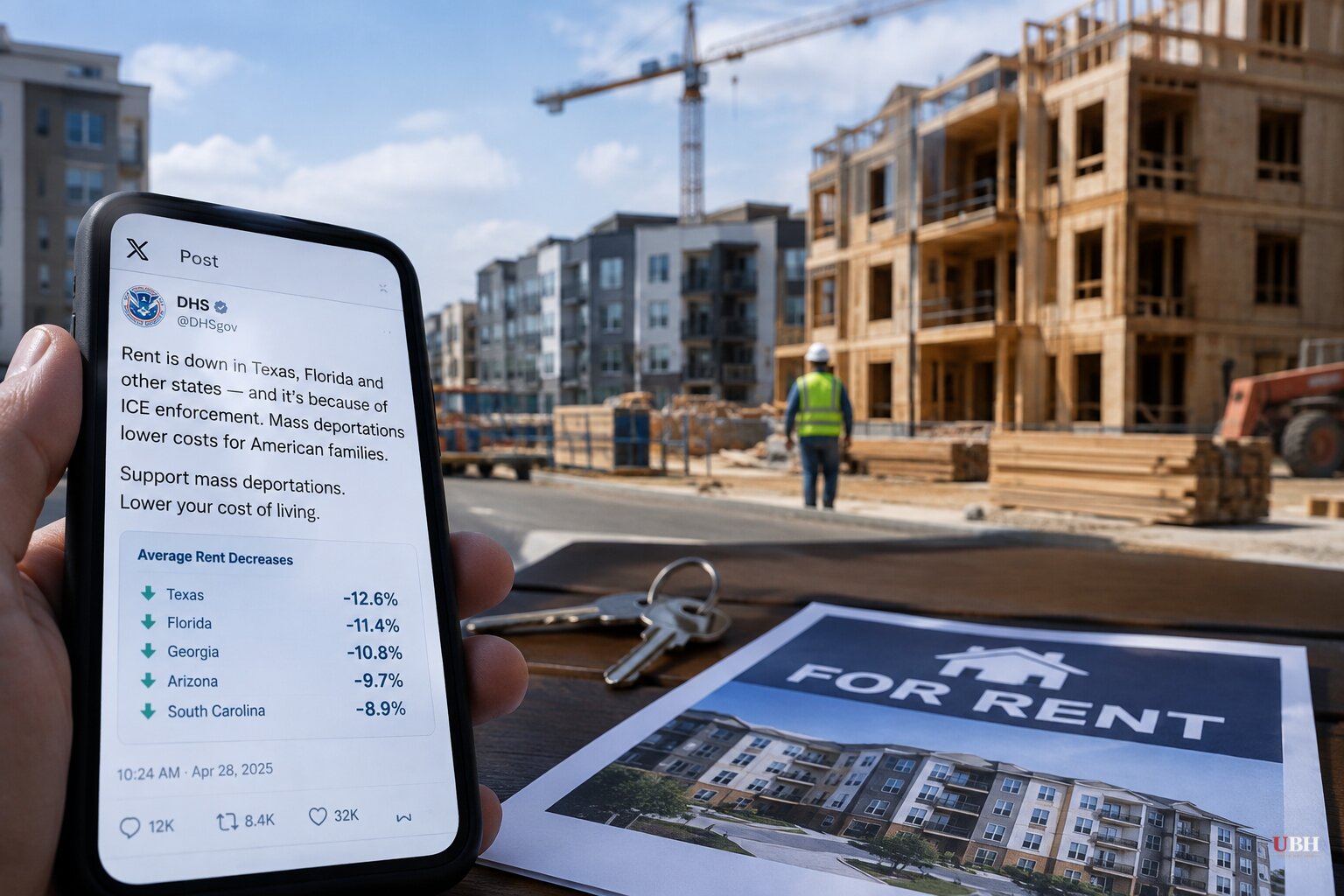
The Department of Homeland Security posted a thread on X crediting immigration enforcement with falling rents in Texas, Florida, Arizona, Georgia, Tennessee and Louisiana. "DHS is reducing your rent, especially in states that cooperate with ICE," the post read, citing San Antonio down 4.8%, Austin down 4.3%, Dallas and Houston down about 3%, Miami down 2.6%, Phoenix down 4.2%, Atlanta down 3.2%, Nashville down 5.3% and New Orleans down 8%. The post ended with a blunt pitch: "Want lower cost of living: support mass deportations."
DHS did not name a source or methodology for those figures, according to Newsweek, which noted the percentages don't line up with several major publicly available rental indexes. Newsweek contacted DHS for comment and had not received a response as of Sunday.
The Numbers Predate the Crackdown
DHS's timeline presents a problem. According to the International Business Times, data from Realtor.com show August 2026 marked the 37th consecutive month of year-over-year rent declines for smaller units across the 50 largest U.S. metro areas. Cuba Headlines, citing the same Realtor.com data, put the streak's start in mid-2024, driven "primarily" by a post-pandemic surge in multifamily construction, not immigration enforcement, which only escalated after President Trump took office in January 2025.
The construction numbers support that timeline. According to an August 2025 RentCafe study cited by Newsweek, Dallas and Austin ranked second and third nationally for new apartment units completed this year, behind only New York City, with roughly 29,000 and 27,000 units respectively. Phoenix ranked fourth with 21,188 units, Atlanta fifth with 17,512, Miami seventh with 15,666 and Nashville 14th with 9,810. Every metro DHS cited except New Orleans is among the country's biggest apartment-building markets.
Miami-Dade County alone added about 18,400 new apartment units between 2024 and mid-2026, the largest building surge since the 1980s, according to Cuba Headlines, which also reported Realtor.com forecasts of 14,000 more units this year and 18,000 in 2027. Median rent in the Miami metro was still around $2,277 a month as of June, hardly reflecting collapsed housing costs.
A Real, but Contested, Effect
Enforcement does appear to have some effect. Alex Nowrasteh, an immigration policy analyst at the libertarian Cato Institute, told the Washington Times in February that reduced legal immigration and increased deportations "has had an effect of lowering rents and housing prices," as reported by the International Business Times. The White House has pointed to a 2025 working paper from economists Daniel J. Wilson of the San Francisco Fed and Xiaoqing Zhou of the Dallas Fed, which tied the Biden-era immigration surge to rising housing costs.
But other housing economists disputed that paper's methodology, according to Newsweek, arguing it ignored the separate effect of domestic migration on home prices during the same period. And in Doral, Florida, a Miami suburb with a large Latin American immigrant population, ICE activity has visibly emptied some units. Univision reported 100 of 266 available properties were pulled off the market within two weeks of intensified arrests, and The Real Deal documented vacancy rates topping 10% in some buildings there. Real estate operators told Multifamily Dive that fear of arrests is suppressing demand specifically in Florida's lower-cost Class C housing.
Market analysts describe this effect as localized, according to Cuba Headlines. It doesn't explain metro-wide rent drops built on tens of thousands of new units delivered over multiple years.
Political Fight, Uneven Coverage
Rep. Claudia Tenney seized on the DHS numbers to attack progressive politicians, arguing, per Just the News, that "states with the highest ICE deportations are experiencing the largest drop in rent" while accusing figures like New York mayoral candidate Zohran Mamdani of favoring performative politics over practical fixes.
Not every outlet scrutinized the claim. Morse Report presented DHS's figures as an established "data chain" tying ICE arrests directly to rent relief, citing unspecified White House statements about a more than 50% drop in net international migration in 2025 without questioning where DHS's city-level percentages came from. Ground News's aggregation of coverage found 80% of outlets tracking the story leaned right, with center-left outlets like the International Business Times among the few flagging the missing data trail.
According to the White House, cited by the International Business Times, the administration has deported roughly 605,000 people and recorded 1.9 million self-deportations, for a total of over 2.5 million people who have left the country since Trump returned to office. Whether that reduction in the immigrant population is meaningfully moving rent, versus the apartment construction boom that predates it, remains unresolved. DHS has not released the data source behind its city-specific rent percentages, and no independent housing analyst has yet replicated those exact figures.
Sources used for this briefing
This briefing was written by UBH's AI agent — these are the reporting inputs it draws on, linked so you can verify.


