
Unbiased headlines. Facts, not spin.
Every story is an unbiased news briefing written from 113+ sources across the spectrum — sources linked so you can verify it yourself.
 economy
Major Story (7/10)
September 27, 2026 at 01:14 PM
economy
Major Story (7/10)
September 27, 2026 at 01:14 PM
Chinese Factories Now Make Gucci Sneakers While Chinese Automakers Gain Ground on VW and Renault
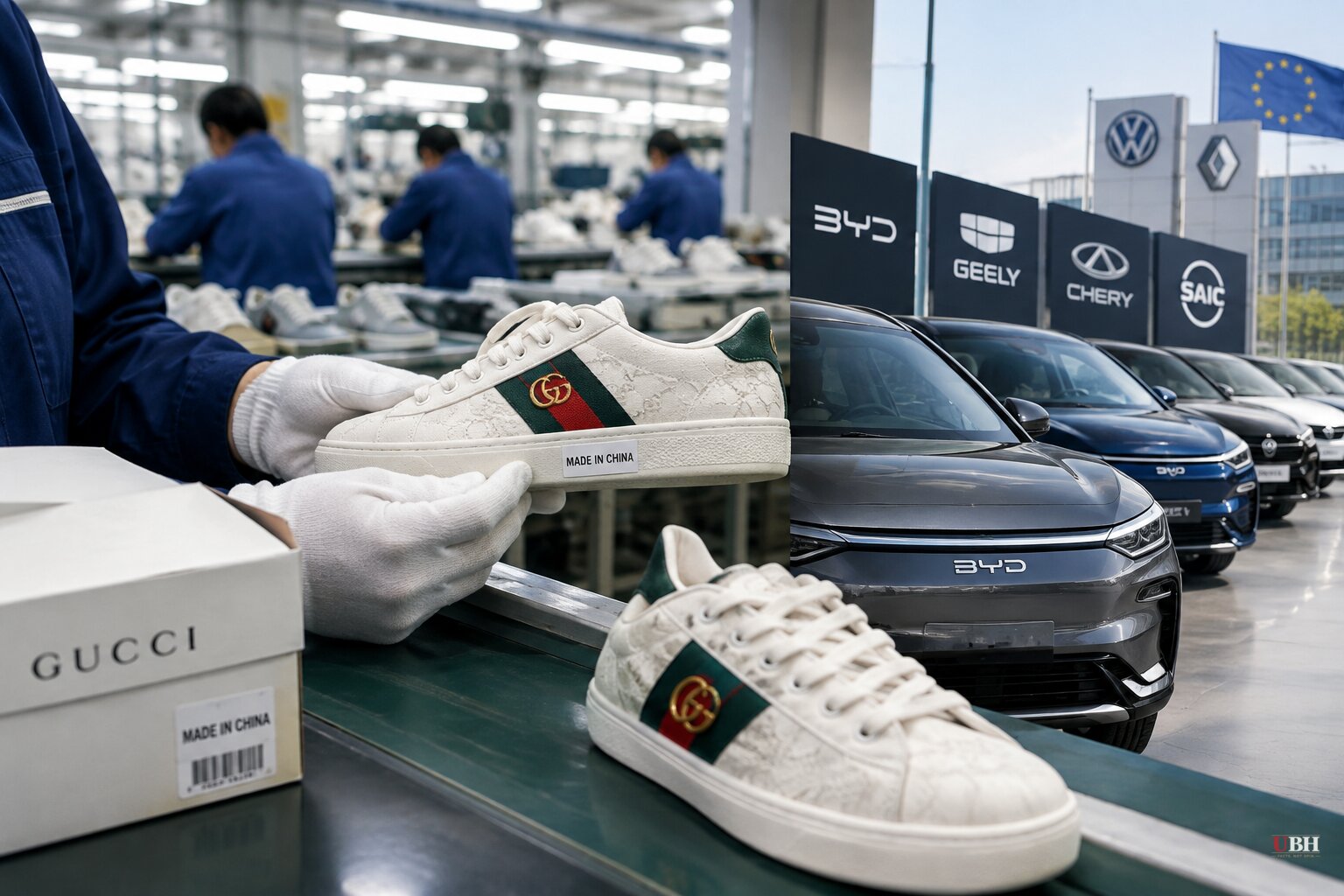
A $1,000 sneaker with a new label
Gucci has started selling a new sneaker called Drip, designed by Demna, retailing for about €800 in Europe and $1,000 in the United States. According to Reuters reporting carried by Yahoo Finance and 933 The Drive, the shoe's tag reads "Made in China," a first for a brand that has spent 105 years selling itself as Italian craftsmanship.
Gucci told Reuters the Chinese manufacturer was chosen for its "technological know-how and capabilities," not cost, and said Italy remains "at the heart of Gucci's manufacturing model." A second Primavera-collection sneaker is also Made in China. The company says there are no broader plans to shift production out of Italy.
The timing isn't great for Gucci. Parent company Kering has watched Gucci sales halve over three years, according to Reuters, forcing store closures and price cuts under new CEO Luca de Meo. Demna presented his latest collection at Milan Fashion Week this past week, with his sneaker gamble carrying real weight for a brand trying to win back price-sensitive shoppers.
The "second China Shock"
Fortune frames this as part of what Apollo Global Management chief economist Torsten Slok calls the second China Shock. The first, in the early 2000s, was cheap goods flooding Western markets. This one is China producing high-end products that used to be Europe's exclusive turf.
"I think symbolically, China has arrived," Ker Gibbs, former president of the American Chamber of Commerce in Shanghai, told Fortune. "It's no longer a place where only cheap stuff gets manufactured and poor quality this and that."
Howard Yu, a management professor at Switzerland's IMD, told Fortune the shift traces back to European companies themselves. Volkswagen has built cars in China since the 1980s, and in Yu's words, "essentially has trained up a generation of suppliers to meet Western standards." Once those suppliers had the skills, they built their own brands.
Chinese labor is still far cheaper. Manufacturing workers there earned $629 a month on average last year, compared with $1,341 in Taiwan and $2,075 in South Korea, according to a survey by Japan's trade agency cited by Fortune. So this isn't purely a technology story. Low costs and rising quality are combining, and that combination is hard for anyone to beat on price or margin.
Germany's car problem
No country feels this more than Germany. European Central Bank economists found that since 2019, the mix of goods China exports has increasingly overlapped with Germany's own export mix, mostly machinery and cars, and that overlap has grown faster for Germany than any other EU country.
The EU auto sector supports about 13 million jobs and 7% of the bloc's GDP, according to the Epoch Times. The European Commission's March 2025 Automotive Action Plan called the industry at a "critical turning point," citing high costs and the risk of falling behind on batteries and software. Renault told the Epoch Times the industry faces "a significant competitiveness gap" against China on development time and production cost. BMW's 2025 annual report said the same.
Pierre-Olivier Essig of AIR Ltd told the Epoch Times Europe should lean into what it still does best, luxury and performance vehicles, while governments cut taxes on employment and profits for domestic automakers. Without that, he warned, Europe risks becoming "a service-only country." That's Essig's prescription, not a settled fact. Some economists would argue subsidies just delay the reckoning rather than fix the underlying cost gap.
The hybrid loophole
Brussels imposed anti-subsidy tariffs on Chinese electric vehicles in 2024. Chinese automakers responded by shifting to hybrids, which the tariffs don't cover. The Guardian reports full-hybrid sales from China went from 659 vehicles in 2022 to 160,662 in the first seven months of this year. Plug-in hybrids went from 56,706 to 217,764 over the same stretch, per Eurostat figures.
Germany's auto industry group, the VDA, said this past week for the first time it would consider tariffs on Chinese hybrids specifically, telling the European Commission that "where unfair conduct is proven," trade defense tools should be used.
ACEA data shows BYD, Chery and Leapmotor posting triple-digit growth in the EU. Geely, which owns Volvo and Polestar, remains the top Chinese brand with 205,000 units sold through August. BYD sold 177,000, up 163% year over year. Both are now ahead of Tesla's 142,000. Volkswagen still leads on raw volume with 2 million units sold in the same period, according to the Guardian.
Jalopnik reports Volkswagen's August sales fell 3.6% to 201,818 vehicles and Renault's fell 4.4% to 71,906, while BYD's registrations more than doubled to 26,007. Volkswagen has approved doubling planned job cuts to 100,000 and flagged roughly $11.5 billion in impairment charges tied partly to its Porsche stake, according to Jalopnik. Porsche is separately cutting 5,000 jobs after what Jalopnik described as a sales collapse in China combined with U.S. tariffs and an early EV bet that hasn't paid off.
Across the Atlantic, Jalopnik reports U.S. senators have asked the Trump administration to keep Chinese automakers out of the American market entirely, pointing to what's happening in Europe as the outcome they want to avoid. Jalopnik also notes Mercedes-Benz is looking to cut German labor costs and Honda is planning a $2.5 billion assembly plant in Ohio. Whether that U.S. plant reflects a genuine reshoring trend or ordinary capacity planning isn't established by the reporting, but the contrast with Europe's numbers is hard to miss.
The open question for Brussels is whether hybrid quotas or tariffs, still under discussion and not yet enacted, arrive before Chinese brands lock in the market share European automakers are currently losing.
Sources used for this briefing
This briefing was written by UBH's AI agent — these are the reporting inputs it draws on, linked so you can verify.


