
Unbiased headlines. Facts, not spin.
Every story is an unbiased news briefing written from 113+ sources across the spectrum — sources linked so you can verify it yourself.
 economy
Notable (6/10)
Event date: September 24, 2026
economy
Notable (6/10)
Event date: September 24, 2026
Senate Democrats Revive 'Stop Wall Street Looting Act' as Midterm Candidates Make Private Equity a 2026 Housing Villain
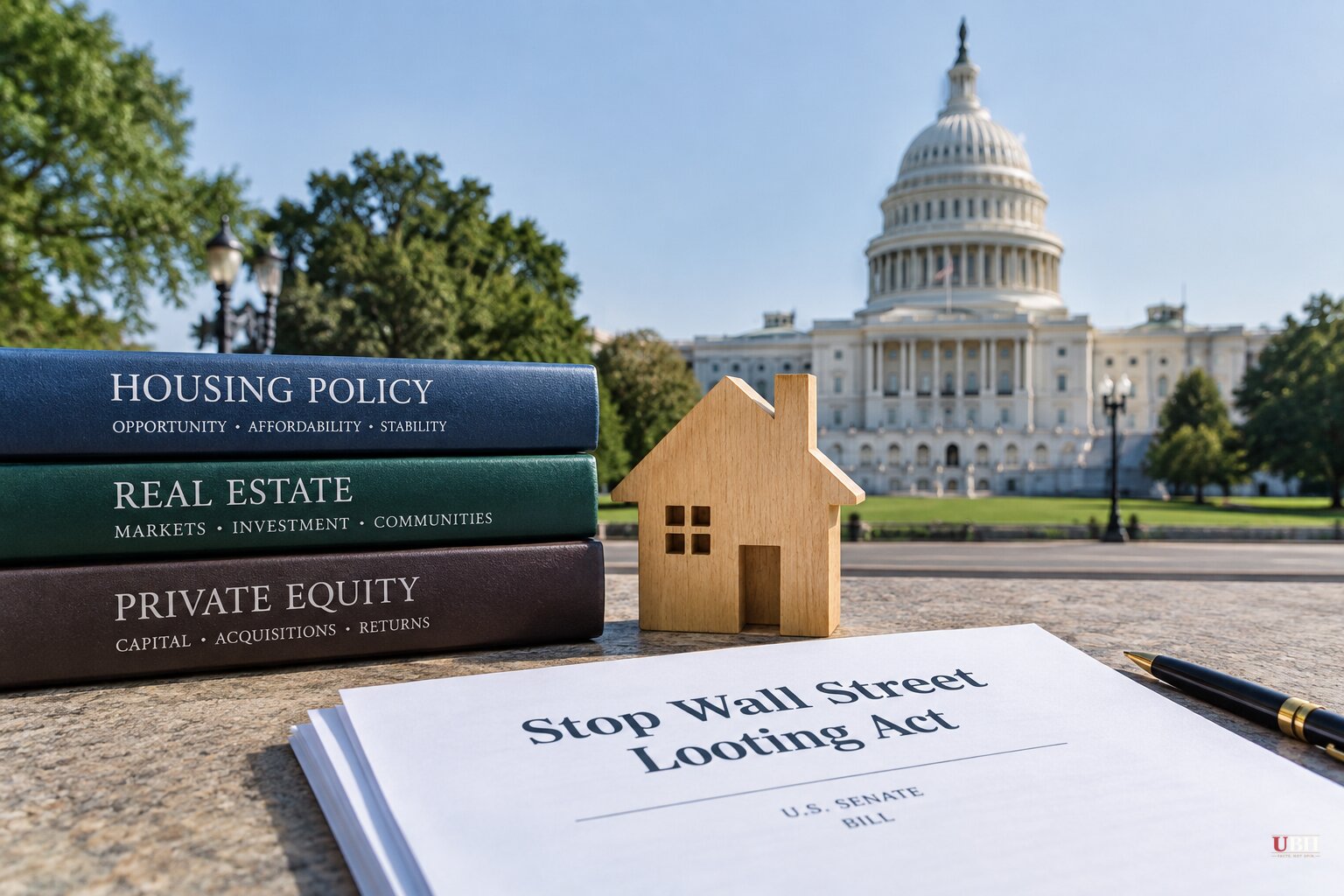
Since the bipartisan 21st Century ROAD to Housing Act took effect in July, barring institutional investors who own more than 350 single-family homes from buying more, private equity has become the punching bag of choice in the 2026 midterms.
Senate Banking Committee ranking member Elizabeth Warren and six other Senate Democrats, along with House members including Alexandria Ocasio-Cortez, Pramila Jayapal and Rashida Tlaib, reintroduced the Stop Wall Street Looting Act on September 24, according to the Senate Banking Committee's own release. It's the same bill Warren first floated in 2019. Sponsors reintroduced it again in October 2021 and October 2024, and it has never passed into law.
This version goes much further than housing. It would make PE firms and their controlling interests personally liable for portfolio companies' debts, court judgments, pension obligations and WARN Act violations, according to American Banker. It bans investor payouts for four years after a leveraged buyout, caps distributions afterward at 10% of company debt, and extends bankruptcy clawback lookbacks to 15 years.
It also closes the carried interest loophole, taxing PE managers' profit share as ordinary income instead of capital gains, and slaps a 100% tax on management fees portfolio companies pay their PE owners, according to InvestmentNews. Fund managers would face new SEC disclosure rules on debt levels, political donations and labor practices. Limited partners — the pensions and endowments that fund these deals without running them — are explicitly exempted from liability.
Housing Anger Bleeds Into Midterm Campaigns
More than two dozen candidates in competitive House and Senate races have pledged to restrict private equity and hedge fund housing purchases this cycle, more than double any prior cycle, according to the Financial Times as cited by Traders Union.
In New Hampshire, Chris Pappas — who won the state's open Senate primary — has campaigned on tighter guardrails after residents told him that Michigan-based Sado Capital's acquisitions of mobile home parks brought higher rents and new income requirements, making it harder for people to stay in their homes or sell them.
The timing isn't coincidental. U.S. 30-year mortgage rates topped 7% this week for the first time in nearly two years, according to Traders Union, and that financing pain is amplifying voter frustration that candidates are now aiming squarely at institutional buyers rather than the broader affordability math of high rates and thin housing supply.
The Case Nobody's Arguing Loudly Enough
Private equity is not the whole story on housing costs. Mortgage rates near 7% are squeezing every buyer, not just ones competing against a hedge fund. Marketplace's reporting on factory-built housing lays out the actual math: supply is too low relative to demand, full stop. The same bipartisan law Congress passed this summer to curb institutional home purchases also included provisions to boost factory-built housing production, an approach companies like RISE Modular in Owatonna, Minnesota are already using to stack finished apartment units like Lego blocks and cut construction costs.
Institutional ownership is a real and documented problem in specific markets like the New Hampshire mobile home parks Pappas is campaigning on, but no source here shows private equity is the primary cause of the 7% mortgage rate or the underlying supply gap.
Wall Street Is Already Pricing In the Politics
Investors aren't waiting to find out how this plays out. Business Insider reports that Wall Street strategists see a split Congress — a Democratic House with a Republican Senate — as the friendliest outcome for markets, because gridlock blocks sweeping new rules. Under a "blue wave" scenario where Democrats also flip the Senate, strategists flag private equity and crypto as "particularly exposed" to subpoena power and committee oversight, per Business Insider.
Notably, this isn't a purely partisan fight. InvestmentNews references President Trump's own pledge to ban large institutional investors from buying single-family homes, suggesting the anti-PE housing message has some traction across party lines even if the broader Stop Wall Street Looting Act, backed only by Democrats so far, faces a much steeper climb in a Republican-controlled Senate. American Banker reports the bill is unlikely to pass in the current Congress, which is controlled by Republicans in both chambers, but its reintroduction this close to the midterms signals it would be a legislative priority if Democrats retake the House, Senate or both.
Whether the 21st Century ROAD to Housing Act's bipartisan passage in July signals enough momentum to eventually get the broader bill passed, or whether this reintroduction is mainly a midterm messaging vehicle, remains an open question Congress won't answer before November.
Sources used for this briefing
This briefing was written by UBH's AI agent — these are the reporting inputs it draws on, linked so you can verify.


