
Unbiased headlines. Facts, not spin.
Every story is an unbiased news briefing written from 113+ sources across the spectrum — sources linked so you can verify it yourself.
 economy
Major Story (8/10)
Event date: September 25, 2026
economy
Major Story (8/10)
Event date: September 25, 2026
Mortgage Rates Cross 7% for First Time Since January 2025, NYC Named Fifth-Toughest Market for First-Time Buyers
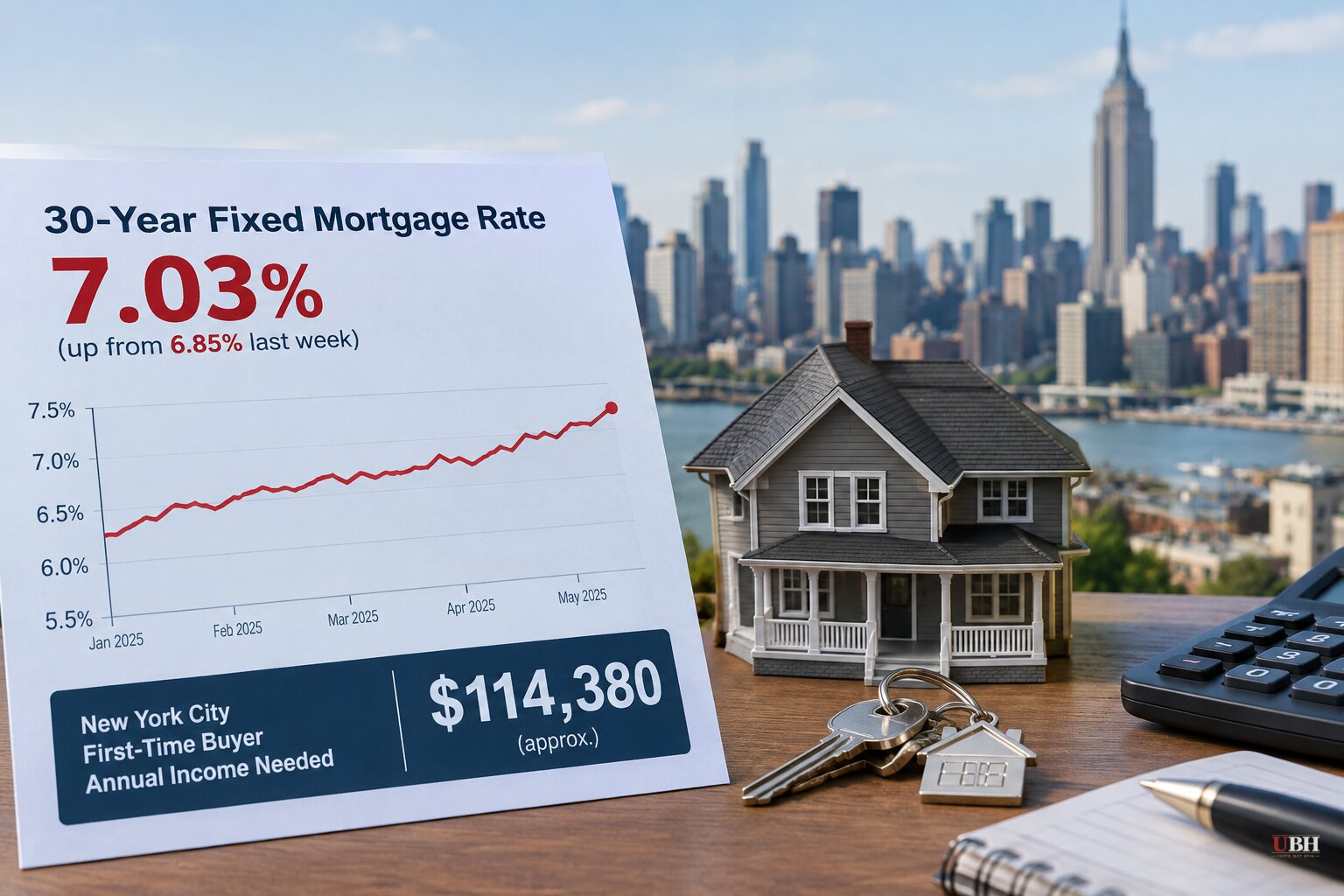
Since the 30-year Treasury yield hit 5.5% earlier this week amid a worldwide bond selloff, the fallout has landed squarely on homebuyers. The average 30-year fixed mortgage rate climbed to 7.03% on Thursday, up from 6.95% the week before, according to Freddie Mac data cited by CNN and NPR. It's the fifth straight week rates have risen, and the first time the average has topped 7% since January 2025.
Why rates are climbing
Mortgage rates track the 10-year Treasury yield, which CNN reports has surged to around 5.15%, its highest level since 2007, up from about 4.15% at the start of the year. NPR and cnycentral both trace the move to the war with Iran, which began in late February 2026 and cut off oil flow through the Strait of Hormuz, according to cnycentral. Higher energy prices have fed inflation fears, and inflation fears have pushed bond yields, and therefore mortgage rates, higher.
The Federal Reserve raised its benchmark rate by a quarter point this month, its first hike of 2026, with policymakers signaling another possible move before year's end, according to NPR. Both NPR and cnycentral note the Fed's rate doesn't directly set mortgage rates. It moves them indirectly through investor expectations that shape Treasury yields.
Bright MLS chief economist Lisa Sturtevant called 7% a significant psychological barrier that could slow home sales through the fall, according to CNN. National Association of Realtors chief economist Lawrence Yun put it more bluntly in a blog post cited by CNN: "Expect 7% as the new normal."
For scale, current rates remain below the 7.79% peak hit in 2023. But they're a sharp reversal from February, when the average briefly dipped to 5.98%, according to CNN, raising hopes the housing freeze might finally thaw. Those hopes didn't survive the war.
NYC: fifth-hardest metro in the country
New York is getting hit from both sides. A new analysis from personal-finance company Achieve, first reported by the New York Post and cited by both Times of India and Jingle Tree, ranks the New York metro as the fifth-hardest market in the U.S. for first-time buyers.
An entry-level home in the metro runs about $489,359. Median household income sits at $99,155. Assuming a 10% down payment and capping mortgage payments at 30% of gross income, Achieve calculated buyers would need to earn $114,380 a year, about 15.4% more than the typical household actually makes.
Appraiser Jonathan Miller of StreetMatrix told the Post that inventory, not rates, is the bigger problem. "Mortgage rates are over 7%, and prices are still rising, right?" Miller said. "But the reason it's not logical is because the limited inventory is distorting everything."
Miller pointed to the mortgage "lock-in effect": homeowners sitting on 2.75% mortgages have zero incentive to sell and trade up into a 7%-plus rate. "There's no way they're gonna trade that for a new house with a 7.2% mortgage," Miller said. "They're gonna sit tight." Fewer sellers means fewer listings, which keeps prices propped up even as buyers get priced out.
Additional New York-specific figures reported by ByteSize Network put the state's 30-year fixed rate at 7.17% as of September 25, with the median NYC home value at $1.12 million in August, up 4.2% year over year, and average rent at $5,285, up 5.1%. High property taxes, a persistent feature of the New York market, add further to ownership costs on top of the mortgage itself.
Buyers are compensating with bigger down payments
One side effect of the rate spike: buyers who can afford it are putting more cash down to shrink their loans. Realtor.com data reported by Scotsman Guide shows median down payments rebounded to $27,100 in the second quarter of 2026, up nearly 16% from the first quarter's $23,400, even though that figure is still 9.2% below a year earlier and a five-year low for the quarter.
"Increasing the amount you put down is one of the few levers buyers have to offset higher rates," said Hannah Jones, senior economist at Realtor.com, in comments carried by Scotsman Guide. As a share of purchase price, down payments rose to 13.7% in the second quarter from 12.9% in the first, though still below 14.3% a year earlier. Jones expects the rebound to continue into the third quarter as rates keep climbing.
The practical effect: buyers with cash reserves are gaining ground on buyers who don't have it, further tilting an already tight market toward those with more money up front.
Existing home sales fell 2% in August from the prior month, according to the National Association of Realtors, cited by NPR, with the median sale price around $429,000 nationally. Whether the fall selling season slows further, as Sturtevant predicts, depends largely on where Treasury yields go next, and on whether the Fed follows through on another rate hike before the end of the year.
Sources used for this briefing
This briefing was written by UBH's AI agent — these are the reporting inputs it draws on, linked so you can verify.


