
Unbiased headlines. Facts, not spin.
Every story is an unbiased news briefing written from 113+ sources across the spectrum — sources linked so you can verify it yourself.
 economy
Notable (5/10)
Event date: September 10, 2026
economy
Notable (5/10)
Event date: September 10, 2026
Tourist Taxes Are Expanding From Pinellas County to London, With No Rate Caps in Sight
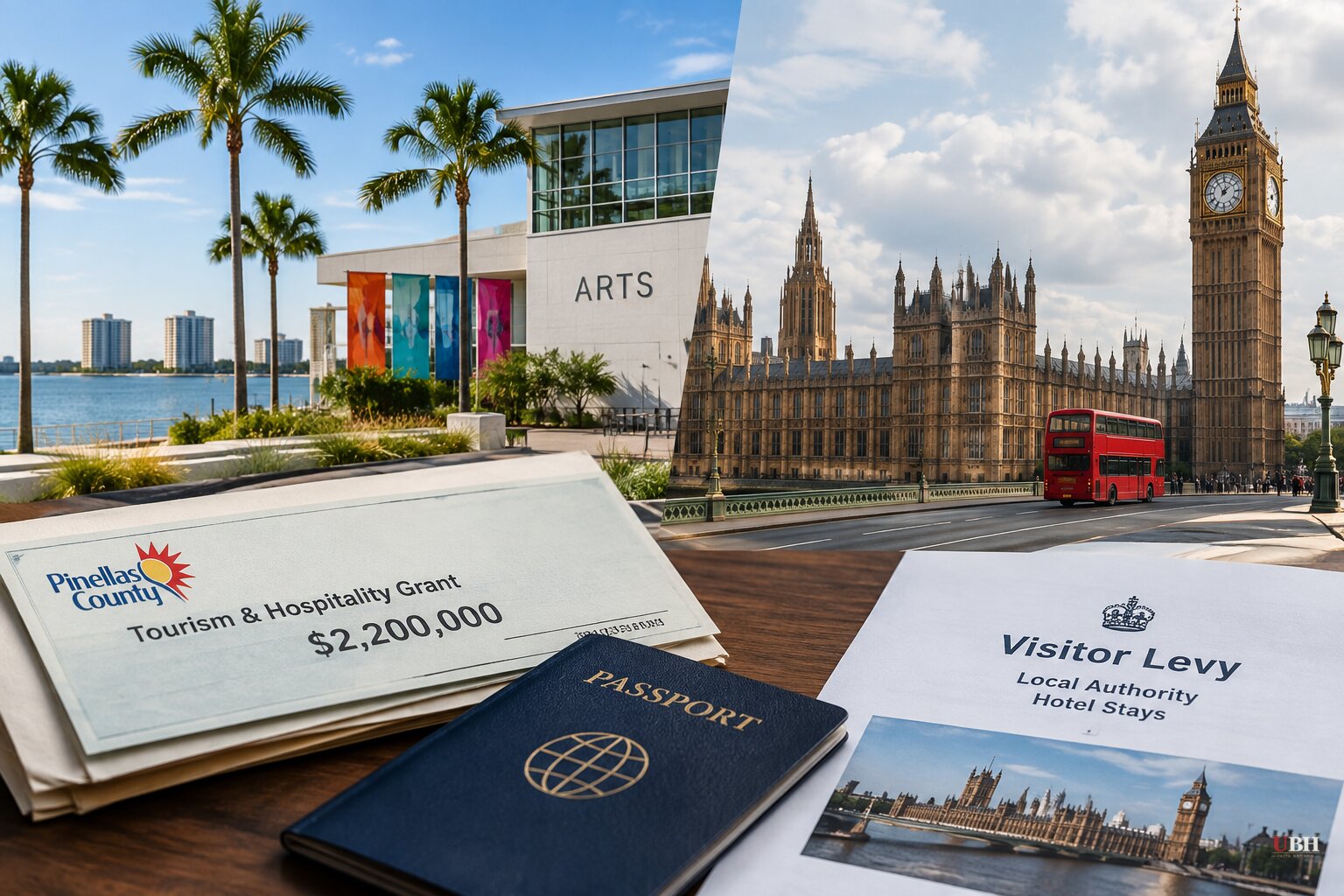
Local governments worldwide have found a tax base that never shows up at the ballot box: tourists. From Pinellas County, Florida to London, officials are expanding levies on hotel stays, day trips and departures, betting that visitors will absorb the cost without complaint.
Florida's bed tax money is flowing
Pinellas County commissioners voted unanimously Thursday to put $2.2 million in Tourist Development Tax revenue toward expanding the Morean Arts Center in downtown St. Petersburg, according to the St. Pete Catalyst. The money reimburses construction costs after the work is done, with the Morean covering everything beyond the county's share.
The number sounds small next to the project's scope. Phase one alone is estimated at $33.7 million for roughly 42,000 square feet of new space that would unite the Morean's galleries with the Chihuly Collection, currently housed across the street. Construction is expected to start in 2027, with a second phase running 2028 to 2030, and the county's funding is tied to fiscal year 2030.
The Morean originally asked the county for more than $15 million. Commissioners capped it at $2.2 million instead, according to the Catalyst.
An economic analysis prepared for the county projects the expansion will draw about 76,600 additional visitors and 30,900 additional room nights over 10 years, generating roughly $18 million in new direct spending. The Catalyst's reporting does not identify who conducted that analysis. Projections like these are standard practice for justifying tourist-tax spending, but they are forecasts, not results, and taxpayers won't know for years whether the numbers hold up.
Bed tax money is legally restricted to tourism-related capital projects, so this isn't general fund spending. But it is still a government body deciding to underwrite part of a private nonprofit's construction bill on the promise of future visitor traffic. That's the kind of application worth questioning even when the dollars come from a dedicated pot.
Meanwhile in Orange County, home to Orlando's theme parks, the tourist tax machine is running at full speed. The county collected $31,474,700 in tourist development tax revenue in July, up 6.4% from July 2025, Comptroller Phil Diamond reported, according to Click Orlando. Year to date through July, collections hit $356,689,700, up 8.6% from 2025. Hotel occupancy rose to 74.1%, with rooms averaging $198.25 a night.
Visit Orlando CEO Casandra Matej expects August collections to dip, but told Click Orlando that hotel demand from August through October should outpace last year, driven by Halloween events at the theme parks, the Epcot Food and Wine Festival, and conventions including Spooky Empire and Romantasy BookCon.
England joins nearly every other G7 country
Across the Atlantic, the UK just closed the gap with the rest of the G7. The Ministry of Housing, Communities and Local Government and the Treasury finalized a plan authorizing English local authorities to introduce their own "overnight visitor levies" by 2029, the BBC reported, as relayed by economy.ac and Alo Japan. The government announced its intent last November, ran a public consultation through February, and released the final framework after a seven-month review.
English authorities including London, Liverpool, Greater Manchester, West Yorkshire, North East England, and York and North Yorkshire can set their own percentage on accommodation bills, with no statutory ceiling. Chancellor Rachel Reeves said the powers would flow through England's devolution framework. No rate cap exists.
Edinburgh got there first within the UK, introducing a 5% accommodation levy in July under Scotland's devolved authority, with Glasgow and Aberdeen pursuing their own versions.
Supporters frame these levies as user fees, asking visitors to help pay for the infrastructure and services they use rather than pushing costs onto residents through general taxation. That's a defensible principle. But once a local authority has open-ended taxing power over a population that doesn't vote in its elections, there's nothing stopping rates from creeping upward year after year, with the only check being whether tourists stop showing up.
Italy shows where this road leads
Italy offers a preview. Rome brought back its tourist tax in 2011 and collected €222.4 million from it in 2024, followed by Milan at €109.3 million, Florence at €82.9 million, and Venice at €38.9 million, according to Siope, Italy's finance ministry tracker, cited by the Guardian. Rates run €1 to €10 per person per night, with five-star Milan hotels charging €12.
"All municipalities want the fee because they need the money," Gianluca De Gaetano of the hotel association Federalberghi told the Guardian. He also noted the friction point: tourists tend to complain when city services don't match what they're paying, especially on top of already-high accommodation costs.
Japan has tripled its departure tax, Greece runs seasonal levies at Santorini and Mykonos, and Manchester has run its own City Visitor Charge since April 2023, according to Travel and Tour World. Revenue is easy to raise from people who don't vote locally. Whether the money actually funds the infrastructure and services tourists are told they're paying for, in Pinellas County, Orlando, or London, is the question that won't get answered until the projects are finished and the receipts come in.
Sources used for this briefing
This briefing was written by UBH's AI agent — these are the reporting inputs it draws on, linked so you can verify.


