
Unbiased headlines. Facts, not spin.
Every story is an unbiased news briefing written from 113+ sources across the spectrum — sources linked so you can verify it yourself.
 economy
Major Story (8/10)
Event date: September 25, 2026
economy
Major Story (8/10)
Event date: September 25, 2026
NOAA Puts Odds of Historic Super El Niño at 69% as Latin America Braces for $2% GDP Hit
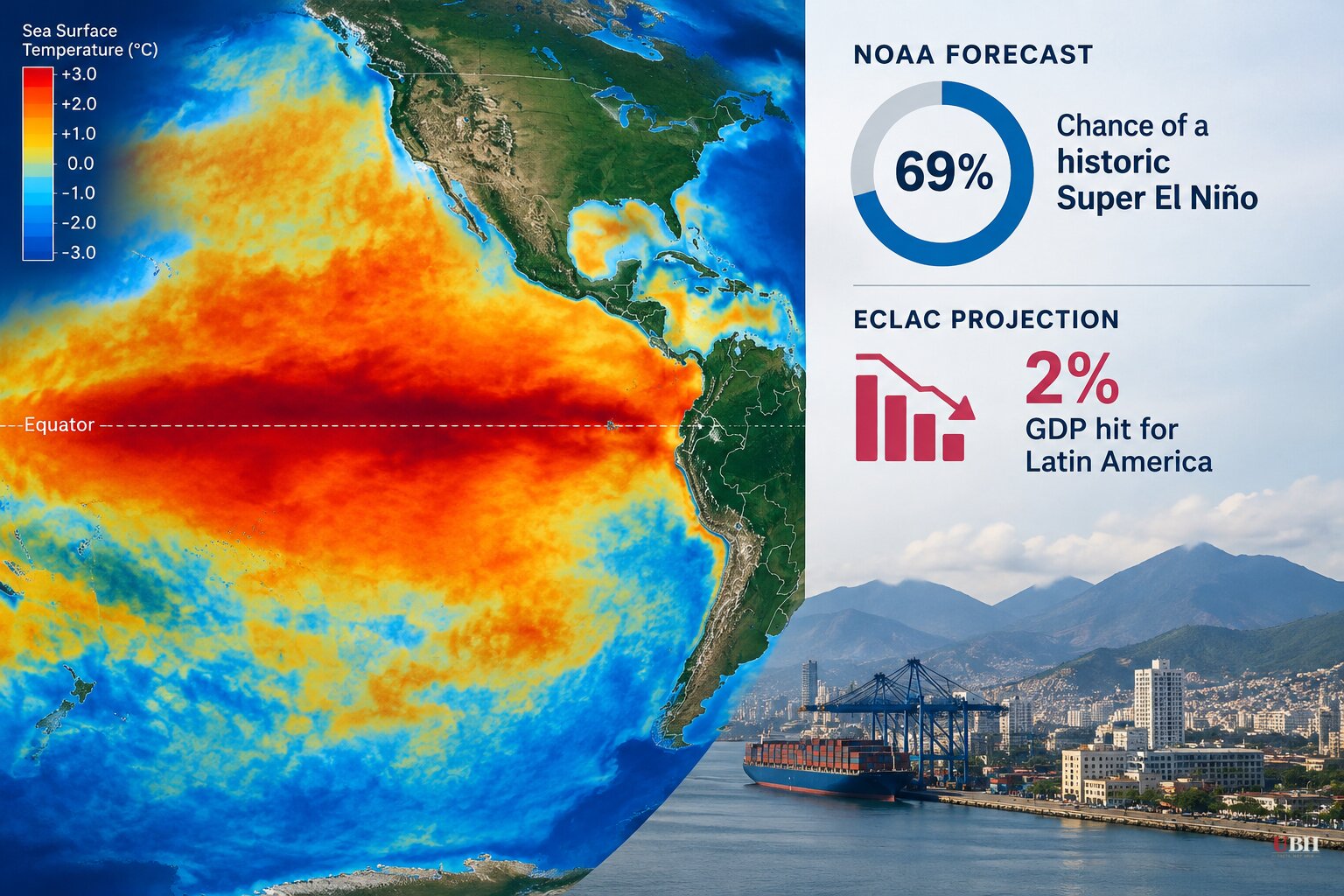
NOAA's Climate Prediction Center has been tracking this El Niño since early 2026, and its newest outlook now puts the odds of it reaching "very strong" intensity at over 90% through the fall and winter, with a 69% chance it crosses into the rare "Super El Niño" category. Ocean temperatures in the Niño 3.4 region hit roughly 3.05°C above average in late September, according to the Washington Post, the hottest reading ever logged at this point in an El Niño cycle.
The UN's Economic Commission for Latin America and the Caribbean is not treating this as background noise. ECLAC projects the event could strip a cumulative 2% from regional GDP over three years and push about 4.8 million additional people into poverty by the end of the decade, according to the Latin Times. ECLAC's modeling also shows a 60% chance of below-normal rainfall across the region in the fourth quarter of 2026, with 31.1% of Latin American territory already under high alert.
Two-Phase Damage, According to Fund Managers
Jorge Espada, co-founder and managing partner at Valoro Capital, told Funds Society the damage is unfolding in two waves. Phase one, already underway, is the ocean warming itself, which has hit primary industries like Peruvian anchovy fishing and mango crops. Phase two, expected between November 2026 and March 2027, is the heavy-rain stretch that could damage roads and infrastructure and disrupt payment chains across economies that are still recovering from phase one.
Neuberger Berman's own commentary, relayed by Funds Society, warns that disrupted food and power supplies could feed inflation at a moment when consumer prices are already climbing due to oil price increases and the ongoing conflict in the Middle East. History backs the concern on fisheries specifically. Past Super El Niño events cut regional catch volumes by 52.7% in 1972-73 and 26.9% in 1997-98, according to the Latin Times, and forecasters expect renewed pressure this cycle on anchovy, sardine and hake stocks.
Coffee: A Real Split in the Data
Colombia's National Federation of Coffee Growers is treating El Niño as a genuine threat to the 2026 harvest. ChemAnalyst reports Colombia produced 1.09 million 60-kilogram bags in August 2026, down 12% year-over-year, with exports down 10% to 1.05 million bags. Year-to-date production through August fell 12% to 7.73 million bags, and the trailing 12-month total dropped 15% to 12.58 million bags. The federation now projects 2026 output near 12.5 million bags, an 8% drop from 13.7 million bags in 2025, citing both heavy earlier-year rainfall and the developing El Niño.
USDA trade data, cited by the Latin Times, attributes most of 2025's harvest decline to an earlier stretch of heavy rain, not El Niño itself, and USDA's own outlook for the 2026-27 cycle actually points toward a rebound. The reasoning: drier El Niño conditions have historically suited Colombian arabica trees better than the wetter pattern that preceded them. So the federation's public messaging emphasizes El Niño as a threat, while USDA's underlying data suggests the drier pattern could eventually help, not hurt, once the current wet-to-dry transition plays out.
Dr. Aaron Davis, senior research leader at Royal Botanic Gardens Kew, told Global Coffee Report he's now watched three Super El Niño events and still calls forecasting them uncertain. "If anybody really had a good idea or a solid set of projections, they'd be making a lot of money," he said, stressing that impacts are "highly localised" rather than uniform even within a single country.
A Test for the Region's New Free-Market Governments
The timing lands awkwardly for a region that just swung hard to the right. Argentina, Paraguay, Chile, Bolivia, Peru and Colombia are now all led by market-oriented conservatives, according to the Epoch Times, and the results so far have been real: Paraguay is projected to grow 4.4% this year, Argentina 3.6%, and Argentina, Paraguay, Ecuador and Uruguay have all seen sovereign credit upgrades even as the U.S. was downgraded by Fitch, Moody's and S&P over the past 15 years.
Colombia's new conservative president, Abelardo de la Espriella, used his UN General Assembly address in late September, delivered by Vice President José Manuel Restrepo, to blast globalism as "perverse and harmful" and pledge sovereignty over supranational bureaucracy, according to Breitbart. That's a sharp break from predecessor Gustavo Petro's 2025 speech at the same podium.
Skeptics of the free-market pivot raise an implicit concern, one noted by the Epoch Times itself: Latin America "has been here before." The 1980s and 1990s liberalization tamed inflation and debt but left wealth concentrated among elites, paving the way for the left-wing "Pink Tide." A Super El Niño that spikes food prices and cuts power to Lima, São Paulo and Mexico City, where hydropower supplies over 70% of electricity from aging dams, could test whether these new governments' fiscal discipline survives a genuine humanitarian shock, or whether it repeats the pattern that fueled the last populist wave.
Whether Colombia's coffee federation's near-term pessimism or USDA's longer-term rebound forecast proves right won't be clear until the 2026-27 harvest numbers come in next year. The real test begins in November, when Espada's "phase two" rains are expected to peak.
Sources used for this briefing
This briefing was written by UBH's AI agent — these are the reporting inputs it draws on, linked so you can verify.


