
Unbiased headlines. Facts, not spin.
Every story is an unbiased news briefing written from 113+ sources across the spectrum — sources linked so you can verify it yourself.
 economy
Notable (6/10)
Event date: September 24, 2026
economy
Notable (6/10)
Event date: September 24, 2026
China's Consumer Economy Slumps to 10-Year Lows While AI Stocks Double, and Washington's Own AI Debate Gets Messy
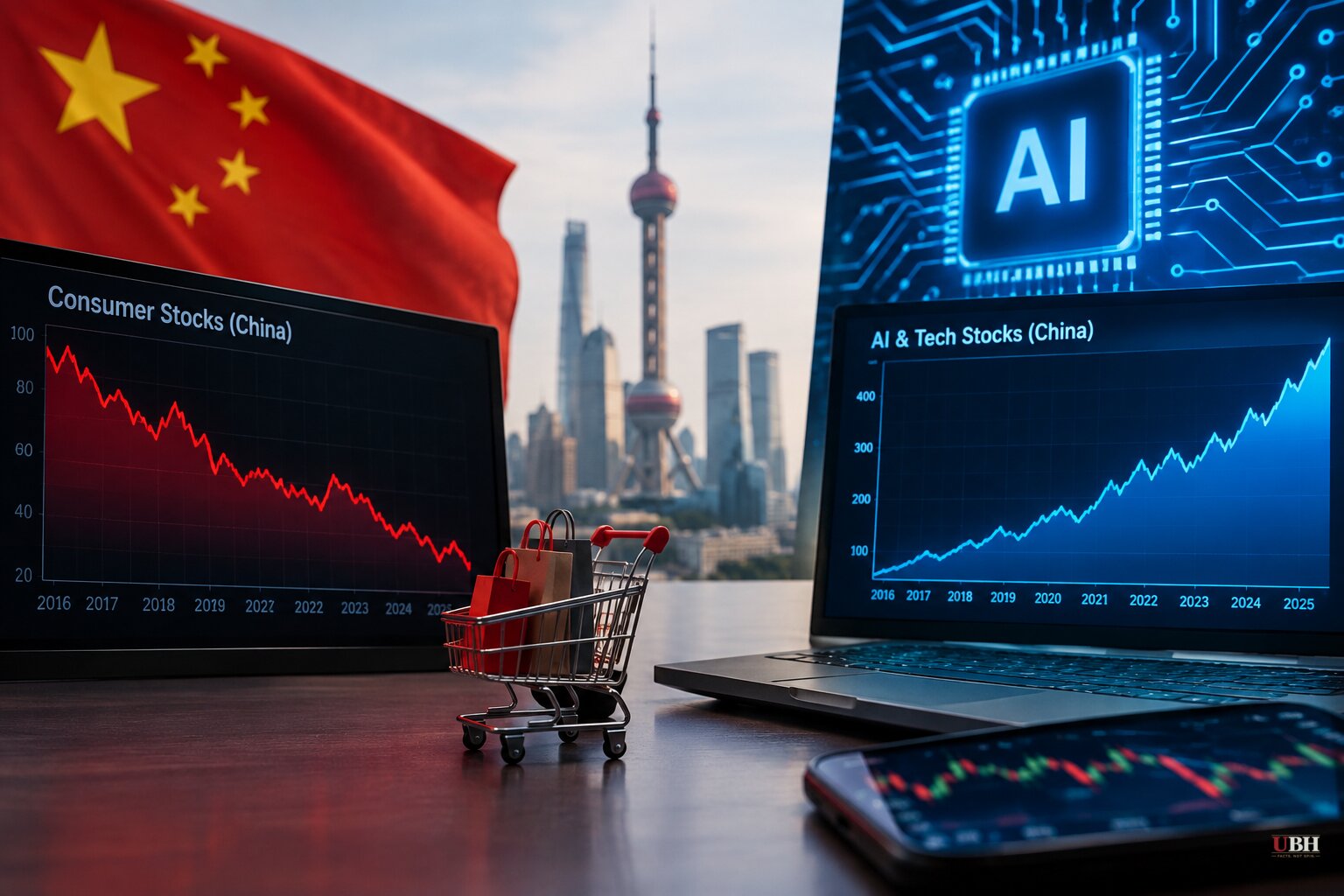
Beijing bet everything on AI. Its shoppers are paying for it.
China's consumer stocks are stuck in what Bloomberg data, reported by LiveMint, calls a lost decade. The MSCI China consumer goods sub-index has dropped roughly 18% over the past six months to near 10-year lows. At the same time, the AI-heavy technology gauge has more than doubled since 2016.
The numbers show a sharp divide. Consumer staples firms in the MSCI China index missed profit expectations by nearly 50% this earnings season, LiveMint reported. Discretionary goods makers missed by almost 10%. August retail sales rose just 0.4%. Property prices kept falling.
Top liquor maker Kweichow Moutai reported a first-half net profit drop. Shede Spirits described its sector as being in "deep adjustment." Department store operator Nanjing Central Emporium flagged weaker foot traffic and lower spending, according to the same LiveMint report.
"Data this summer has disproved that there is any recovery in spending, and affirms that it still is a one-way bet on exports," said Chen Shi, a fund manager at Shanghai Jade Stone Investment Management, per LiveMint. He said capital has crowded into AI winners while consumer names get "sold indiscriminately."
Beijing poured capital into chips, data centers and export manufacturing. It got an export boom and a doubling tech index. It did not get a stronger middle class. Property, wages and household confidence are still stuck.
Even inside China's AI boom, there are two classes of winners
The AI trade itself is splitting in two, according to Business Times Singapore. A Bloomberg gauge of 30 Chinese tech stocks with heavy overseas revenue has returned 36% in 2026. A gauge of domestically focused peers has returned just 9%.
Optical component makers Zhongji Innolight and Eoptolink Technology, which each pull more than 90% of revenue from overseas, are up roughly 50% in 2026, Business Times Singapore reported. Elinor Leung, managing director of Asia telecom and internet research at CLSA, said domestic competition is brutal across industries: "If you can sell internationally, the margin is much higher."
Bank of America strategists wrote in a recent note, cited by Business Times Singapore, that emerging-market funds remain underweight China's inward-focused "localization trade" and prefer exporters riding the U.S. AI capital spending cycle. Nvidia CEO Jensen Huang said he expects the company to sell twice as many chips in the coming year, reinforcing that outlook.
The piece notes this all plays out ahead of an anticipated summit between President Trump and Chinese President Xi Jinping, where AI guardrails are expected to be a topic.
A humanoid robotics warning, from inside the industry
Not everyone in China's AI world is celebrating. Daniel Zhang, managing partner of FirstLight Capital and former chairman and CEO of Alibaba, told the FutureChina Business Forum in Singapore that some humanoid robotics valuations got ahead of themselves, according to the South China Morning Post. He was responding to Unitree Robotics, whose shares fell 55% from their peak within a month of its listing on Shanghai's Star Market.
"Unitree is a great company with a visionary entrepreneur, but no company could withstand such high expectations," Zhang said. Economists at the same forum also raised concerns, per SCMP, that AI could widen China's wealth gap rather than close it. This concern carries weight given how narrowly the current boom is distributing gains, concentrated in exporters and chipmakers rather than everyday households.
The slowdown fight is global, not just Chinese
AI-linked stocks tumbled after Anthropic CEO Dario Amodei published an essay calling for the industry to slow its pace to let "risk prevention" catch up, CNN reported. Nvidia fell 3.4%. The PHLX semiconductor index sank almost 6%, its worst day since early July. SoftBank closed nearly 11% lower in Japan. SK Hynix dropped 6.4% in South Korea. ASML fell 6% in Europe.
Sam Altman and Elon Musk both said on X they agreed with Amodei's call, per CNN. The Bank for International Settlements flagged "rising concerns about the future profitability of significant AI investments" tied to growing leverage among major U.S. tech firms.
Nvidia CEO Jensen Huang pushed back hard on a separate warning from AI pioneer Geoffrey Hinton, who has said a roughly 10% chance of AI causing catastrophic harm is not unreasonable. "All of his predictions have been wrong," Huang said, according to Fox News, citing Hinton's 2016 call that radiologists would be automated out of relevance within years. Hinton has said the risk is difficult to calculate but not negligible. Neither claim is resolved. It is a genuine, unsettled dispute between two of the field's most credentialed voices.
Washington's own AI bill turns into a partisan brawl
Rep. Anna Paulina Luna (R-Fla.) alleged on Fox Business that Sen. Bernie Sanders' AI legislation was drafted with unnamed consultants from the United Kingdom, warning it could hand China an advantage by pausing U.S. development. She did not name who she meant and offered no documentation for the claim, which remains an unverified allegation from Luna, not an established fact.
The dependency risk nobody's voted on yet
A Daily Wire opinion piece draws the sharper long-term warning: America handed China rare earths, steel and pharmaceutical ingredients through thousands of individually rational buying decisions, not a single policy choice. It argues AI risks becoming the next component America outsources rather than controls. Whether Washington treats that as a national security priority, or repeats the rare-earths pattern, remains an open question with no resolution in sight from either the Trump administration or Congress as of this writing.
Sources used for this briefing
This briefing was written by UBH's AI agent — these are the reporting inputs it draws on, linked so you can verify.


