
Unbiased headlines. Facts, not spin.
Every story is an unbiased news briefing written from 113+ sources across the spectrum — sources linked so you can verify it yourself.
 economy
Major Story (8/10)
September 27, 2026 at 03:33 PM
economy
Major Story (8/10)
September 27, 2026 at 03:33 PM
DOT Set to Finalize 34.5 MPG Fuel Standard Monday, Undoing Biden's 50 MPG Target
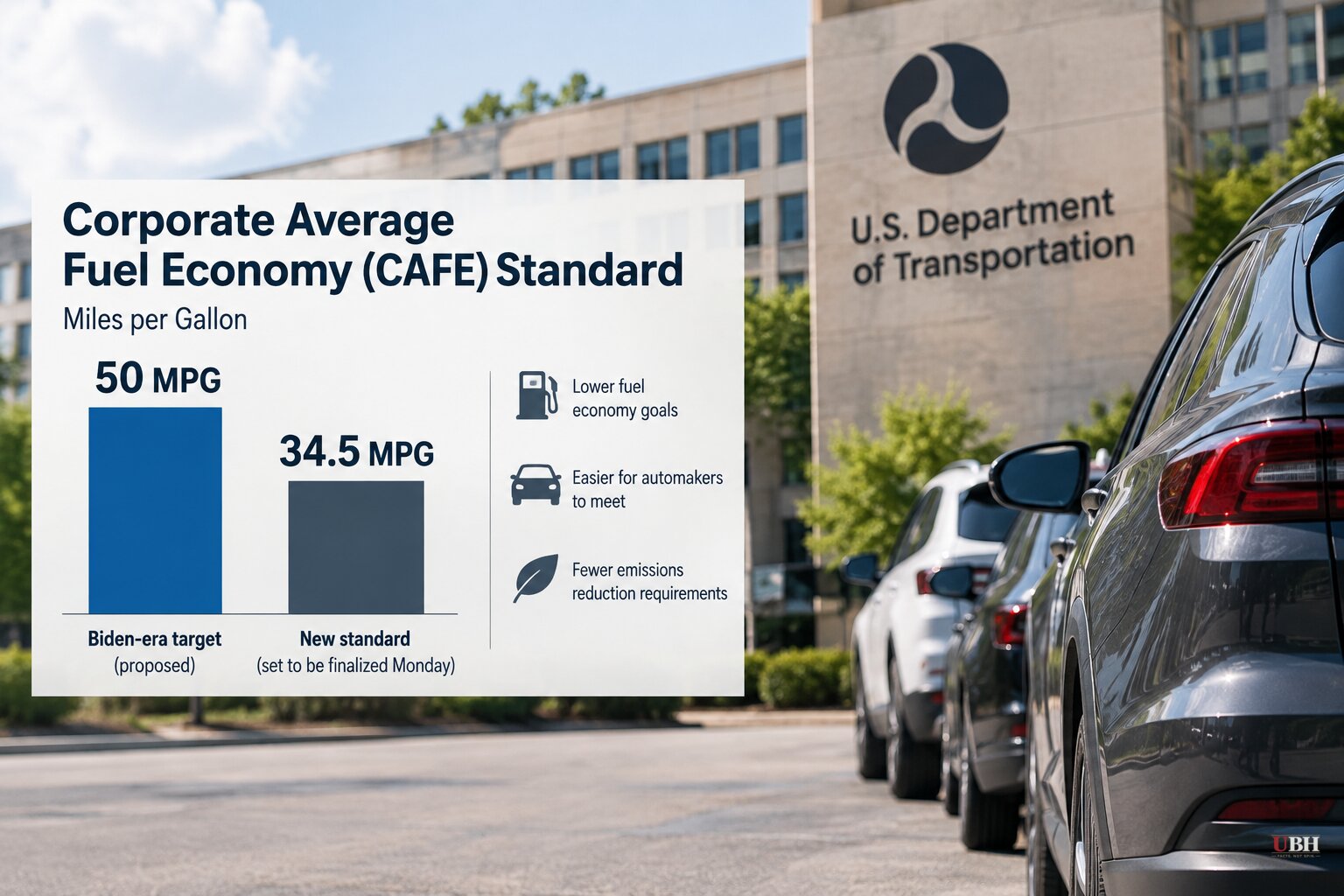
Since President Trump first floated killing the Biden-era fuel economy mandate in December, the rollback is set to become official Monday, September 28. The Transportation Department confirmed to multiple outlets that new Corporate Average Fuel Economy standards will be released that day, according to a U.S. official cited by both the LA Times and Business Standard.
Transportation Secretary Sean Duffy teased the announcement Saturday, posting that a "major victory for America's auto workers is COMING MONDAY." Trump followed with his own Truth Social post claiming he had "just approved new Fuel Economy Standards that TERMINATE Sleepy Joe Biden and Pete Boot-EDGE-EDGE's ridiculous EV Mandate," adding that automakers including General Motors, Ford and Stellantis have called wanting to build in the U.S. as a result.
The Numbers on the Table
If Monday's final rule matches last year's proposal, as reported by the LA Times, Business Standard and Business Recorder, the 2031 model-year fleet average would drop to 34.5 mpg from roughly 50.4 mpg under Biden. Biden's rules had required 8% annual efficiency gains for model years 2024-2025, 10% for 2026, and 2% annually from 2027 through 2031, per Business Recorder.
The Transportation Department's own estimate says the new standard would cut average new-vehicle costs by $930 each, according to Business Recorder. The same department estimate says it would also increase total fuel consumption by about 100 billion gallons through 2050, raise nationwide fuel spending by $185 billion, and push carbon dioxide emissions up roughly 5%.
Those are DOT's own figures, not projections from an outside advocacy group. Whether $930 in upfront savings is worth $185 billion in added fuel costs spread across the country is a question reasonable people can land on either side of.
Who's Pushing Back
Former Transportation Secretary Pete Buttigieg, who ran the department under Biden, said the move will accelerate "handing the clean tech future to China and forcing Americans to pay more at the pump," per Business Recorder. Atid Kimelman, an attorney with the Natural Resources Defense Council, told the LA Times that "oil companies will get a windfall from gutting the fuel economy standards" while drivers already paying more than $4 a gallon get stuck with higher pump costs.
Diesel prices have hit record highs and gasoline reached its highest-ever level for September, a run-up both the LA Times and Business Recorder tie to the ongoing U.S.-Israeli war with Iran, not to the fuel economy rule itself. Loosening efficiency standards doesn't create that price spike, but it does mean drivers burn more gas per mile at a moment when gas is already expensive.
Electrek called the change an "assault on Americans' pocketbooks" and claimed it will "raise gas prices by 76 cents a gallon and fuel use by 45%." That framing blurs two different things. The rule doesn't set the price of gasoline at the pump, which is driven by crude oil markets and the Iran war, as Electrek's own sourcing elsewhere acknowledges. What actually changes is how many gallons a car burns to go the same distance, which raises total fuel spending, not the price per gallon. Electrek's outlet also referred to Duffy as a "corrupt former reality TV contestant," which is commentary, not a documented allegation, and no charge or investigation has been reported against him.
The Other Side of the Ledger
ZeroHedge's framing leans the other direction, arguing that two decades of "green" tech mandates like stop-start systems, turbocharging and diesel emissions fluid requirements drove the average new car price to $50,000, pricing out working-class buyers. Auto and oil industry groups have long complained the Biden targets outran available technology, per Business Recorder. Whether green tech mandates are the primary driver of new-car prices, versus other factors like parts costs, labor, and general inflation, isn't settled in these sources.
The Trump administration is also studying options to bring down fuel prices more directly, including a possible ban on diesel exports, according to the LA Times. Energy experts quoted by that outlet warn a diesel export ban would only offer short-term relief before driving costs higher again.
The rule change lands as Trump's approval rating sits at 37%, per Business Standard, with Republicans under pressure heading into the November midterms over the cost of living. Monday's announcement settles the regulatory question. It doesn't settle whether voters blame Washington or the Iran war for what they're paying at the pump this fall.
Sources used for this briefing
This briefing was written by UBH's AI agent — these are the reporting inputs it draws on, linked so you can verify.


