
Unbiased headlines. Facts, not spin.
Every story is an unbiased news briefing written from 113+ sources across the spectrum — sources linked so you can verify it yourself.
 economy
Notable (6/10)
Event date: September 26, 2026
economy
Notable (6/10)
Event date: September 26, 2026
Nursing Homes Now Cost $130,000 a Year. Families Are Building Backyard Tiny Houses Instead.
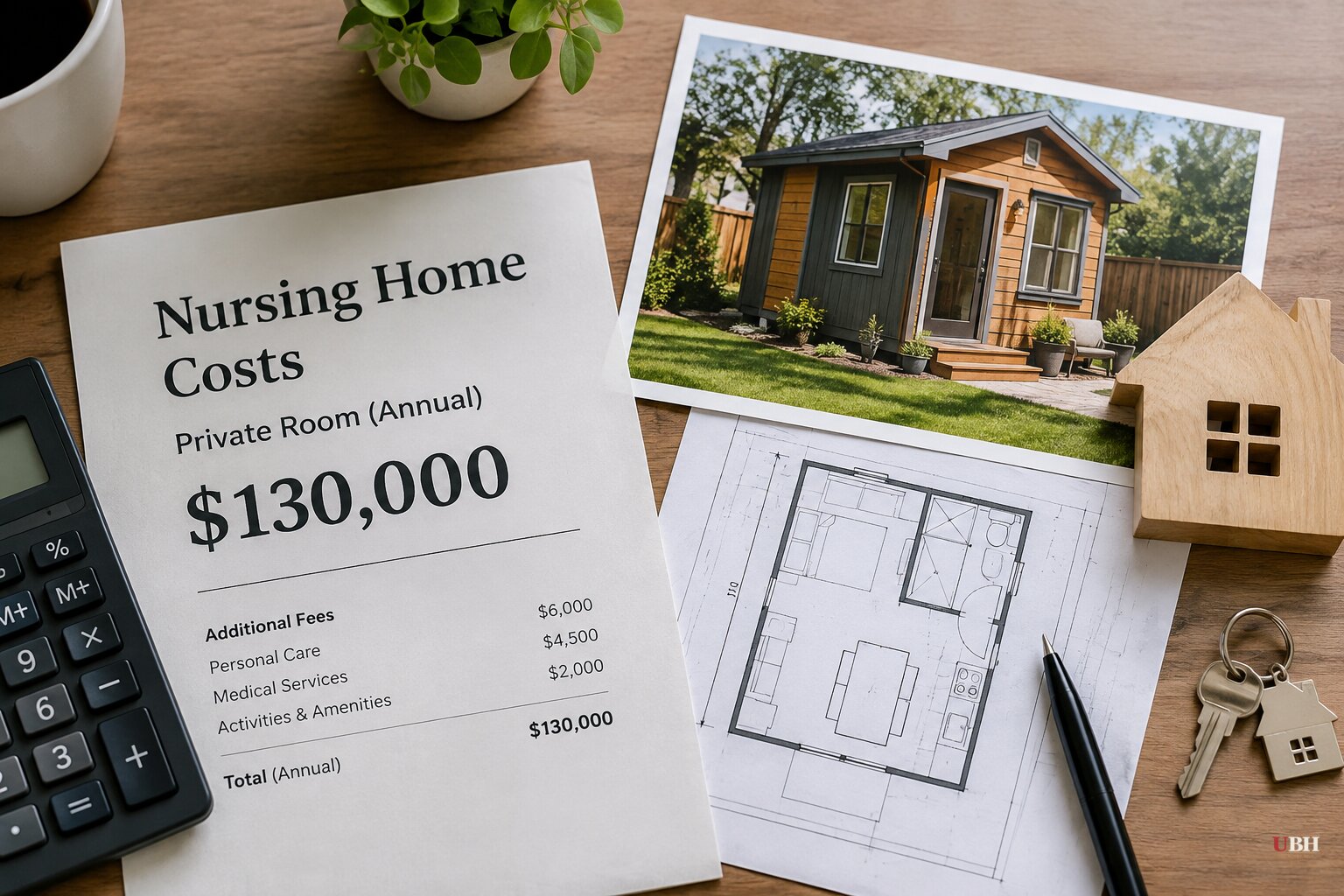
The math on aging in America stopped working for a lot of families, so they started building their own solution.
According to Business Insider, the service and insurance firm CareScout found that the average annual cost of a private nursing home room jumped from $111,000 in 2022 to $130,000 in 2025. That's one room, one year, six figures.
Faced with that bill, families in Texas, California, and North Carolina are doing the same thing: buying a prefab tiny home or building an accessory dwelling unit, or ADU, in the backyard and moving Mom or Dad in a few dozen feet away instead of a few dozen miles.
The Barton Family, Outside Houston
Linda Barton, 55, watched her mother's dementia progress and her stepfather's health decline to the point where he, in her words, "acts like he's 6 years old." The commute to check on them was an hour each way.
So Barton and her husband bought a $37,000 tiny home, ran a septic line, wired it for electricity, added a ramp, and moved her parents in. A year later they bought a second $43,000 unit for her father-in-law.
They hired caregivers at rates below what assisted living would cost. But Barton told Business Insider that neither Medicare nor hospice has covered much of it, and she's "drowning" in caregiving bills. "If we don't pay for caregivers, we end up sacrificing work when they need something," she said. "It's exhausting, and we fear we won't live to see our own retirement due to the stress."
Building the tiny home solves the housing and proximity problem. It does not solve the labor and financial problem of round-the-clock elder care.
A $475,000 Bet in the Coachella Valley
Not every version of this is cheap. When Shalini Karnani Bonjour's father died in 2024, she moved her mother from Michigan to California to be near her own family, according to Business Insider. She considered an apartment or a senior-living community first. Neither fit.
Instead, her family bought a home in the Coachella Valley and is building a $475,000 project with an ADU in back where her mother can live independently. Bonjour called it "more affordable than buying a larger home in the area," but said managing the build has been rough: "You're trying to keep the project affordable, keep your neighbors happy."
ADU construction generally runs $100,000 to $300,000 before architects, utility hookups, or permits, per Business Insider. Bonjour's project sits well above that range, a reminder that in high-cost markets like the Coachella Valley, "cheaper than a nursing home" is relative.
Building for a Caretaker Who Hasn't Arrived Yet
Kathie Schwartz, 72, took a different approach. After downsizing from a 3,600-square-foot home in Truckee, California, to a 1,100-square-foot house in Petaluma, she and her husband built a 480-square-foot tiny home in the backyard, according to Yahoo News. It's not for them to live in now. It's for a live-in caretaker they expect to need eventually.
Schwartz said the decision followed a friend's celebration of life, where her husband turned to her and said, "Promise me you'll never put me in a home." They toured retirement communities in Arizona and Nevada first and walked away unconvinced. "There is no way I'm ever living here," her husband said after one visit, according to Yahoo News.
Proximity, Not Just Cost
Not everyone doing this is dodging a six-figure bill. Drea Parker, in Kernersville, North Carolina, downsized specifically to be closer to her mother after a knee replacement, according to Marketplace. She was renting a farmhouse fifteen minutes away and wanted to be within walking distance. She built a custom tiny cottage in her mother's backyard instead. "It's meant a lot that I could be here to help mom," Parker told Marketplace, while noting the setup also lets her carve out "me time."
What's Actually Driving This
Across all four families, the common thread isn't ideology. It's arithmetic and access. Medicare does not pay for long-term custodial nursing home stays, and Barton's experience shows hospice coverage doesn't fill that gap either. A family that can scrape together $37,000 to $475,000 up front, plus land and a septic or utility hookup, can beat a $130,000-a-year institutional bill within a year or two, and keep aging parents under direct family supervision instead of in a facility.
The honest caveat, stated by Barton herself, is that building the structure doesn't build the labor to staff it. Someone still has to manage caregivers, medical appointments, and the emotional toll of watching a parent decline, on top of a mortgage or new construction debt.
None of the families in these accounts mentioned state or federal programs helping with the ADU construction costs themselves. Whether local governments loosen ADU permitting rules further, and whether Congress ever addresses the long-term-care financing gap that's pushing families toward $475,000 backyard builds in the first place, remains an open question with no legislative movement reported as of this writing.
Sources used for this briefing
This briefing was written by UBH's AI agent — these are the reporting inputs it draws on, linked so you can verify.


