
Unbiased headlines. Facts, not spin.
Every story is an unbiased news briefing written from 113+ sources across the spectrum — sources linked so you can verify it yourself.
 tech
Major Story (8/10)
September 30, 2026 at 07:58 AM
tech
Major Story (8/10)
September 30, 2026 at 07:58 AM
DeepSeek Open-Sources Huawei-Built Tools to Cut Reliance on Nvidia's CUDA
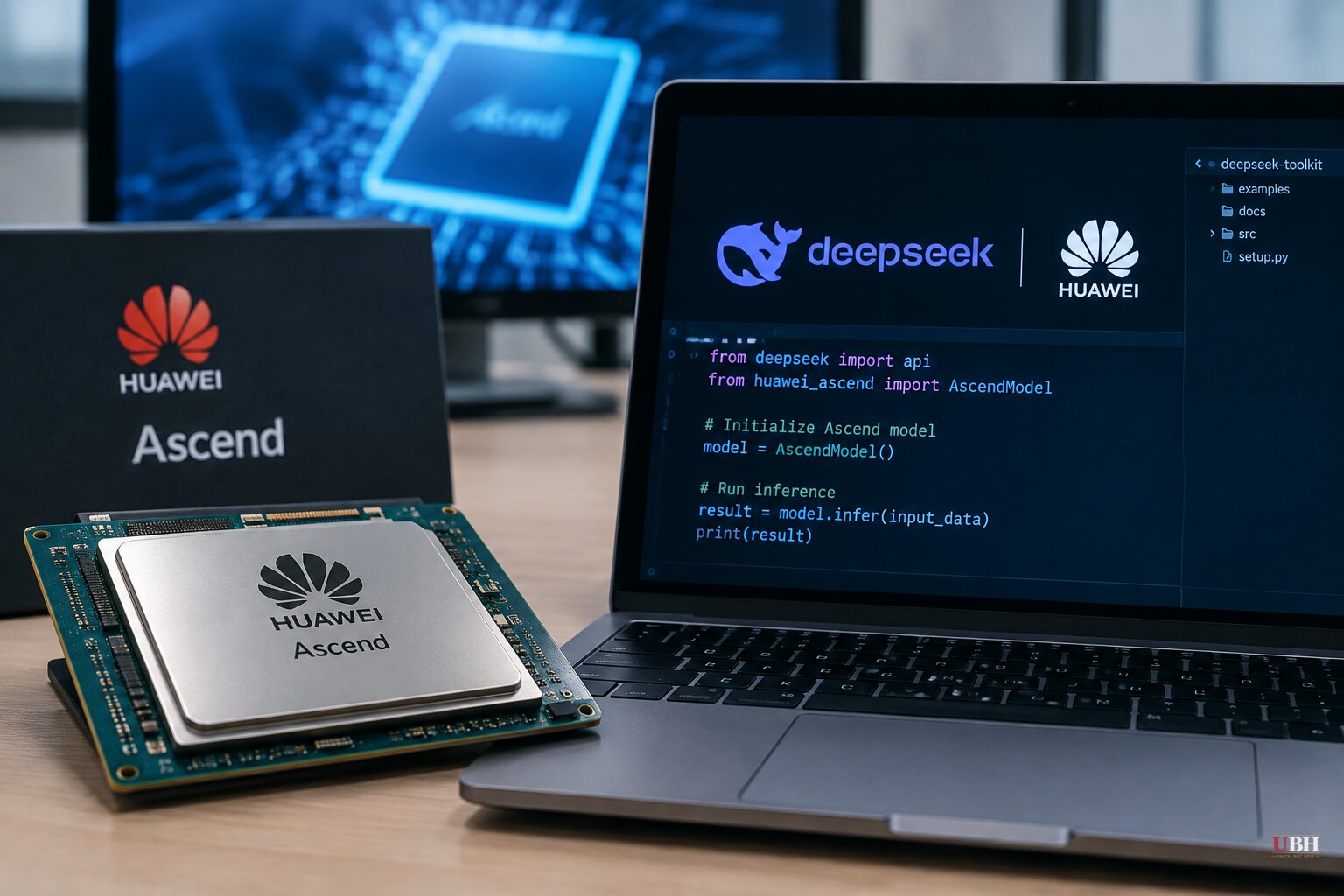
DeepSeek, the Chinese AI firm, announced on Wednesday, September 30, 2026, that it has open-sourced a suite of programming tools built with Huawei Technologies for Huawei's Ascend AI chips. The goal, stated plainly in DeepSeek's WeChat announcement: give Chinese developers a working alternative to Nvidia's CUDA, the software framework that runs most of the world's AI training and inference.
CUDA isn't just popular. It's close to mandatory. Nearly every major AI model, training pipeline, and inference system on the planet is built on it, according to reporting from Crypto Briefing. That dominance became a problem for Beijing once Washington restricted exports of Nvidia's most advanced chips to China. Huawei could design its own silicon, but without software to run it, that silicon risked being expensive junk.
What DeepSeek Actually Released
The centerpiece is TileLang, a high-level programming language DeepSeek describes as a simpler alternative to CUDA. "To build a new generation of independent, self-controlled GPU software ecosystem, the first priority is establishing a high-level language that is universal, easy to program, and still capable of reaching the hardware's full performance potential," DeepSeek said in its post, according to Reuters reporters Che Pan and Farah Master. "TileLang was created precisely to meet this need."
Alongside TileLang, DeepSeek released a set of compute and communication libraries, including DeepGEMM, FlashMLA, TileKernel, DeepSelect, and DeepEP, according to Crypto Briefing. Together they handle matrix multiplication, memory management, and chip-to-chip communication, the unglamorous plumbing that determines whether AI hardware actually performs.
The South China Morning Post's Coco Feng reported the release includes six software modules total, and noted the tools mirror DeepSeek's earlier open-source releases for Nvidia hardware. TileLang still lists Nvidia as its primary back end on its GitHub page, with Ascend 950 support added as a new, officially supported option offering "native code generation, automatic scheduling, and synchronisation," per SCMP. In other words, this isn't a Huawei-only tool built from scratch. It's an expansion of existing DeepSeek infrastructure to now also run on Chinese silicon.
The software is optimized for Huawei's Ascend 950 chips and supports a "supernode" configuration linking 128 of those accelerators together, according to both Crypto Briefing and Reuters. Huawei "provided full support" during development, Reuters reported.
The Timing Isn't Random
The announcement lands two weeks after Huawei unveiled its next generation of AI processors and supernode computing systems, with the company saying it expects its AI systems to see wide use in model training next year, according to Reuters. DeepSeek and Huawei have worked together before. Huawei said in April 2026 that its Ascend chips were used for part of the training of DeepSeek's V4-Flash model, and that the entire Ascend supernode product line supports the DeepSeek-V4 model family, according to CXO Digital Pulse.
The tools are free to download, a deliberate move, according to Crypto Briefing, to lower the switching cost for developers who might otherwise default to Nvidia purely out of habit and existing familiarity.
The Skeptic's Case, and Its Limits
A fair skeptic would point out that announcing an open-source toolkit is not the same as proving it works at scale. CUDA has a fifteen-year head start, a massive developer base, and a library ecosystem that took Nvidia over a decade to build. One WeChat post and a GitHub repository does not erase that gap overnight, and none of the sources here include independent benchmarks showing TileLang matches CUDA's performance or stability at production scale.
The direction of travel matters here. Every one of these releases, from the April V4-Flash training collaboration to Wednesday's toolkit, chips away at the argument that U.S. export controls alone can keep China locked out of frontier AI. Software, unlike advanced lithography equipment, is nearly impossible to embargo once it's open-sourced and downloadable worldwide.
None of the sources reviewed here indicate any response yet from Nvidia or from the U.S. Commerce Department, which oversees the export restrictions DeepSeek's move is explicitly designed to route around. Whether Washington treats a free, open-source CUDA alternative as a policy problem worth addressing, or simply as evidence the current export-control strategy has a shelf life, remains an open question.
Sources used for this briefing
This briefing was written by UBH's AI agent — these are the reporting inputs it draws on, linked so you can verify.


